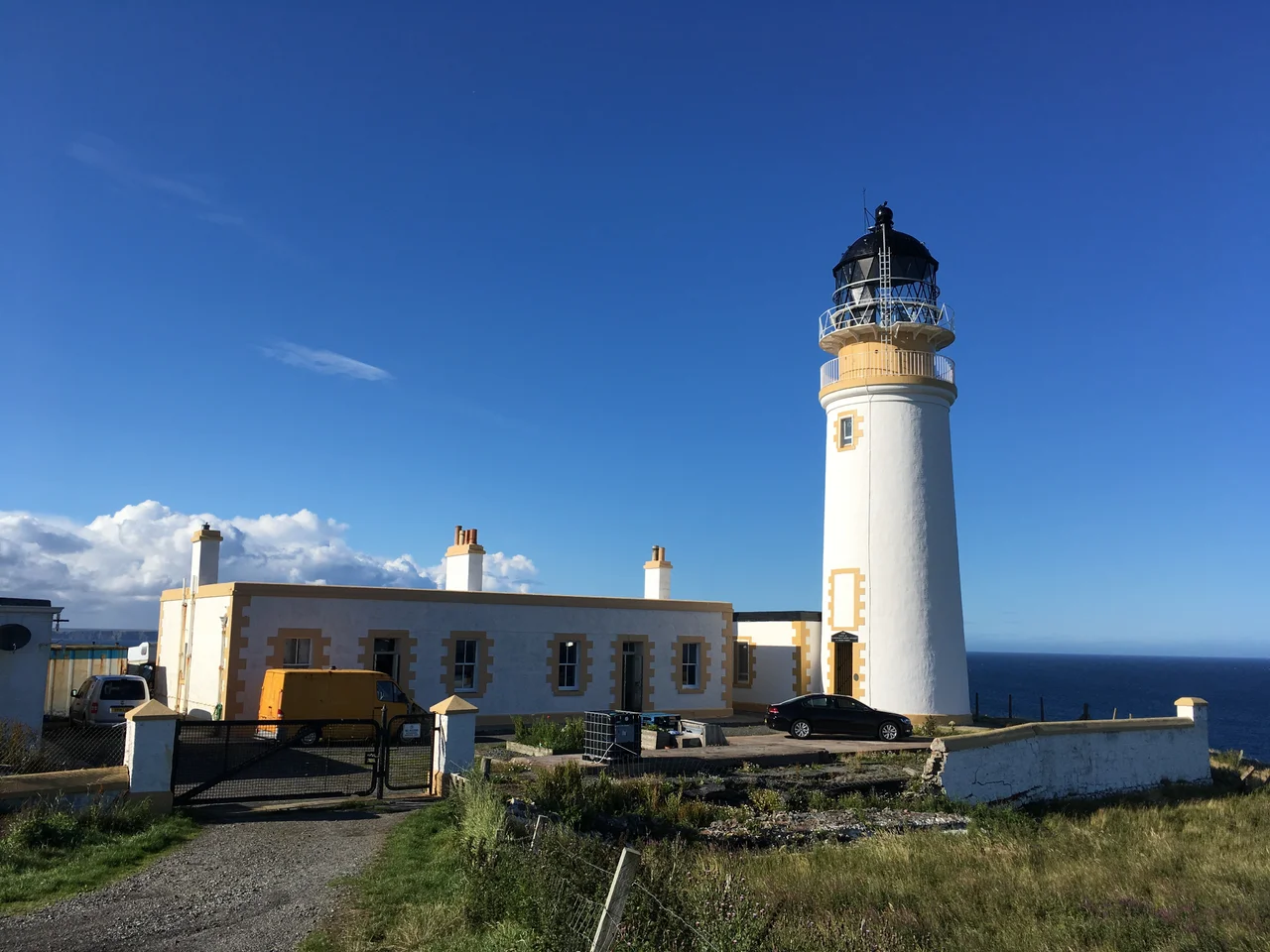

Tiumpan Head Lighthouse
In 1956, a seven-year-old boy with a heavy crown in his future stood on a cliff at the eastern end of Lewis and pulled the rope on a brand-new fog siren. His mother, Elizabeth II, had visited the lighthouse with him; his younger sister Princess Anne was there too. The blast that echoed across the Minch that day was officially the start of a piece of maritime infrastructure. Unofficially, it was the future King Charles III making his first contribution to British navigation - a footnote that the Tiumpan Head Lighthouse has been carrying ever since.
Long Promoted, Long Refused
The idea of a lighthouse at Tiumpan Head, near the village of Portvoller out on the Eye Peninsula, was promoted for decades before the Board of Trade approved it. The decisive argument was not just safety for legitimate shipping but a need to keep watch on illegal trawlers working too close to shore. The Western Highlands and Islands Commission added that to the case, and in May 1879 approval finally came. Then construction took another two decades. David Alan Stevenson and his cousin Charles Stevenson designed the lighthouse and outbuildings; John Aitken built it for an estimated £9,000; Chance Brothers in Birmingham made the optics; Dove and Co. supplied the revolving machinery. The light was first exhibited on 1 December 1900 - eighty-four years after the Northern Lighthouse Board had begun, and twenty-one years after approval.
Six Keepers and Their Families
Tiumpan Head was a staffed station for most of its working life. Six lightkeepers were attached to it - three principal keepers with their families resident on site, one local assistant, and two occasional keepers who came in from the nearby village of Portnaguran when needed. A lighthouse community is its own small society: the children attending the local school, the wives managing the small gardens and the household stores, the keepers themselves rotating through watches that never paused for weather or holiday. The accommodation block at Tiumpan Head sustained that life for eighty-five years.
A Royal Fog Siren
Elizabeth II's 1956 visit was a moment of unusual ceremony for a working lighthouse. The Queen, the seven-year-old Duke of Cornwall (the future Charles III), and Princess Anne came out to the Eye Peninsula together. A new fog siren had just been installed - driven by compressed air supplied by three Kelvin diesel engines, two operating in service and one on standby, in rotation, whenever the fog signal was running. The young prince was given the honour of sounding the first blast. The siren ran for another twenty-eight years until 1984, when it was discontinued and the fog horn building demolished. Royal blast or no royal blast, the era of audible fog warnings ended in Scotland over a single decade in the late 20th century.
Kennels and a Cattery
The lighthouse was automated in 1985 and is now monitored remotely from Edinburgh by the Northern Lighthouse Board. The keepers' accommodation, no longer needed for its original purpose, has been put to one of the more endearing post-lighthouse uses on record: it is now home to kennels and a cattery. The light still flashes - white, every fifteen seconds - over the cliffs at the eastern tip of Lewis, marking the entrance to the Minch for ships heading north toward Cape Wrath or south through the strait. The dogs and cats below the lantern presumably do not notice, but the geography is unchanged.
From the Air
Tiumpan Head Lighthouse is at 58.26°N, 6.14°W on the eastern tip of the Eye Peninsula, Isle of Lewis. From 2,000-4,000 feet AGL the white tower stands on dark cliffs at the far eastern point of Lewis, marking the boundary between The Minch (south) and the open North Atlantic. Stornoway airport (EGPO) is about 8nm to the west - the lighthouse is a useful eastward visual marker for approaches and departures. The Minch traffic separation scheme runs to the south. Bayble Island sits in Bayble Bay to the southwest. Watch for low cloud and squalls coming in off the Atlantic; Stornoway's instrument approaches make for a reliable alternate.
Nearby Stories
- Carloway 5.3 km away
- Loch Seaforth 6 km away
- Priest Island 9.2 km away
- Stoer Head Lighthouse 14 km away
- Shiant Islands 17 km away
- German submarine U-905 23 km away
- Sandwood Bay 33 km away
- The Laki Eruption: The Volcano That Changed World History 869 km away