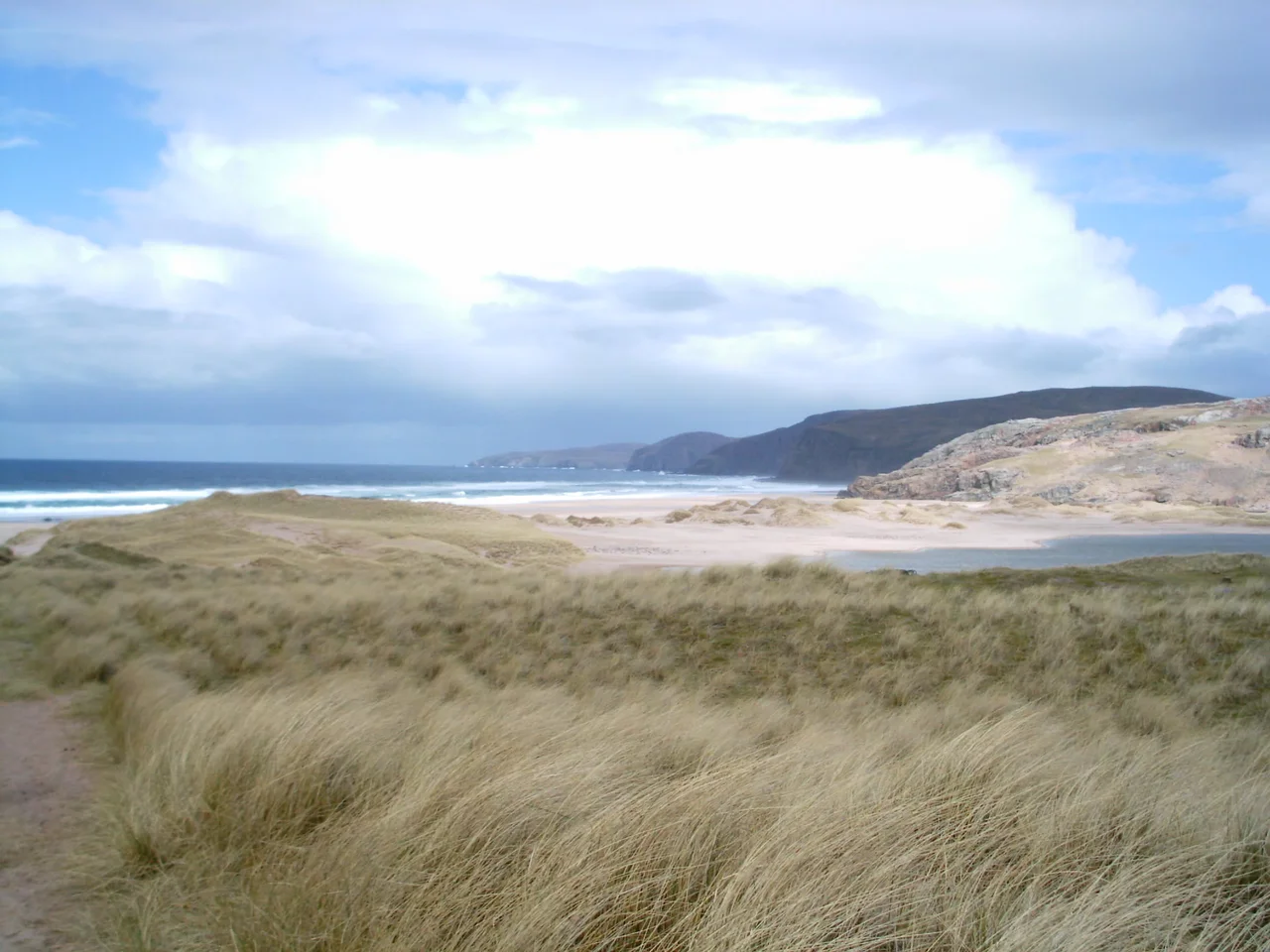

Sandwood Bay
There is no road to Sandwood Bay. You park at the gravel lot in Blairmore, shoulder a pack, and walk four miles across peat bog and moor before the dunes finally open and the beach rolls out in front of you - one mile of pale pink sand, a sea stack called Am Buachaille standing watch at the south end, and behind it all the freshwater Sandwood Loch, separated from the Atlantic by nothing but a wall of sand. Most ratings call it the cleanest unspoilt beach in mainland Britain. Sergeant Michael Kilburn might have agreed; he crash-landed a Spitfire here in 1941, walked away from the wreck, and left his Rolls-Royce Merlin engine in the sand. Sometimes it still surfaces.
The Viking Anchorage
The name almost certainly comes from Old Norse - Sandvatn, "sand water" - a reminder that these waters were a Viking highway long before they became Scottish. The bay was a known stopover for longships running the coast between the Orkneys and the Hebrides, and Pictish remains in the area suggest people had been using the cove far longer still. The naturalist Seton Gordon, walking the dunes in the 1920s, counted dozens of wrecks half-buried in the sand. "All of them are old tragedies," he wrote in his 1935 book Highways and Byways in the West Highlands. "Since the placing of a lighthouse on Cape Wrath just over a hundred years ago, no vessel has been lost here." He suspected Viking longboats lay under the dunes too, waiting their century out.
The Mermaid of January 5th
On January 5th, 1900, a farmer named Alexander Gunn was on the beach searching for a lost sheep when his collie suddenly cringed and howled. On a ledge above the tide line a figure was reclining against the rock face. At first Gunn thought it was a seal. Then he saw the hair - reddish-yellow - the eyes greenish-blue, the body about seven feet long. The story he told 39 years later, to a man named MacDonald Robertson, never changed. He maintained until his death in 1944 that he had seen a mermaid of ravishing beauty. The bothy on the bay - once a cottage, now a refuge for walkers - is said to be haunted by the ghost of a shipwrecked sailor who knocks on the windows in storms. None of which has hurt the bay's reputation. In 2018 the Scottish fiddler Duncan Chisholm released an album called Sandwood that won the Scots Trad Music Awards' album of the year.
Sandy of Strathchailleach
About a mile east of the beach, the farmstead of Strathchailleach sits alone in the heather - a mid-19th-century building with no road, no electricity, no neighbours. James MacRory-Smith, known to everyone as Sandy, moved in during 1962 and stayed until 1994, living as a hermit. He painted murals on the interior walls, drank from the burn outside, and walked into Kinlochbervie only when he had to. The cottage is now a bothy maintained by the Mountain Bothies Association. Walkers who shelter there for the night sleep among Sandy's paintings - a kind of accidental gallery in one of the most isolated corners of Britain. The bay itself sits in the Sandwood Estate, owned and managed by the John Muir Trust, which protects the dunes, the loch, and the herd of red deer that still drift through the heather behind the beach.
From the Air
Located at 58.54 degrees north, 5.06 degrees west, about 5 nautical miles south of Cape Wrath. Nearest controlled airfield is Inverness (EGPE), roughly 110 nautical miles south. The bay is unmistakable from the air: a curving mile of pale sand backed by extensive dunes and the dark freshwater Sandwood Loch, with the 65-metre sea stack Am Buachaille standing offshore at the southern end. The Cape Wrath Training Area extends to the south of the bay - check NOTAMs for live-firing activity. Weather is North Atlantic typical: persistent low cloud, sudden squalls, and onshore winds that can build seas into 4-metre swell within hours.
Nearby Stories
- Scourie 3.2 km away
- German submarine U-905 10 km away
- Loch Naver 14 km away
- Kyle of Tongue Bridge 16 km away
- Tiumpan Head Lighthouse 32 km away
- Broch of Borwick 72 km away
- Skara Brae 102 km away
- The Laki Eruption: The Volcano That Changed World History 880 km away