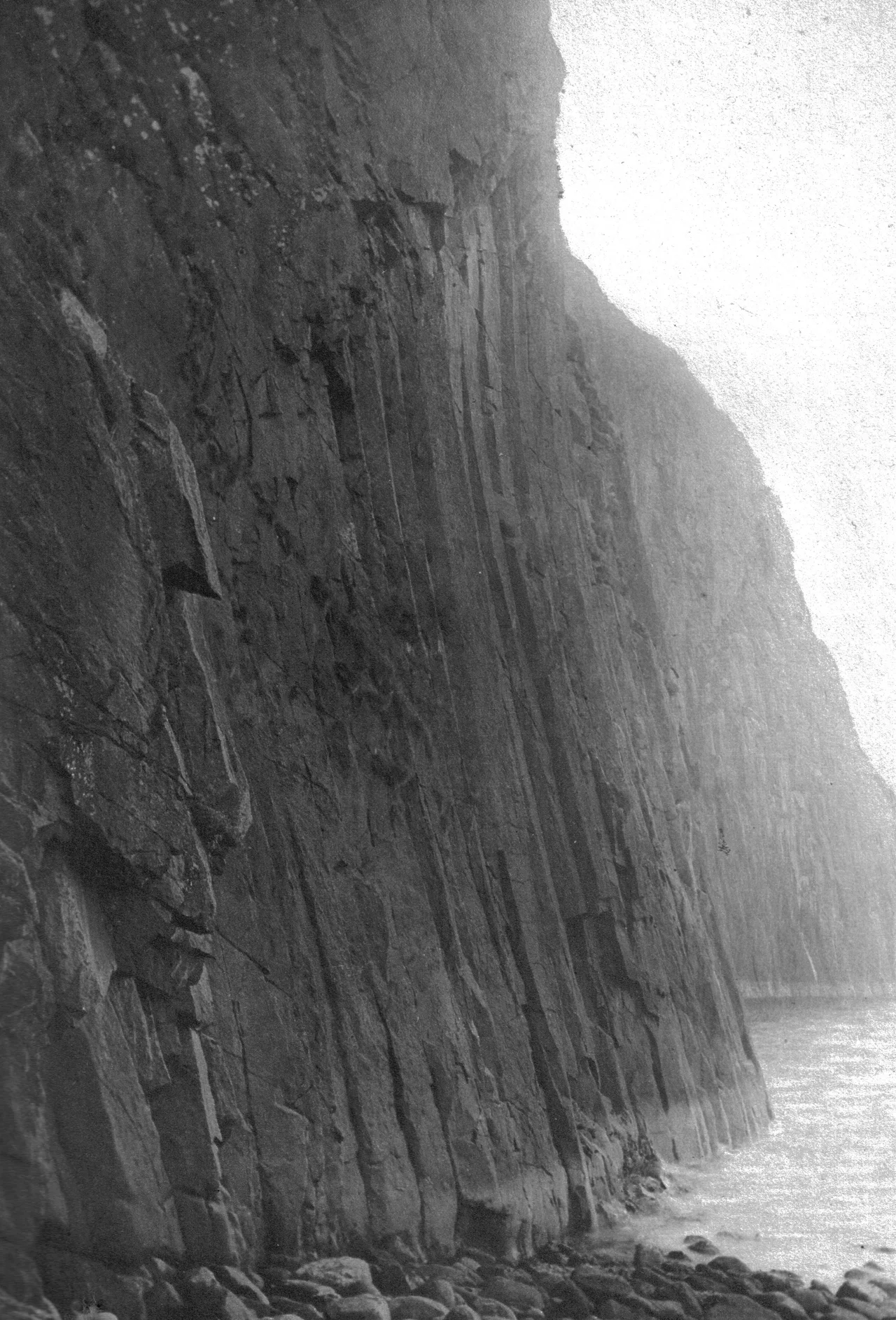

Shiant Islands
On a calm summer morning in the Minch, the Shiant Islands look exactly as the Gaelic name suggests - Na h-Eileanan Seunta, the enchanted isles. Cliffs the colour of wet iron drop to a sea so clear you can count the kelp fronds. Puffins whirr in their tens of thousands. The Galtachan rocks to the west catch the light like a half-submerged spine. The 'enchanted' translation is, scholars now say, probably a Gaelic misreading of an older Norse word for 'sound' or 'cleft.' Either name will do. Spend a day on the Shiants and you stop arguing about which language got it right.
Three Islands and a Family of Rocks
The Shiants are a privately owned island group five miles southeast of the Isle of Lewis, lying in the Minch east of Harris in the Outer Hebrides of Scotland. There are three main islands: Garbh Eilean ('rough island') and Eilean an Taighe ('house island'), joined by a narrow isthmus of shingle, and Eilean Mhuire ('island of the Virgin Mary') to the east. The two western islands together cover 143 hectares. Out to the west, a procession of jagged stacks - Galta Beag, Bodach, Staca Làidir, Galta Mòr, Sgeir Mhic a' Ghobha, Damhag - run roughly in line. The owners' family has held the Shiants since 1937, when the writer Nigel Nicolson, then an Oxford undergraduate, bought them. They were given to his son Adam, and now to his grandson Tom.
Volcanoes and Dolerite
Geologically, the Shiants are an extension of the Trotternish peninsula of Skye. Their rocks are volcanic and, at 60 million years old, are very young by Hebridean standards. The dolerite columns on the north side of Garbh Eilean are over 120 metres tall and about two metres in diameter - higher in places than those at Staffa or the Giant's Causeway, though formed by the same slow cooling of magma underground. Intrusive sills exhibit a chemical progression from olivine-rich rock at the base to olivine-free rock at the top, a signature of crystal settling. In some places the basalt is overlain by Jurassic mudstone, which weathers to a fertile soil unusual in the Western Isles. It is why the human history of the Shiants was, briefly, possible.
The Hole of the Seals
Donald Monro, the Dean of the Isles, sailed past the Shiants in 1549 and described in Scots 'an isle called Ellan Senta, which means in English fable island.' He noted a great vault on the eastern side of Garbh Eilean - a sea cave, longer than an arrow shot, through which 'we used to row our sail boats, for fear of the horrible break of the seas that is on the outward side.' That vault is still there. The Nicolson family calls it the Hole of the Seals; Adam Nicolson described rowing a dinghy through it in his 2001 book 'Sea Room.' In 1703 the traveller Martin Martin wrote that Eilean Mhuire was 'fruitful in corn and grass,' with a chapel dedicated to the Virgin Mary. By the early 20th century only eight people lived here. Today, no one does.
Puffins, Rats, and the Recovery
Tens of thousands of Atlantic puffins breed in burrows on the slopes of Garbh Eilean. Razorbills, guillemots, fulmars, kittiwakes, shags, gulls and great skuas crowd the cliffs alongside them. There are fewer puffins here than at St Kilda, but they are much more densely packed - Garbh Eilean is one of the most concentrated seabird colonies in Britain. For years the islands also held a population of black rats, presumed shipwreck survivors, who were among the last colonies of Rattus rattus left in the UK. Whether they ate live chicks or only scavenged was never settled, but in the winter of 2015-16 a project funded by the EU, SNH, RSPB and private donors began a two-year eradication. In March 2018 the Shiants were declared rat-free. The seabirds, now uncontested, are slowly increasing.
From the Air
57.899°N, 6.364°W in the Minch, roughly halfway between Skye and Lewis. The three-island group plus the western Galtachan stacks are unmistakable from the air. Cruise 1,500-3,500 ft for a clear view of the dolerite cliffs on Garbh Eilean's north face. Stornoway (EGPO) lies about 22 nm north; Scalpay sits about 8 nm west; Trotternish on Skye about 15 nm south. The Shiants are a useful waypoint when crossing the Minch. Expect lively winds and strong tidal flows in the surrounding sounds.
Nearby Stories
- Lewis 5.9 km away
- Lochmaddy 9.7 km away
- Uig 11 km away
- Rua Reidh Lighthouse 12 km away
- Loch Torridon 15 km away
- Stoer Head Lighthouse 34 km away
- The Flannan Isles Mystery: The Lighthouse Keepers Who Vanished 35 km away
- Sollas 36 km away