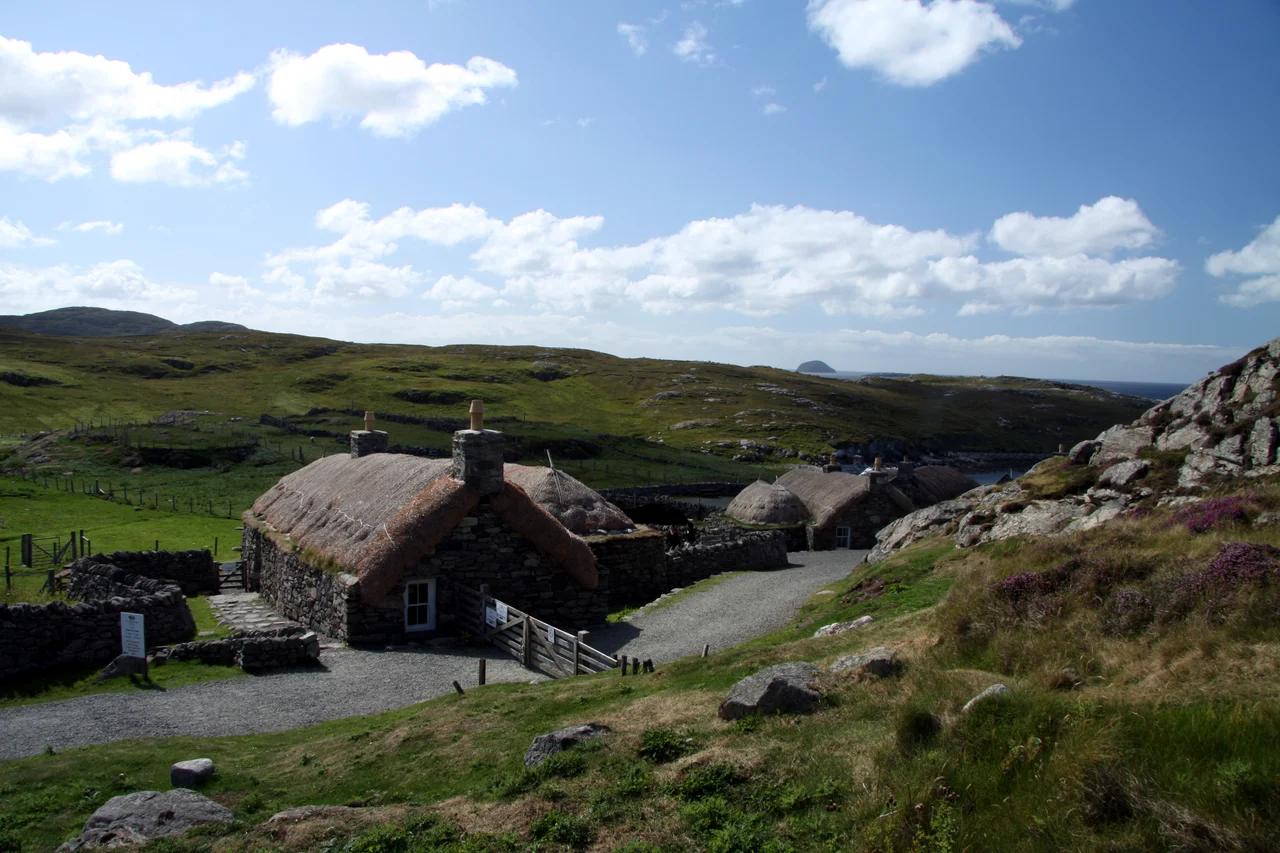

Carloway
Carloway has one of the finest preserved Iron Age brochs in Scotland, the oldest still-running Agricultural Show in the Outer Hebrides, the longest annual Highland Games in the islands, and a football club with one of the best pitches north of Glasgow. None of which gets mentioned in the first sentence of its Wikipedia article. The district is small - roughly 500 people across eight crofting townships - and like much of the west coast of Lewis it does its remarkable things quietly. Dun Carloway broch sits on a low hill above the village, a stone tower that has held its walls together for two thousand years.
Eight Townships and a Bridge
Carloway lies on the west coast of the Isle of Lewis in the parish of Uig, on the A858 road. The district has been a separate civil registration district since 1859, when it was carved out from the bordering parishes of Lochs and Uig. Today it divides into eight crofting townships: Knock Carloway, Park Carloway, Doune Carloway, Upper Carloway, Garenin, Borrowston, Kirivick and Dalmore. The Carloway River runs through the middle of the district and is crossed by the Carloway Bridge, which is said to be one of Scotland's oldest flyovers - a stone overpass built in the mid-19th century, carrying the road above the Pentland Road that leads from the harbour out to Stornoway. Services in the small village include a community shop, a hotel, a youth hostel, a freshly renovated Harris Tweed mill, a museum, two churches, a football pitch, a war memorial and a historical society. It is not a settlement that lacks for organisation.
Dun Carloway
Above the village stands a circular stone tower built sometime in the Iron Age. Dun Carloway broch is one of the most complete brochs surviving in Scotland - the best preserved in the Outer Hebrides, and among the very finest anywhere, after Mousa in Shetland and Dun Telve in Glenelg on the mainland. Brochs are uniquely Scottish: tall, drystone, double-walled towers, built between roughly 100 BC and 300 AD, found nowhere else in the world. The walls of Dun Carloway still stand to a height of about nine metres on the north and west sides. The internal gallery, built into the thickness of the wall, can still be walked. From the broch the view opens west across the Atlantic and east across the moors of central Lewis. The builders chose the hill deliberately. From this vantage you can see weather coming and you can see anything approaching by sea. The broch is a scheduled monument and free to visit. There is no fence around it, no admission, just a footpath up from the road.
The Show, the Bridge, the Tweed
Carloway's Agricultural Show and Highland Games is held on the first Wednesday of August at the Show Ground behind Carloway School. First held in 1911, it is the longest-running annual show on the island - the Stornoway show, called Beinn-na-Dròbh, ended some years ago - and locally it is called the Premiere Show. In 2011 the 58th show drew about 2,500 attendees, which is more people than live in the district. The Harris Tweed mill in the village was renovated recently and still produces cloth woven on hand looms in the surrounding crofts. The community shop combines off-licence, general store and post office. The two churches sit next to each other near the bridge in Knock Carloway: the Free Church of Scotland, built in 1884, conducts services in both English and Scottish Gaelic; the Church of Scotland next door, built in 1908, holds services in English. Both have small congregations. Both are still open.
A Football Pitch That Hosted Rangers
Carloway F.C. was founded in 1933 and reconstituted in 1946 after the Second World War. It plays in the Western Isles league, on what regulars and visiting opponents alike say is one of the best playing surfaces in the Highlands and Islands. The pitch was opened in 1991 with a friendly match against Rangers reserves, which drew about 1,100 spectators. The club's catchment area stretches across the western edge of the parish of Uig from Dalmore to Breanish. Two Carloway players have gone on to play professionally. Ronnie MacKinnon played for Rangers and the Scotland men's national team. His twin brother Donnie played for Partick Thistle. Carloway won its first League title in 2013, after eighty years of trying. The club won several cup competitions during the 1950s before going through a long fallow period; the 2012-13 season saw a sudden rush of trophies - the Co-operative Cup, the Lewis Cup, the Acres Boys Club Cup, the Jock Stein Cup and the League. A village of 500 people produced all of that.
Two Chapels in Ruins
Beyond the broch and the bridge, two older ruined chapels mark the religious history of the district. Teampall Chiarain - St Ciaran's - sits on the east side of the Laimishader peninsula at the foot of a crag, reached by a footpath. Local folklore held that the ill were brought to this chapel, walked clockwise around it, and made to sleep the night inside; the morning supposedly cured them. Teampall Mhicheil - St Michael's - stands on the southern shore of Loch Carloway, across the water from Borrowston and Port Laimishader, next to the ruins of the post-medieval township of Baile an Teampaill. The graveyard there has a quiet custom: the inhabitants of the surrounding crofts used to paint their croft numbers on the unmarked grave stones in tar, marking who lay where. The names were lost or never written, but the croft numbers endured.
From the Air
Coordinates 58.27 N, 6.77 W. Carloway lies on the west coast of Lewis along the A858, identifiable from the air by the Iron Age broch on a low hill above the village. Dun Carloway shows as a small circular ruin against the surrounding moorland. Nearest airport is Stornoway (EGPO), about 14 nm east. Recommended viewing altitude 1,500-3,000 ft to take in the relationship between the village, the broch, the Carloway River and the open Atlantic. The Garenin Blackhouse Village is visible a couple of kilometres to the north, a cluster of restored thatched stone houses against the moor.
Nearby Stories
- Hebrides 8.6 km away
- Tiumpan Head Lighthouse 11 km away
- The Flannan Isles Mystery: The Lighthouse Keepers Who Vanished 12 km away
- German submarine U-905 33 km away
- Rua Reidh Lighthouse 35 km away
- Spaceport 1 40 km away
- Sandwood Bay 104 km away
- The Laki Eruption: The Volcano That Changed World History 843 km away