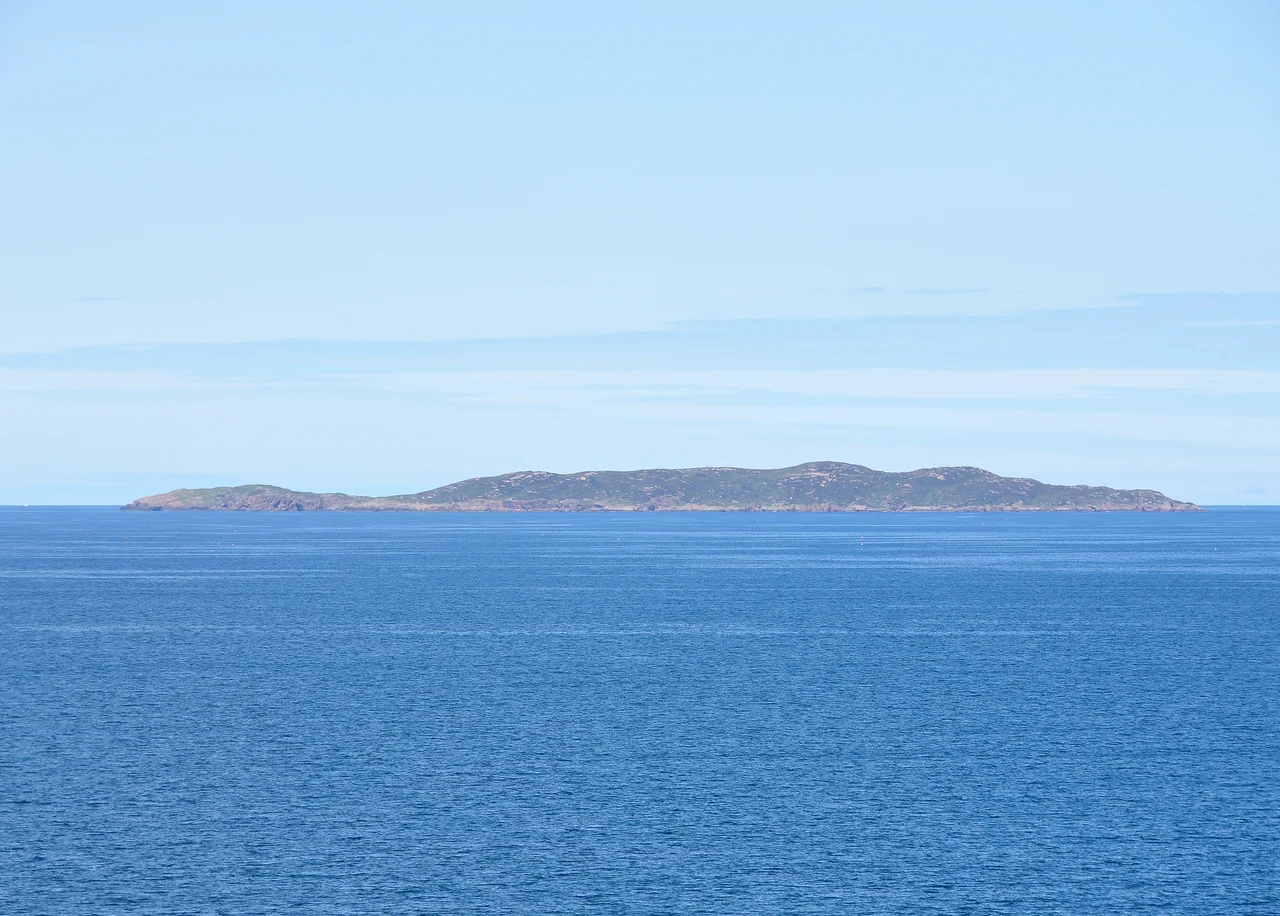

Priest Island
Two men hid on Priest Island for nearly a year. Jim Miller and John Bellord were on the run from the law, helped by an accomplice named Geoff Green, and from September 1975 until the summer of 1976 the small uninhabited rock off the Wester Ross coast was effectively theirs. They were eventually found, the story ran on the front pages, and the BBC's Everyman strand made a documentary about it. A Canadian film crew came back in 2008 and made another. For an island of perhaps a square mile, accessible only by boat from a coast that does not advertise itself, that is a strange amount of fame. The island had been hiding people for far longer than that.
The Vanishing Circle
On 4 July 1884 the naturalist John Harvie Brown stepped ashore on Priest Island and found something that ought not to have been there: a near-perfect circle of nine stones lying flat, smaller ends inward, the whole thing flush with the short green sward. The stones, he wrote, had a 'highly polished surface... as if done by human hands (or feet).' He sketched it - a feature about four metres across - and made a careful note of where it sat. When he returned for his second visit, the stones were gone. Not weathered, not collapsed - removed. On his fourth visit in 1903 he searched the surrounding ground, collected nine stones he was fairly sure were the originals, and laid them out again in the same plan. He also noted at least two other stone circles nearby, smaller and less perfectly built. The 1794 Statistical Account spoke of a 'large cove on the south side of Priest Island, said to have been the alternative home of a Popish priest' - probably one of the island's caves, which still survive, one of them subdivided by a drystone wall from floor to ceiling.
The Hermit and the Naturalist
The Gazetteer for Scotland records Priest Island as an early Christian retreat - a piece of land remote enough that a hermit who wanted to be left alone with God could mostly count on the weather to do it for him. The island's Gaelic name, Eilean a' Chleirich, means the cleric's island, and the cove with the drystone wall may have been his cell. Centuries later the place attracted another solitary: Frank Fraser Darling, the pioneering ecologist who lived on the island for a stretch in the twentieth century while doing the kind of patient observational work that helped found British nature writing. Fraser Darling found a midden in one of the caves - probably the priest's - though no trace of it survives now. The history of Priest Island is a string of people who deliberately chose to be hard to find.
The Birds Took Over
Today the Royal Society for the Protection of Birds owns and manages Priest Island as a nature reserve. It is a Site of Special Scientific Interest and a Special Protection Area, and it holds one of the largest colonies of European storm petrels - Hydrobates pelagicus - in the United Kingdom. Salt spray and bird guano enrich the soil enough to support unusually species-rich maritime heath and cliff communities around the coast, and a small amount of woodland clings to the more sheltered ground. Pygmy shrews, otters and grey seals share the rocks with the seabirds. In the summer of 1960, pupils and teachers from Whitgift School in South Croydon spent two weeks here with formal permission to ring birds - hauling a quarter of a ton of supplies on a trek cart pulled all the way from Garve Station. They netted storm petrels at night and shags on the cliffs by day. It is hard to imagine the modern logistics of that, harder still to picture the children doing it. But Priest Island has always rewarded patience and punished anyone who came expecting comfort.
From the Air
Priest Island lies at 57.96N, 5.50W, the outermost of the main Summer Isles cluster off the Wester Ross coast, with Ben Mor Coigach rising on the mainland behind it. From altitude the island appears as a small green-and-grey rock surrounded by a scatter of smaller islets. Nearest airport is Inverness (EGPE), 95 nautical miles east-southeast. The coast is exposed to North Atlantic weather; expect frequent low cloud, gusty westerlies, and limited visibility outside summer mornings.
Nearby Stories
- Stoer Head Lighthouse 6.8 km away
- Beinn Eighe 8.7 km away
- Tiumpan Head Lighthouse 13 km away
- South Rona 14 km away
- Battle of Tuiteam Tarbhach 17 km away
- Conon Hydro Scheme 22 km away
- Shiant Islands 23 km away
- Loch Naver 33 km away