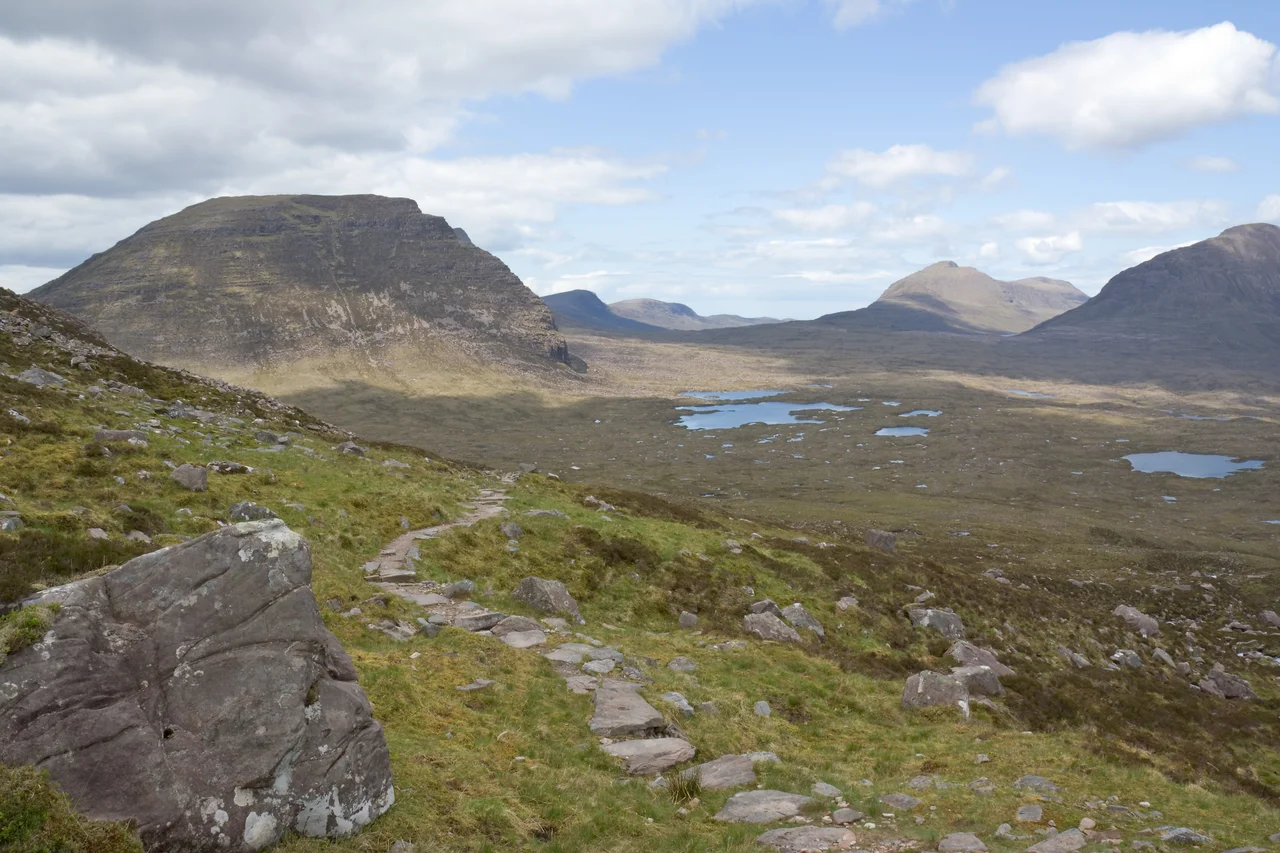

Beinn Eighe
In the early hours of 14 March 1951, an Avro Lancaster of 120 Squadron came back from a maritime patrol over Rockall and never reached its bed at RAF Kinloss. The aircraft had departed RAF Kinloss on the evening of 13 March; it struck the summit ridge of Beinn Eighe about five metres below the crest in the early hours of the following morning, in a gully now called Fuselage Gulley above the dark water of Loch Coire Mhic Fhearchair. Eight men died: a pilot, a co-pilot, a navigator, four air signals operators, a flight engineer. Wreckage still litters the corrie. So does the older story of this mountain, which became Great Britain's first national nature reserve a few months later that same year.
The Mountain of White Stone
Beinn Eighe rises in the Torridon hills of Wester Ross, its long ridge studded with Cambrian quartzite scree that flashes silver in sun and looks, on hazy days, exactly like snow. Two of its summits are Munros: Ruadh-stac Mor, the Big Red Stack, at 1010 metres, and Spidean Coire nan Clach, the Peak of the Corrie of Stones, which was promoted to Munro status only in 1997 at 993 metres. East of the main ridge lies a wicked line of pinnacles called the Black Carls, narrow enough that a full traverse becomes a scramble before it becomes a walk. The southern flank slopes down to the A896 and A832 roads near Kinlochewe. Northwest, the land empties: Flowerdale Forest, the Torridon Hills, no roads, no houses, only watercourses and red deer.
Coire Mhic Fhearchair
Round the back of the mountain, hidden from every road, the Triple Buttress Corrie waits like a secret. Three vast cliffs of Cambrian sandstone and quartzite drop into a glacial lake. Climbers have been finding routes up the buttresses since the late Victorian era, but the cartographer Timothy Pont sketched the bowl on his maps four hundred years ago. Inside the rock here are the Fucoid Beds, a thin Cambrian layer whose fossils are utterly different from those in English rocks of the same age. That mismatch was one of the early clues that during the Cambrian, an ocean lay between the two landmasses. Britain, geologically, used to be two countries pasted together.
Plants That Live Nowhere Else
The summit plateau is the only place in Britain where the northern prongwort liverwort, Herbertus borealis, has been found growing. The moss Daltonia splachnoides reaches its northernmost known global station here. The Scots pines on the lower slopes are genetically closer to pines in southern Europe than to those in eastern Scotland, because western Scotland thawed first after the last ice age and the pines walked north along the Atlantic edge before the eastern ice retreated. Golden eagles ride the thermals above the ridge. Pine martens hunt in the wood. Otters breed along Loch Maree and have been tracked up burns and lochans 400 metres above the sea.
First in the Realm
In 1951, Dr John Berry, then Director of Nature Conservancy in Scotland, designated Beinn Eighe Britain's first national nature reserve. It covers 4,758 hectares of moor, bog and ancient Caledonian pinewood. NatureScot runs a visitor centre at Aultroy outside Kinlochewe, and two way-marked trails climb out of the forest: the gentle Woodland Trail through the Coille na Glas Leitir pinewood, and the harder Mountain Trail rising 6.5 kilometres to a conservation cairn at about 550 metres, with Loch Maree spread out below and the steep wedge of Slioch across the water. A field station with laboratories houses up to fourteen researchers. A tree nursery raises pines from local seed for replanting on the reserve.
What Survives Up There
In 2014 the reserve was administratively joined with the Loch Maree Islands NNR, more than sixty islands holding the most important breeding population of black-throated divers in Britain. The whole area sits within the UNESCO Wester Ross Biosphere. Up on Fuselage Gulley, weathered aluminium still emerges from the moss every spring. Walkers reach the wreckage by climbing into the corrie from the head of the loch. There are no plaques on the mountain. The names of the eight men, the youngest a sergeant of nineteen, are recorded at memorials lower down. Beinn Eighe holds them, and the rare mosses, and the genetic memory of trees that walked north out of Iberia, all in the same silver light.
From the Air
Beinn Eighe lies at 57.58 N, 5.42 W in the Torridon hills of Wester Ross, with summits to 1,010 metres (3,313 ft). The Triple Buttress Corrie sits on the north side, hidden from the A832/A896 road approach. Maintain a generous AGL clearance for ridge and rotor turbulence; the quartzite scree often resembles snow cover. Nearest ICAO airport is Inverness (EGPE), about 65 nm east-southeast; alternatives include Stornoway (EGPO) across the Minch to the west. Mountain weather changes fast off the Atlantic, and the 1951 Lancaster crash in Fuselage Gulley is a reminder of low cloud over these ridges.
Nearby Stories
- South Rona 3.8 km away
- Capture of Eilean Donan Castle 5.7 km away
- Gruinard Bay 6.3 km away
- Glamaig 9.2 km away
- Glenmoriston 16 km away
- Alladale Wilderness Reserve 18 km away
- Conon Hydro Scheme 19 km away
- Shiant Islands 24 km away