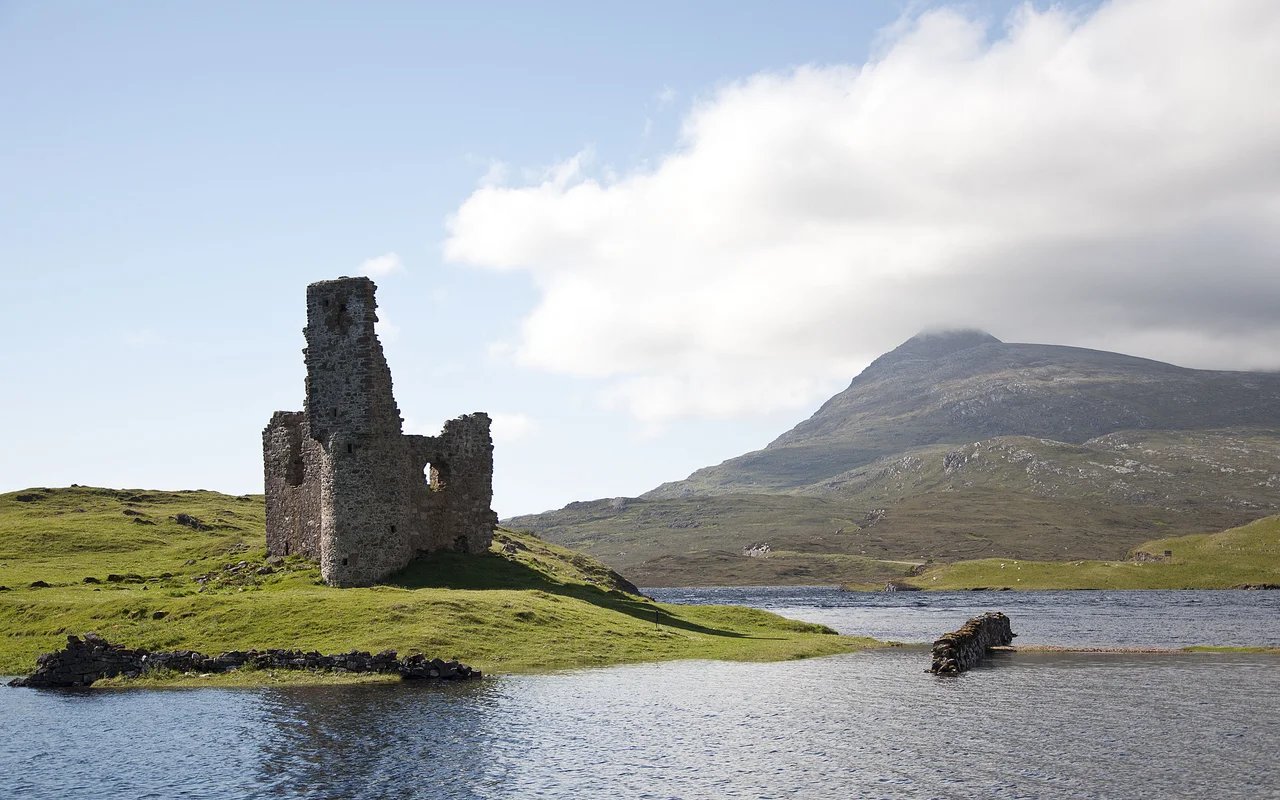

Ardvreck Castle
In 1650, James Graham, the 1st Marquess of Montrose, was Scotland's most charismatic Royalist general - the man Charles I had trusted to keep the Highlands in the king's name. After his defeat at Carbisdale, hunted and starving, he sought refuge at Ardvreck Castle on the rocky promontory of Loch Assynt. The Laird of Assynt, Neil MacLeod, took him in. Then handed him over to the Covenanter forces for £25,000 in coin and £20,000 in oatmeal. Montrose was hauled to Edinburgh and hanged. MacLeod's name has been a Highland curse word ever since. The castle that witnessed the betrayal still stands above the loch, ruined and roofless, three storeys of grey rubble masonry against the water.
Built for a Clan
Ardvreck was built around 1490 by the MacLeods of Assynt - a branch of the larger Clan MacLeod of Lewis - on a small rocky peninsula jutting into Loch Assynt. It replaced Assynt Castle, four miles northwest of Inchnadamph, which had served as the clan seat before. The new location was strategic: the promontory put the castle almost in the water itself, defensible from three sides, with a sweeping view down the long axis of the loch toward where attackers might come. The MacLeods would hold it for almost two centuries, riding out clan wars and Highland politics from inside its walls, until everything came apart in the middle of the seventeenth century.
The Capture of Montrose
The Marquess of Montrose's campaign in Scotland collapsed at the Battle of Carbisdale in April 1650. His army shattered and his cause lost, he fled west across the hills, hoping to reach friendly country and a ship home to exile. Two days of walking brought him, half-dead, to the gates of Ardvreck Castle. Neil MacLeod's clan was officially aligned with the Covenanters, the parliamentary religious faction the king had been fighting. There are competing accounts of what was said. What is certain is that Montrose was held, then turned over for the bounty. He was taken to Edinburgh, tried, and hanged on 21 May 1650. His head was displayed on the Tolbooth for eleven years.
The 1672 End
Twenty-two years after the Montrose betrayal, in 1672, Clan Mackenzie attacked Ardvreck Castle and took it. The MacLeods of Assynt lost their seat for good. The Mackenzies built Calda House a short distance away on the loch shore, abandoning the cramped tower for a more comfortable mansion. Calda burned down in 1737, and after the Jacobite rebellion of 1745 the Mackenzies themselves were ruined by the British government for backing the wrong side. Both structures - the castle and the burnt-out mansion - sit within walking distance of each other on the A837, side by side, as a kind of accidental open-air museum of how Highland landlordship can end.
What Remains
Ardvreck was a simple rectangular keep with a round staircase tower at the southeast angle. The architecture is unfussy late-medieval Scottish: corbelled upper floors that step out from the lower walls to form square rooms, a small stair turret carried on those corbels, four levels in all. The ground floor held three vaulted compartments. The first floor above was also vaulted; the upper levels had simple joisted timber floors that have long since rotted away. Gunports - small openings for firearms - are scattered in the walls, marking the moment when castle architecture began responding to gunpowder. Today the ruin is a scheduled monument. There is no admission charge and no fence; you walk out across the promontory from a layby on the A837 and the castle is just there, weathering.
From the Air
Ardvreck Castle stands at 58.167°N, 4.996°W on a promontory in Loch Assynt, halfway between Lochinver and Kylesku. From the air the castle is unmistakable: a small grey ruin on a tongue of land jutting into the loch, with Calda House's burned shell visible half a mile to the south. Nearest airport is Inverness (EGPE), 70 nm southeast. Recommended viewing altitude 1,500-3,000 ft to catch the castle, the loch's length, and the mountain Quinag rising to the north.
Nearby Stories
- Loch Shin 2.2 km away
- HMS Nelson (28) 2.5 km away
- An Teallach 9.6 km away
- Battle of Drumnacoub 11 km away
- Kinlochbervie 12 km away
- Fyrish Monument 21 km away
- The Minch 21 km away
- German submarine U-905 25 km away