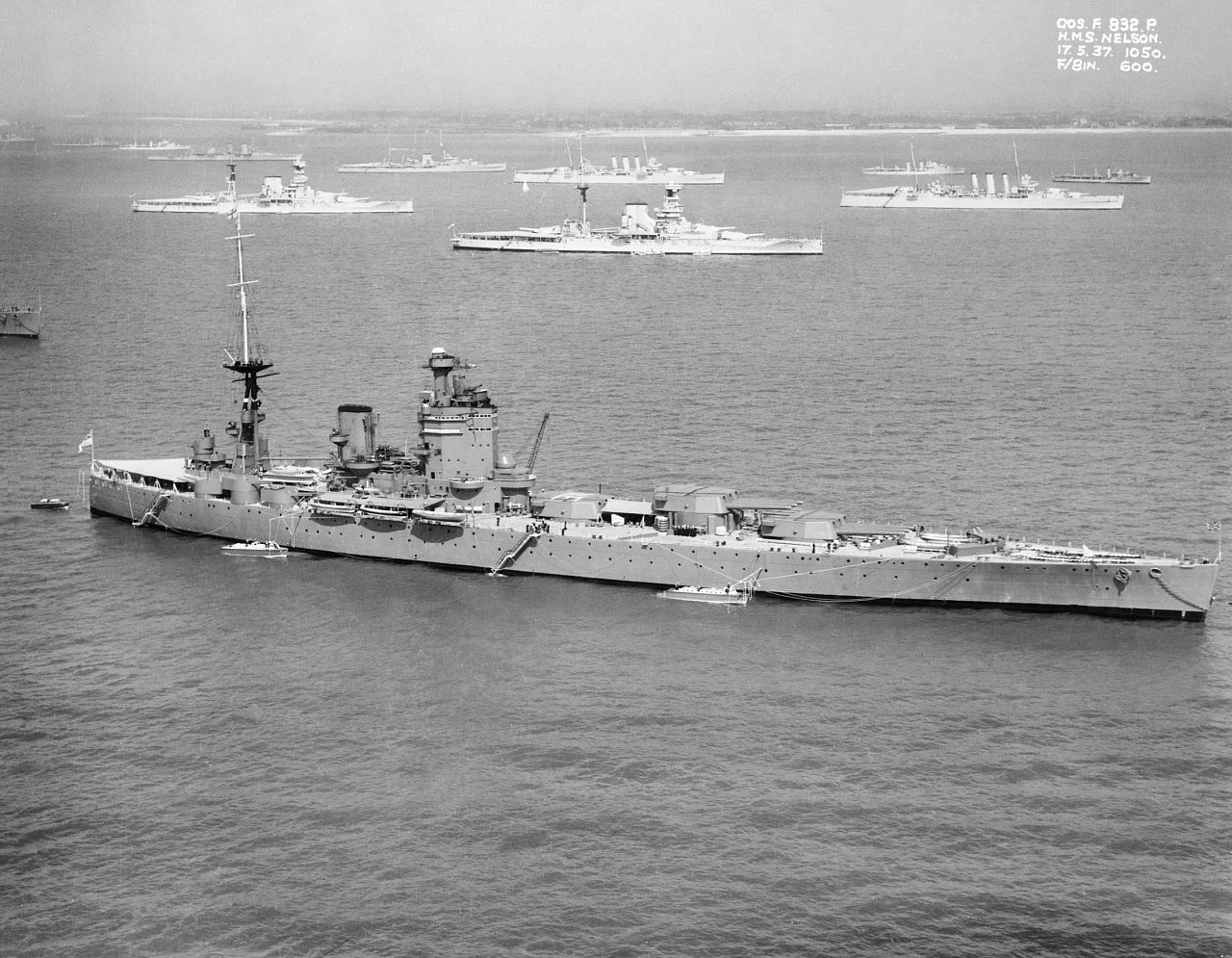

HMS Nelson (28)
On 29 September 1943, General Dwight Eisenhower and Marshal Pietro Badoglio signed the Italian surrender in the wardroom of HMS Nelson, anchored off Malta. Two years later, on 2 September 1945, the Japanese forces in northern Malaya formally surrendered aboard the same ship at George Town, Penang. No other Royal Navy vessel hosted the capitulation of two Axis powers. Built to meet the impossible constraints of the Washington Naval Treaty, mocked as one of the 'ugly sisters' and the 'Cherry Tree class' (cut down by the Washington axe), Nelson outlived her critics and ended the war as the most diplomatically distinguished battleship in the British fleet.
A Treaty Battleship
When the Washington Naval Treaty of 1922 capped battleship displacement at 35,000 long tons, the Royal Navy had to redesign from scratch. The result was the Nelson class: a smaller, slower battleship version of the cancelled G3 battlecruiser, with all three triple turrets of nine 16-inch guns mounted forward of the superstructure, an arrangement that saved weight and armour but made the ships impossible to fire astern. Nelson was laid down at Armstrong Whitworth's Low Walker shipyard on Tyneside on 28 December 1922 and commissioned on 21 October 1927. She measured 709 feet overall, 106 feet across the beam, displaced 33,300 long tons standard load, and could make 23 knots. The crew called her the Queen's Mansions for her blocky superstructure, the pair of boots, the ugly sister. The unusual layout worked. Nelson and her sister Rodney served as fleet flagships for most of their peacetime years, and both went on to fight a hard war.
Two Mines and a Torpedo
Nelson's war began badly. On 4 December 1939, three months into the conflict, she detonated a German magnetic mine at the entrance to Loch Ewe on the Wester Ross coast, the same Loch Ewe that would become the assembly anchorage for the Arctic convoys. The mine blew a ten-foot hole forward of A turret, flooding the torpedo compartment and adjacent spaces. No one was killed, but seventy-four sailors were wounded, and the ship spent the next eight months under repair at Portsmouth. She missed the Norwegian Campaign as a result. In September 1941, escorting a Malta convoy, a Savoia-Marchetti SM.84 torpedo bomber punched a thirty-foot hole in her bow with a torpedo dropped at point-blank range. Again, no fatal casualties. Again, months under repair. And in June 1944, during the Normandy landings, she struck two mines on the same day and had to be towed across the Atlantic to the Philadelphia Naval Shipyard for the final major refit of her career.
Malta, Sicily, Salerno
Between her injuries, Nelson worked. From mid-1941 onwards she escorted Malta convoys through the most dangerous stretch of the Mediterranean, when the island was on the edge of starvation and the Royal Navy was the only thing keeping it supplied. In November 1942 she covered Operation Torch, the Allied landing in French Algeria. In July 1943, with Rodney and the carriers, she covered Operation Husky, the invasion of Sicily. On 31 August 1943 she and Rodney bombarded coastal artillery between Reggio Calabria and Pessaro in preparation for Operation Baytown, the amphibious invasion of mainland Italy. On 9 September she helped cover the landings at Salerno, using her main guns in 'barrage' mode against German torpedo bombers. Three weeks later, with the Italian campaign won, Eisenhower and Badoglio signed the surrender on her decks. Nelson had become, almost accidentally, the diplomatic centrepiece of the Mediterranean war.
From Quarterdeck to Target
After her Philadelphia refit, Nelson sailed for the Eastern Fleet, arriving in Colombo on 9 July 1945. She supported Operation Livery against Japanese forces along the Malayan coast. When the Japanese garrison at George Town, Penang, formally surrendered on 2 September, the ceremony took place aboard Nelson, the only Royal Navy battleship to host two formal Axis capitulations. She returned to Britain in November 1945, served briefly as flagship of the Home Fleet, then became a training ship in 1946 and was reduced to reserve in October 1947. The final indignity came in 1948: between June and September she was used as a target ship in the Firth of Forth, struck repeatedly with 2,000-pound armour-piercing aerial bombs to evaluate how well her armoured deck could withstand them. She was sold for scrap to Thos. W. Ward in January 1949 and demolished at Inverkeithing. The treaty had cut her down at conception; the bombs finished what the treaty had started, twenty-six years later.
From the Air
HMS Nelson is historically associated with Loch Ewe, where she struck a German magnetic mine on 4 December 1939. The mining position is approximately 57.81 N, 5.64 W, at the entrance to the loch between the Isle of Ewe and the mainland. Loch Ewe is a deep sea loch on the Wester Ross coast, used during World War II as the British assembly anchorage for the Russian Arctic convoys. The Russian Convoy Memorial stands at Cove on the east side of the loch, commemorating the roughly 3,000 Allied sailors who died on the Murmansk and Archangel routes. Nearest airfields: Plockton private grass strip 35 nm south, Inverness (EGPE) 65 nm east-southeast, Stornoway (EGPO) 50 nm west-northwest across the Little Minch. The loch is visible from cruising altitude as a sheltered indentation behind the Aultbea peninsula.
Nearby Stories
- BUTEC 4.3 km away
- Duntulm Castle 6.9 km away
- An Teallach 7.1 km away
- The Minch 11 km away
- Eilean Chaluim Chille 13 km away
- Suilven 14 km away
- Dunvegan Castle 16 km away
- Glen Affric 30 km away