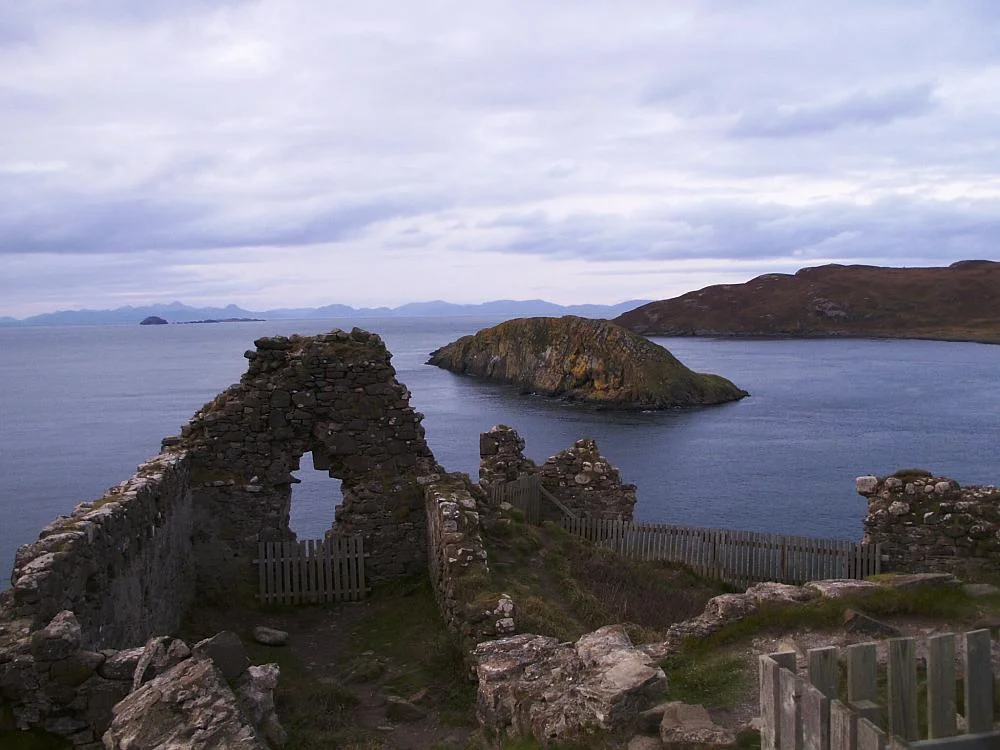

Duntulm Castle
Walk to the edge of the cliff at the top of Trotternish and the castle is barely a castle anymore. A few sections of wall, a corner that might have been a tower, the green and stone footprint of what was once the seat of the MacDonalds of Sleat. The Minch opens to the north, the Outer Hebrides smudging the horizon, and the wind has the place largely to itself. Duntulm was once the loudest power on Skye. Now it is a scheduled monument that the sheep wander past. The story it tells is not about defence. It is about what happened to clan chieftains when their world ran out.
Before the Castle, a Dun
Locals long believed that, in prehistoric times, a broch or dun called Dun David - Dun Dhaibhidh in Gaelic - stood on this headland. The position invites it: a sheer drop to the sea on three sides, a clear sightline up and down the coast, water at the foot of the cliff. No archaeological evidence has been found to confirm the earlier fort, but the name has the ring of memory rather than invention. The Iron Age peoples who built brochs all along the Atlantic coast of Scotland would have found Duntulm an obvious place to fortify. Whoever first piled stones here was reading the landscape the same way the medieval chiefs would: from this rock, you control the sea road.
MacLeod and MacDonald
The medieval castle was built in the 14th and 15th centuries, when northern Skye was being torn between two clans. The MacLeods held Trotternish from their seat at Dunvegan in the west. The Macdonalds, descendants of the Lords of the Isles, pushed up from the south. Trotternish changed hands repeatedly, sometimes after pitched battles, sometimes after the slower violence of legal manoeuvre at Edinburgh. Defences at Duntulm were improved in the 16th century, but the real shift came in the early 17th: by then the MacDonalds of Sleat had gained the upper hand in the area. In 1618 the Privy Council and Sir Donald MacDonald of Sleat - 'Donald Gorm Og,' the 9th chief - signed a charter requiring him to repair Duntulm and live there fittingly as a chief should.
A Roof, Then No Roof
By the early 18th century, the MacDonalds had moved their main seat south to Monkstadt and then to Armadale, on the more sheltered Sleat peninsula at the southern end of Skye. Duntulm was abandoned. Like many highland castles unroofed by their owners, it began to dissolve back into the cliff it stood on. Local legend claims a piper's tunes still echo from the dungeons; a nurse is said to have dropped the chief's baby from a window into the sea. The truths beneath the stories are harder to recover. What survives is the placement - dramatic, exposed, calculated - and the long shadow it casts in clan history. Duntulm is a scheduled monument now: protected, mapped, and slowly weathering toward whatever comes next.
From the Air
57.6835°N, 6.3489°W at the northern tip of Skye's Trotternish peninsula. Approach altitude 1,500-3,000 ft for the best view of the clifftop ruin and the Minch beyond. Tulm Island lies just offshore. Stornoway (EGPO) is about 35 nm north across the Minch; Inverness (EGPE) sits about 75 nm to the east-southeast. The Trotternish ridge, with the Quiraing and the Old Man of Storr, is the dramatic spine running south. Expect strong onshore winds and quick weather changes off the Atlantic.
Nearby Stories
- The Minch 4.6 km away
- Dunvegan Castle 6.3 km away
- BUTEC 6.3 km away
- Eilean Chaluim Chille 12 km away
- Gair Loch 15 km away
- Lochmaddy Sheriff Court 17 km away
- Benbecula 18 km away
- The Flannan Isles Mystery: The Lighthouse Keepers Who Vanished 45 km away