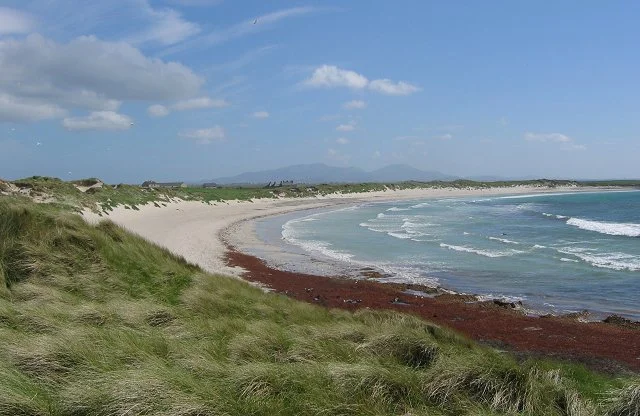

Benbecula
In August 1980, a grizzly bear named Hercules slipped his tether on Benbecula and ambled off into the boggy interior. He had been on the island to film a Kleenex commercial, of all things. For twenty-four anxious days he was nowhere. The local joke ran: have any of the Irish maids' costumes been taken? The reference was old, but everyone on Benbecula got it.
The Island of Fords
The name was a medieval mispronunciation. Beinn nam Fadhla, in Gaelic, would mean something like Mountain of the Fords. Except there is no mountain. The highest point is Ruabhal at 124 metres, more a swelling than a peak, and the island is otherwise so flat that almost all of it lies below 20 metres of elevation. The fords, however, were real. Until causeways were built in the twentieth century, you reached Benbecula from North Uist or South Uist by wading the channels at low tide, or by waiting hours for the boat at high. The whole island is a lattice of small lochs cut into peat, the kind of terrain that makes maps look like a sponge.
Over the Sea to Skye
In July 1746, Prince Charles Edward Stuart, three months after the disaster at Culloden, washed up here in a storm. He was the most wanted man in Britain, with thirty thousand pounds on his head. The islanders did not turn him in. Flora MacDonald, then 24, dressed him in the clothes of an Irish maid named Betty Burke and rowed him across the Minch to Skye. The song that came out of the escape, sung in pubs from Stornoway to Sydney, is set to a tune that Sir Harold Boulton wrote in 1884 to fit older Gaelic boatmen's words. The Prince made it to France. Flora was arrested, briefly imprisoned in the Tower of London, and lived out her days back on Skye. Hercules the bear had no such political stakes when he disappeared. He had been the trained co-star of a Scottish wrestler named Andy Robin. After twenty-four days the bear was spotted swimming in a sea loch, tranquillised, and recovered. He had lost around 127 kilograms, roughly a third of his body weight, having eaten none of the island's many fish or sheep. He went on to appear in the James Bond film Octopussy, met Margaret Thatcher, and caddied for Bob Hope at Gleneagles. He was reburied in 2015 at Langass on North Uist.
Iron Age Echoes
Benbecula's history before the Jacobites is longer than its history after. A stone circle at Rubha Bhidein sits next to the old ford to Grimsay, and chambered cairns from the Neolithic dot the moors. The Iron Age built brochs here, drystone fortress-towers that once stood across northern Britain. The best preserved on Benbecula is Dun Buidhe, which crouches on an islet in Loch Dun Mhurchaidh, reached by a sturdy stone causeway. A seventeenth-century village was later built right on top of it, then abandoned. The island also has the Grimsay Wheelhouse, an Iron Age oddity of stone cubicles radiating from a central hearth, possibly more ritual than domestic. A site called Airidh na h-aon Oidhche, the shieling of one night, gathers the folk-tales told to shepherd boys about underworld creatures who would come for them if they did not say grace.
Catholic, Gaelic, Wind-Battered
Benbecula remains predominantly Gaelic-speaking and Roman Catholic, the only major island in the chain to keep both. The Catholic identity matters culturally and visibly: the white statue of Our Lady of the Isles, a few miles south on a hill above South Uist, was raised in part to defend the island's character against the Cold War missile range. The main road, the A865, runs north to south across the boggy interior. Most settlements, including Balivanich, the airport, and the shops, hug the west coast loop. The beaches are quiet, often empty. Midges are merciless in summer. The breeze, when it comes, is your only friend.
From the Air
Located at 57.45 N, 7.32 W in the central Outer Hebrides, between North Uist and South Uist, connected to both by causeways on the A865. Benbecula Airport (EGPL/BEB) sits in the northwest. Almost the entire island lies below 20 m elevation, peppered with small lochs that flash silver from the air. Westerly Atlantic winds are typical. Recommended viewing altitude 3000-5000 ft for the full island and its causeways. Alternates: Stornoway (EGPO) north, Glasgow (EGPF) southeast.
Nearby Stories
- SS Politician 6.2 km away
- Dunvegan Castle 8.2 km away
- Canna 11 km away
- Leverburgh 16 km away
- Duntulm Castle 20 km away
- St Kilda, Scotland 54 km away
- German submarine U-516 138 km away
- German submarine U-764 163 km away