
SS Politician
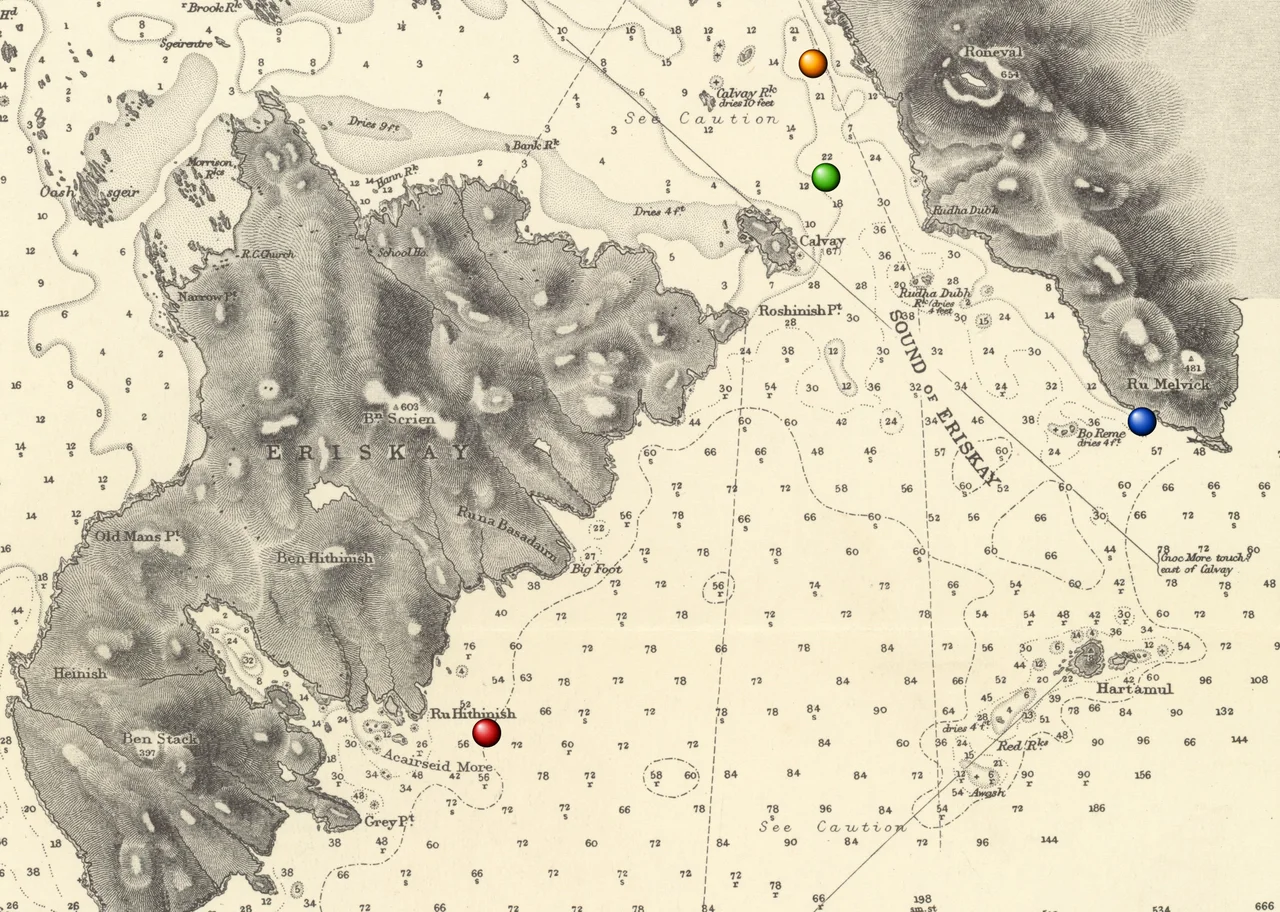
At about 7:40 in the morning on 4 February 1941, in bad weather and poor visibility off Eriskay, the freighter SS Politician hit rocks and stopped moving. Her crew thought they were south of Barra. They were not. Below decks in hold five sat 22,000 cases of Scotch whisky, 264,000 bottles in all, bonded for export to fund the war effort. In hold five with them were eight crates of Jamaican banknotes, in ten-shilling, one-pound, and five-pound denominations, with a face value of £3 million. Both cargoes were about to enter Hebridean folklore. The Bank of Jamaica would spend a decade quietly accepting damp, oil-stained notes presented at counters from Liverpool to Malta.
London Merchant Becomes Polly
The ship was launched in 1921 as SS London Merchant by the Furness Shipbuilding Company in County Durham, completed in 1923, and worked the Atlantic for Furness Withy, sailing between Manchester and the US west coast. In December 1924, during American Prohibition, Oregon's state prohibition commissioner George Cleaver seized her whisky cargo despite federal approval; the British Embassy in Washington complained, and the federal authorities ordered the whisky released. Cleaver had to write an apology. After the Depression tied her up in Essex with sixty other ships, she was sold in 1935 to Charente Steamship Company and renamed Politician. Her crew called her Polly. The Second World War brought her into Atlantic convoy service, and on 4 February 1941 she sailed from Liverpool to rendezvous with a convoy in the north of Scotland. She did not reach it.
What the Crew Forgot to Mention
All 51 crew got ashore safely. Some were billeted that night with islanders on Eriskay, where, as anyone might in a strange kitchen with whisky-deprived hosts, they mentioned the cargo. By the next morning, when Captain Worthington returned to inspect his ship, personal possessions had already been removed. The Liverpool and Glasgow Salvage Association arrived and found the engine room and stokehold flooded and the propeller shaft broken. The salvors took 500 long tons of recoverable cargo but left hold five, full of seawater and engine oil, alone. When the salvage crew finally left on 12 March, the rescue of the whisky began in earnest. Boats came from Eriskay, South Uist, Barra, and across the Hebrides. Between twenty and fifty men a night worked the oily hold, dressed in their wives' frocks to keep their own clothes clean.
Customs Officer McColl
HM Customs and Excise officer Charles McColl and his superior Ivan Gledhill chased the islanders for months. McColl commandeered a boat in March, intercepted three loads of whisky off Eriskay, and began raiding crofts; the crews and their families had hidden the bottles in rabbit holes, behind peat stacks, in creels submerged in the bay, and behind house panels. Burying caches brought a second problem, since islanders who had not gone to the wreck would watch and dig them up. One man stashed 46 cases in a cave on an island off Barra. When he came back only four remained. In June 1941, 32 men were tried at Lochmaddy Sheriff Court for theft. Nineteen were sentenced to terms between 20 days and two months at Inverness Prison. The night the verdicts came in, someone burned out a garage in revenge; McColl's car was damaged and another destroyed. He later reported he had been threatened so often he should not be deployed on further searches.
The Banknotes That Travelled
The Jamaican banknotes had a stranger fate. Children on Eriskay were spotted playing with them. Within two months water-stained notes were being exchanged in Liverpool. Salvors eventually recovered £360,000 of the cargo for the Bank of England. By 1958, 211,267 notes had been accounted for, but 2,329 more had been presented at banks in Ireland, Switzerland, Malta, the US, and Jamaica itself, often by people who had no idea where their souvenir came from. About 76,400 banknotes were never located. On 1 July 1952 the Bank of Jamaica withdrew the blue ten-shilling notes from legal tender entirely and replaced them with purple ones on a light orange background. The world's currencies have rarely been redesigned by a single shipwreck.
Whisky Galore
In August 1941 McColl, frustrated and outwitted, used sixteen sticks of gelignite to destroy hold five and prevent further looting. The historian Arthur Swinson called it 'the ultimate in stupidity, waste, and vandalism'. Compton Mackenzie, a resident of Barra since 1933, watched all of this and in 1947 published Whisky Galore, a fictionalised account set on two imaginary islands. Ealing Studios filmed the 1949 adaptation locally, with Mackenzie himself playing a brief role as the doomed ship's captain. A 2016 remake followed. The Am Politician pub on Eriskay is named for the wreck, and one of the original Jamaican banknotes still hangs over the bar. Bottles continue to surface from the seabed and from forgotten caches on land; eight bottles came up in 1987, twenty-four more in 1990. They go to auction. The story refuses to end.
From the Air
Coordinates approximately 57.0833N, 7.2667W (the wreck site is variously placed between Calvay islet at the north of Eriskay and Ru Melvick at the south of South Uist). The Sound of Barra lies south of Eriskay; the wreck broke up across rocks here in 1941. Recommended viewing altitude 2,000-3,000 ft to take in Eriskay, the Sound, and the southern tip of South Uist together. Nearest airport is Barra (ICAO: EGPR) on Traigh Mhor's tidal beach runway; Benbecula (ICAO: EGPL) is the larger field on the Uist chain to the north. Common conditions: strong Atlantic westerlies, low cloud, frequent marine haze.
Nearby Stories
- Canna 8.3 km away
- Our Lady of the Isles 10 km away
- Wiay, Inner Hebrides 11 km away
- Coll 18 km away
- HMS Sturdy (1919) 35 km away
- St Kilda, Scotland 76 km away
- SS Athelstane (1941) 102 km away
- German submarine U-516 130 km away