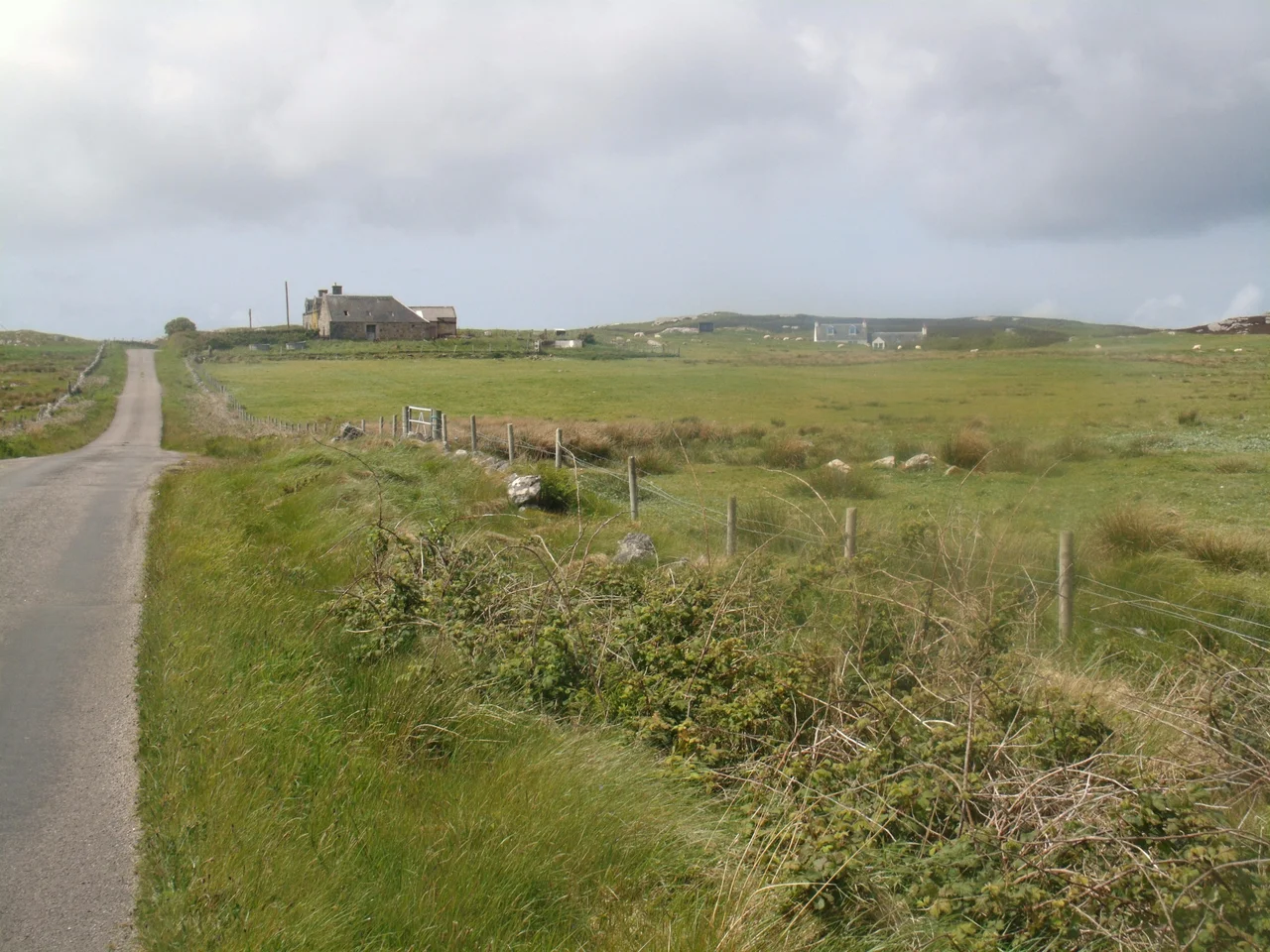

Coll
A child's picture book gave Coll a second life. Mairi Hedderwick, the writer and illustrator who lived on Coll for years, drew this island into the Katie Morag stories under the name Isle of Struay, and a generation of British children grew up with a Coll that was not quite Coll but very nearly. The real island is rougher than the book version. Rocky, tussocky, 195 people in 2011 and 176 in the 2022 census, no street lights, no taxi, and a granny who would recognise the harbour at Arinagour even if she had only ever seen it drawn from memory.
Johnson and Boswell, 1773
Samuel Johnson and James Boswell ended up on Coll on 3 October 1773, having missed Iona because of bad weather, and stayed nearly two weeks as guests of the local Maclean laird. In the morning we found ourselves under the Isle of Col, Johnson wrote afterwards. Their host was a young chief, Donald Maclean, returned from India but not too rich to settle in his own country. The island itself is formed of Lewisian gneiss, lumpy and infertile, which is probably where the name comes from. Old Norse kollr means a rounded mound, and the bedrock here makes the same shape over and over across the twelve-mile length of the island. The Macleans built Breachacha Castle, ruled Coll from the medieval period, feuded bloodily with a rival branch of their own clan in the sixteenth century, and lost the population in the post-Napoleonic clearances. Even the Clan Chief left, for South Africa. By the time the steamer service started in the late nineteenth century, the island that had supported a thousand people supported only a few hundred.
The Dùns of Loch Anlaimh
Several small fortified dwellings, called dùns, sit on islets in Coll's freshwater lochs. They are usually called crannogs, the term for prehistoric artificial islets, but most of these have masonry instead of wooden piles, and Coll's local tradition dates them to the late medieval period. Plausible legend describes the inhabitants as sullen Norsemen holding out after Norse rule of the Hebrides ended in 1266. A submerged causeway with a tight bend and a rocking boulder slowed any hostile approach to the dùn in Loch nan Cinneachan. A sixteenth-century treaty offers a less romantic alternative. The dùns, it said, were quhair brokin men hes duelt. Broken Men were chiefless outlaws, not Vikings but with squalid predatory lifestyles and lamentable table-manners, who probably did hole up here. Both accounts may be partly true. The dùns saw use for centuries, and their inhabitants were various.
Basking Sharks, Sand Lizards, Dark Sky
Coll became Scotland's first official Dark Sky Community in December 2013. No street lighting, very little ambient glow, and a sky clear enough that the winter aurora is often visible. Mid-summer is a lost cause because that far north it never goes properly dark, but most of the year a few minutes of dark adaptation buys you a stellar field that does not exist over any mainland city. Basking sharks gather from spring to early autumn in the Sound of Gunna, the narrow channel between Coll and Tiree where tides concentrate plankton, and Basking Shark Scotland runs boat trips from Arinagour to watch them. The Isle of Coll Distillery, founded in 2021, makes gin and vodka. A small introduced population of sand lizards, released in the 1970s by scientists testing how far north they could survive, is still thriving. In January 2024 the island felt a 3.3-magnitude earthquake, a rare event the British Geological Survey duly recorded.
From the Air
Coll lies at 56.63 N, 6.56 W in the Inner Hebrides, northeast of Tiree across a narrow sound. Coll Airport (EGEL) sits between Uig and Arileod on the southwestern part of the island, served by Hebridean Air Services from Oban one day a week, BN2 Islander aircraft, basically an airborne school bus. Recommended viewing altitude 2,000-4,000 ft. Visual landmarks: Ben Hogh (106 m), the island's highest point in the mid-west, with a rocking-stone boulder near the summit; Breachacha Castles, old and new, in the southwest; Arinagour village on the east coast at the head of Loch Eatharna; the long sand dunes of Hogh and Feall bays; the Sound of Gunna between Coll and Tiree; Gunna islet itself between them.
Nearby Stories
- Bullough Mausoleum 7.6 km away
- Eden (2016 TV Series) 8.5 km away
- Morar 9.6 km away
- Moy Castle 11 km away
- Skerryvore 13 km away
- SS Politician 20 km away
- SS Seniority 38 km away