
Skerryvore
On 4 July 1840, the seventh Duke of Argyll laid the first granite block of what would become the tallest lighthouse in Scotland onto a rock that measured 280 square feet at low tide. Around him in every direction, for eight miles, the sea hid more than 130 named hazards - a barrier of metamorphic remnants stretching south-westwards from Skerryvore proper, the Great Skerry, Sgeir Mhor in Gaelic. Between 1790 and 1844, more than thirty ships were known to have been wrecked here. Robert Stevenson had recommended a beacon in 1804. His son Alan, aged thirty when the project was finally entrusted to him, would spend the next six summers giving him one.
What the Survey Found
Alan Stevenson's painstaking 1834 survey of the reef told him the truth about what the project would demand. There was essentially no choice of location - the single largest area of usable rock at low tide was a patch of 280 square feet. Wave-pressure readings indicated that any tower would have to withstand forces of 6,000 pounds per square foot. Cast-iron or bronze towers had been proposed by others; Robert Stevenson dismissed them out of hand. The light, the elder Stevenson wrote, would have to be granite, and the granite would have to be massive enough that it could not be moved. The Northern Lighthouse Board's commissioners hesitated. They were facing a projected cost of 63,000 pounds, a fortune even for a Lighthouse Board, and they set up a Skerryvore Committee to visit the rock by steamer. On the way back, a fire broke out in the steamer's boiler room. The committee was persuaded.
The Barrack That Vanished
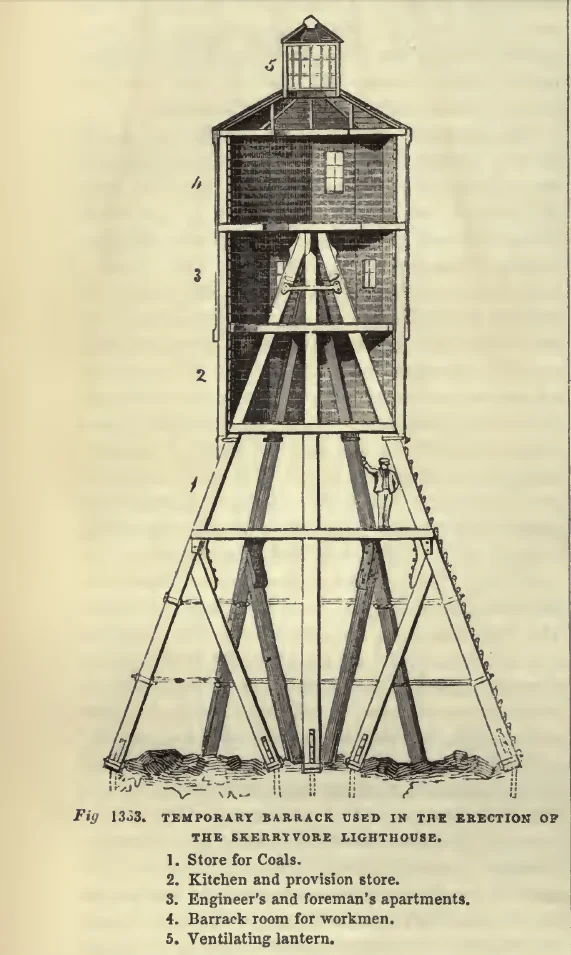
Construction logistics at Skerryvore were a separate engineering problem from the lighthouse itself. The rock lay 11 nautical miles south-west of Tiree, 50 miles from the mainland, and on most days could not be safely landed on at all. The first season, 1838, was spent installing a six-legged wooden barrack - a forty-man bunkhouse on stilts - in holes blasted out of the rock. Work ran 16 hours a day between 4 am and 8 pm. Many of the men preferred sleeping on the damp rock to riding out the pitching anchored sailing-vessel Pharos. By 11 September the barrack legs were in but the upper structure was not. Two months later Stevenson received a letter from the storekeeper at Hynish: 'Dear Sir, I am extremely sorry to inform you that the barrack erected on Skerryvore Rock has totally disappeared.' Stevenson hired a boat to inspect the damage that same day and resolved to rebuild, identically but stronger.
Hynish, the Shore Station
On Tiree's south-west corner, the village of Hynish became Skerryvore's mainland base. Granite blocks quarried on Mull were brought to Hynish to be cut and shaped before being shipped out to the reef. Several keepers' cottages were built in 1844 from the same stone, alongside a massive pier and a tall granite signal tower so that the keepers on Skerryvore could communicate with the shore. Stevenson noted that the hive of activity at Hynish contrasted with the desolation and misery he imagined to be the lot of the surrounding population - a remark that lands awkwardly today but reflected, accurately enough, what he was seeing. Tiree in the 1840s was in the run-up to the Highland Potato Famine; the islanders were in considerable hardship and would shortly be deeper in it. The lighthouse project paid wages. For a few hundred families it made the difference.
The Tower
Between April 1839 and June 1840, 4,300 granite blocks were quarried from Mull, shipped to Hynish, hammered and chiselled into shape, and ferried out to the reef. A single block could take 320 worker-hours to complete. The largest was 23 inches square at the base; the smallest was carved to within a millimetre of its specified dimensions. The summer of 1840 saw up to 95 blocks a day arrive on the rock; by the autumn 800 tons of granite stood 8 feet high. The tower rose through 1841 and 1842. The last block was laid in July 1842. Stevenson chose a hyperbolic curve for the tower's outline for aesthetic reasons - 'No philistine,' as Wikipedia drily notes - and his nephew Robert Louis Stevenson, who would grow up to write Treasure Island and Kidnapped, called the result 'the noblest of all extant deep-sea lights.' At 156 feet high with walls 9.5 feet thick at the base, Skerryvore remained the tallest and heaviest lighthouse anywhere in the world for some years.
The Light, the Fire, the Helipad
The lamp was lit on 1 February 1844 and it shone without interruption for 110 years. Statistics for the 1880s describe Skerryvore as the stormiest part of Scotland - 542 storms in twenty years, totalling 14,211 hours. One keeper lost his hearing for weeks after a lightning strike threw him through the entrance door. In July 1940 a German bomber put a stick of bombs on the rock, cracking two lantern panes. Then on 16 March 1954 a fire started on the seventh floor and spread downwards. The keepers were driven out onto the rocks and rescued the next day when the relief vessel arrived on schedule. The reconstruction took five years; the lantern was re-lit on 6 August 1959. A helipad was added in 1972, ending the era of perilous sea landings. The Northern Lighthouse Board automated the light in 1994. It still shines, monitored from Edinburgh, marking what is still one of the most dangerous bits of water in the British Isles.
From the Air
Skerryvore lies at 56.323 degrees north, 7.115 degrees west, on a low rock 11 nautical miles south-west of the island of Tiree in the southern Inner Hebrides. From 1,500-3,000 feet on a clear day the tower is unmistakable - a slim white-grey cone rising from an otherwise nearly featureless sea, with the long flat outline of Tiree visible to the north-east. The rocks themselves are Lewisian gneiss, Precambrian and among the most ancient in Europe. Tiree Airport (EGPU) is the nearest civilian field, about 14 nautical miles north-east. Glasgow (EGPF) is roughly 110 nautical miles to the south-east; Oban (EGEO) handles small-aircraft Hebrides traffic. A magnetic anomaly in the area is noted as a navigational hazard for ships; pilots flying low over the reef should be aware of compass deviation. Coll lies a few miles north of Tiree.
Nearby Stories
- Coll 7.8 km away
- Oronsay 28 km away
- Barra Head 33 km away
- SS Athelstane (1941) 40 km away
- SS Justicia 56 km away
- German submarine U-994 74 km away
- St Kilda, Scotland 144 km away