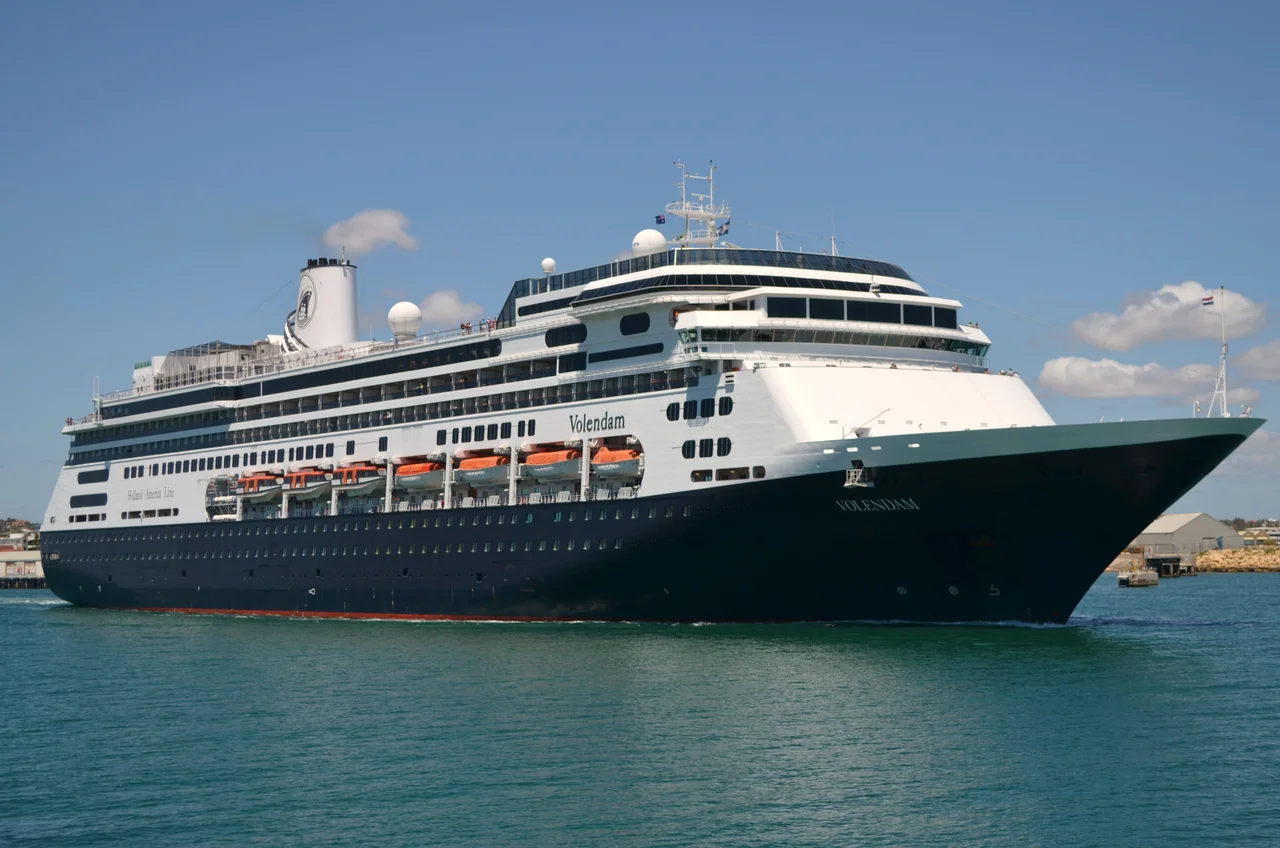

SS Justicia
She was a sister ship of an idea, not a class. Built on the same Harland & Wolff slipway in Belfast where the Titanic had been laid down five years earlier, SS Justicia was meant to be the new flagship of the Holland America Line. The Great War interrupted that future. Acquired by the British government still incomplete, fitted out as a troop transport instead of an ocean liner, she carried American soldiers across the Atlantic to fight in France. On 19 July 1918, with the war four months from ending, two German U-boats found her off the Donegal coast. Six torpedoes, two days, and one of the largest ships ever built went down twenty-three miles north-west of Skerryvore. Sixteen men died with her. It was a near-miracle that the number was not far higher.
An Unfinished Flagship
Statendam, as she was originally to be called, was an exercise in modernity. Holland America Line planned 800 first-class berths, 600 second-class, and 2,030 in third class, all served by a crew of 600. The first-class saloon was to be the largest of its type on any ocean liner of the era. Décor was deliberately modern - a rebuke to the heavy historicist excess that British and German lines still favoured. Harland & Wolff laid her keel on slipway number 3 in 1912, the same slipway Titanic had used from 1909 to 1911. She was launched on 9 July 1914. Three weeks later, Europe went to war.
The Engineering
Justicia carried a hybrid propulsion arrangement that was Harland & Wolff's signature - the combination machinery. Two four-cylinder triple-expansion steam engines drove her port and starboard screws. Exhaust steam from those engines then powered a low-pressure turbine driving the central screw. The arrangement squeezed extra work from every joule of heat and gave her three screws, three funnels (though one was a dummy, included purely for visual balance), and a service speed of 17 knots. Her three engines together produced 22,000 indicated horsepower - more, even, than her near-sister Belgenland. With the exception of the three Olympic-class liners, she was among the most powerful ships ever built with this combination of reciprocating and turbine engines.
Renamed for a War
In 1915, with construction stalled and shipping in crisis, the British government requisitioned the half-finished hull. Cunard was offered her to replace Lusitania, torpedoed in May 1915. The name Justicia - Latin for justice - conformed with Cunard's convention of -ia endings (Mauretania, Aquitania, Carpathia). But Cunard could not raise a crew. When the hospital ship Britannic struck a mine off Greece in November 1916 and sank, White Star Line suddenly had spare engineering officers experienced with combination machinery. Justicia was transferred to White Star management. She kept her name - the only ship in the line that did not end in -ic - and entered service in April 1917 painted plain wartime grey.
Two Days, Six Torpedoes
On 19 July 1918, sailing in convoy off the Donegal coast, Justicia was found by UB-64. She developed a list, but her watertight doors held. UB-64 fired two more torpedoes; one was shot down by Justicia's deck guns, the other missed. The tug Sonia took her in tow, heading for Lough Swilly. UB-64 fired a fourth - destroyed in flight by gunners. A fifth hit, but the great hull stayed afloat. The damaged U-boat withdrew, radioing her position. By the next morning, 20 July, UB-124 had joined the hunt. Two torpedoes amidships, and Justicia finally went under. Sixteen of her crew died. The wreck became the second-largest ship sunk by enemy action in the entire First World War - exceeded only by Britannic herself.
A Protected Grave
Justicia rests in the territorial waters of the Republic of Ireland, twenty-three miles north-west of Malin Head, in around seventy metres of water. Because the wreck is more than a century old and lies in Irish waters, she is automatically protected under the National Monuments (Amendment) Act of 1987. Divers must obtain a licence from the Department of Tourism, Culture, Arts, Gaeltacht, Sport and Media before entering the site. The hull is broken but enormous - over 750 feet of steel, three engines, three propeller shafts, the architecture of an unbuilt future for transatlantic travel lying scattered on the seabed. She would have been the largest ship Holland America ever owned. She was, briefly, one of the largest troopships in the world. She is now, indisputably, one of the largest archaeological sites on the Irish continental shelf.
From the Air
Wreck position approximately 55.63°N, 7.65°W - some 28 nautical miles west-north-west of Malin Head, in roughly 70 metres of water. Nearby airports: City of Derry (EGAE) 40 nm south-east; Donegal/Carrickfin (EIDL) 30 nm south-south-east. The wreck lies inside Irish territorial waters and is a protected national monument. From cruising altitude on clear days, the Inishowen Peninsula and Tory Island are visible to the south; the Scottish Hebrides to the north.
Nearby Stories
- SS Laurentic 7.8 km away
- SS Athelstane (1941) 15 km away
- Tory Island 15 km away
- Greencastle Lifeboat Station 18 km away
- German submarine U-1005 25 km away
- Dubh Artach 36 km away
- Bruichladdich Distillery 44 km away
- Skerryvore 55 km away