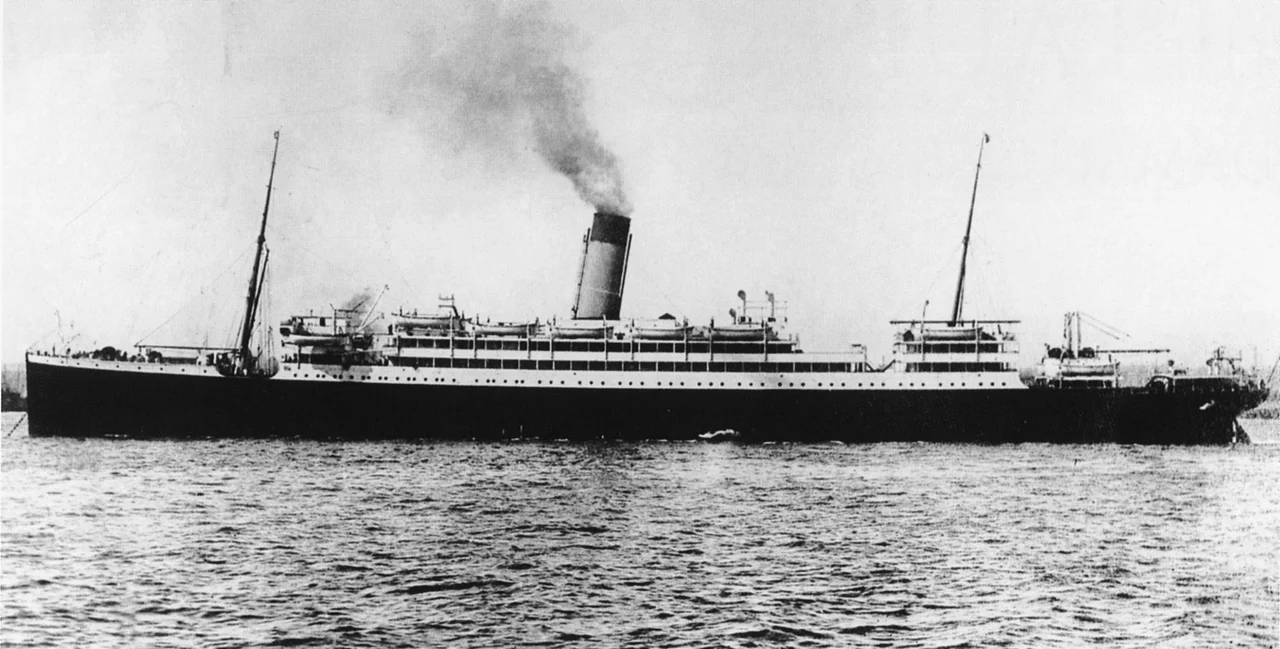

SS Laurentic
At seventeen hundred hours on 25 January 1917, the armed merchant cruiser SS Laurentic slipped out of Buncrana into a bitterly cold blizzard. There were warnings of a U-boat near the mouth of Lough Swilly. Her commander, Captain Reginald Norton, had been told to wait for a destroyer escort. He chose to sail anyway. Within an hour, Laurentic had struck two German mines off Fanad Head. She went down quickly. The crew abandoned ship in good order. Then, in lifeboats adrift in a winter Atlantic gale, three hundred and fifty-four men died of hypothermia. The ship carried forty-three tons of gold in her second-class baggage room. Most of it would eventually be recovered. The dead never were.
From Liverpool Liner to Armed Cruiser
Laurentic was built in Belfast by Harland and Wolff, launched on 10 September 1908, and completed the following April. She was an experiment: her two outer screws were driven by triple-expansion engines whose exhaust steam fed a low-pressure turbine driving the centre screw. The arrangement produced twenty percent more power than her sister Megantic for the same coal, and the design was adopted for the Olympic-class liners that followed. In peacetime she ran the route between Liverpool and Quebec for the White Star Line, carrying 1,660 passengers in three classes. In 1914, like so many merchant ships, she was requisitioned by the Royal Navy. First a troopship, then an armed merchant cruiser, she served off West Africa, Singapore, the Bay of Bengal, and the Far East before being assigned to Atlantic patrols.
The Lifeboats
The crew managed to launch their boats in time. They got off the ship. But the Atlantic in January, in a blizzard, off the cliffs of Fanad, is a killing environment. Three hundred and fifty-four men froze before help arrived. Many of those who reached the rescue ships died in the hours afterward. Seventy-one of the dead are buried in a mass grave in St Mura's parish churchyard at Fahan, on the Inishowen side of Lough Swilly. One body washed ashore on Heisker in the Outer Hebrides, a hundred and fifty miles north, and was buried there. A few were taken home to County Down, County Wicklow, Liverpool. Most of the dead have no grave but the sea. They are commemorated on Royal Navy memorials at Chatham, Plymouth, and Portsmouth. The survivors were given a civic reception in the Guildhall, Derry. Each man received a ten-shilling note and a packet of cigarettes.
The Gold
Laurentic was carrying 3,211 gold bars, about forty-three tons, payment for American war supplies. Within months the Royal Navy began salvage operations led by Captain Guybon Damant, a specialist in deep-water diving. Among his team was Petty Officer Augustus Dent, the ship's own diver, who had survived the sinking. They found the wreck listing sixty degrees to port. They blew open a watertight door with guncotton. A diver named E.C. Miller used a hammer and chisel to open the baggage room. In two days they raised four boxes, each worth about eight thousand pounds. Then a week-long gale crushed the wreck. When the divers returned, the entry port had sunk deeper, the companionway was squashed, and the gold was gone, scattered as the ship had collapsed onto itself.
Digging by Hand
Damant abandoned the original route. He directed his crew to blast away the mainmast and dig a vertical shaft down through five decks. Minesweepers in the area kept detonating loose German mines; one explosion gave a diver what Damant called a severe blow. By the end of 1917 they had retrieved 542 bars worth £800,000. The work ran for years. In 1922, with HMS Racer as their support ship, the divers settled into a method that should not have worked: they wore standard diving dress but kept their hands bare, plunging them into silt loosened by fire hoses, recognising gold bars by touch. They wore their fingertips raw. They worked from April to October. By the end of 1923, 1,255 bars had been brought up, worth nearly two million pounds. Each diver received half a crown bounty for every hundred pounds recovered.
What Remains
By 1924, when Damant was awarded the CBE, his team had recovered 3,186 of the 3,211 bars. Three more turned up in the 1930s through private salvage. Twenty-two are still down there, somewhere in the silt between Fanad and Malin Head. The wreck lies in Irish territorial waters and is protected by Irish law; divers need a licence. Time and currents have broken much of the ship apart, but her Scotch boilers are still recognisable. In 2007 a team of divers from Sheephaven Bay raised one of her six-inch guns and put it on display at the pier in Downings. In 2018 Derry City and Strabane District Council bought the ship's bell at auction and brought it to the Guildhall. The metal came home. The 354 men did not.
From the Air
Wreck site near 55.30N, 7.59W, between Fanad Head and Malin Head in northern County Donegal waters. Nearest airport is Donegal (EIDL) about 30 nm south-southwest. From altitude, look for the deep notch of Lough Swilly running south to Buncrana, with Fanad Head Lighthouse marking the western entrance and Dunaff Head the eastern. The Laurentic lies offshore in deep water, invisible from the surface, marked only on charts and in memory. North Atlantic conditions here are notoriously changeable; a clear Donegal day is rare and treasured.
Nearby Stories
- German submarine U-155 (1941) 7 km away
- Grianan of Aileach 8 km away
- Tory Island 8.9 km away
- Greencastle Lifeboat Station 9.2 km away
- Dungiven 12 km away
- The Rosses 21 km away
- German submarine U-1005 23 km away
- Bruichladdich Distillery 49 km away