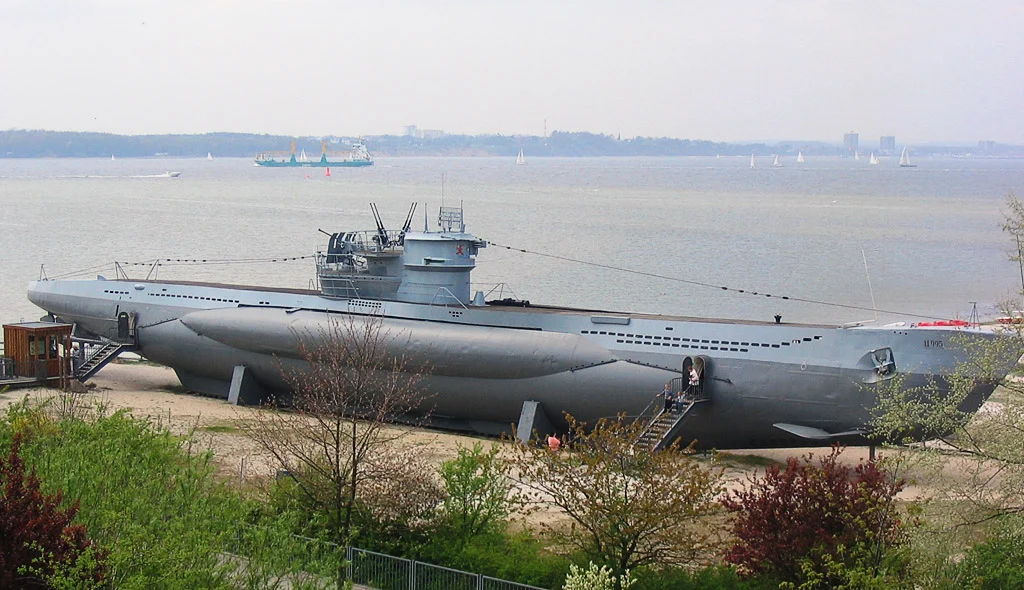

German submarine U-1005
The breathing tube changed everything for the last U-boats. Fitted with a Schnorchel sometime before February 1945, U-1005 could finally run her diesel engines while submerged, hidden from the radar-equipped aircraft that had killed so many of her predecessors on the surface. It came too late. By the time the device gave her some chance of survival, the Allies had won the Atlantic and the German war was weeks from collapse. She sailed two patrols. She found no targets. She surrendered at Bergen in May 1945 and was hauled to a Scottish loch to wait for the British to come and sink her.
Hamburg, 1943
Blohm und Voss laid down her keel on 29 January 1943 in Hamburg, a city that would be firestormed five months later by RAF Bomber Command - Operation Gomorrah, which killed 37,000 people in a single week. The shipyard kept building U-boats. U-1005 was yard number 205, a Type VIIC/41 - the improved variant of the workhorse design that had nearly strangled British shipping in 1940-42. She was 67 metres long, displaced 769 tons surfaced, could dive to 230 metres, carried fourteen torpedoes. By the time Oberleutnant Joachim Methner commissioned her on 30 December 1943, the wolfpack tactics that made the early Type VIIs so deadly had been beaten by Allied technology and tactics. New U-boats now died on their first patrols, often before they had fired a single torpedo.
The Snorkel Refit
Sometime before February 1945, U-1005 had a Schnorchel - a Dutch invention captured by the Germans and rapidly copied - installed in her conning tower. The device was a hinged tube that ran from the diesel engines to the surface, allowing the boat to recharge her batteries and run her engines while staying submerged. For the first time in U-boat history, a Type VII didn't have to surface every night. It was a major tactical leap. It was also, by 1945, far too late. Allied centimetric radar could detect even a snorkel head in moderate seas. Coastal Command aircraft were patrolling the Western Approaches in such density that surfacing for any purpose, even for a few minutes, was suicidal.
Two Patrols, No Sinkings
U-1005's two war patrols left no trace in the Allied shipping records. She sank nothing, damaged nothing, was sunk by nothing. What this meant in practice was long weeks submerged in cold, dark, foul-smelling air, the crew sleeping in shifts on damp bunks, listening for the propeller noise of escort vessels overhead. The interior of a Type VII was the size of a railway carriage filled with machinery, with no privacy, no shower, two toilets for forty-eight men. Crews returning from patrol had to be carried off their boats. U-1005 endured this twice and came home both times without firing a torpedo at anything that mattered.
Surrender at Bergen
On 14 May 1945, six days after the German surrender took effect, U-1005 hauled into Bergen, Norway, and gave herself up. Methner and his crew were processed, interned, and eventually sent home. The boat herself was transferred to Loch Ryan in Scotland on 2 June, joining the growing fleet of surrendered U-boats waiting for the Royal Navy to decide their fate. She was 116th in line - one of those selected for Operation Deadlight, the planned scuttling of the German submarine fleet in deep water northwest of Ireland. She would not have to wait long, but she would not reach the scuttling ground.
Foundered Under Tow
On 5 December 1945 the tug took up the cable and U-1005 began the last journey of her short, uneventful life. The North Atlantic in early December is the Atlantic at its worst - long, building swells, cold rain, gale-force winds rolling in from the southwest with no continent to break them. The cable parted. The U-boat, with no crew aboard to fight her flooding or run her pumps, simply foundered. She sits today on the Atlantic floor somewhere around 55.55 degrees north, 8.45 degrees west, one of fifty-six U-boats that went down under tow before reaching the formal scuttling area. The Battle of the Atlantic killed 783 German U-boats. Operation Deadlight killed 116 more after the war was over. U-1005's grave is one quiet entry on a very long list.
From the Air
Wreck site approximately 55.55°N, 8.45°W, west of County Donegal in the Operation Deadlight scuttling area. Recommended viewing altitude 4,000-6,000 ft. The Donegal coast lies 20 nm east as a visual reference; Aranmore Island can be made out on clear days. Nearest airport: Donegal Airport (EIDL), 18 nm east. The waters here hold dozens of U-boat wrecks at depths from 100 to 500 metres - too deep for recreational diving but charted by the Irish Naval Service and wreck researchers.
Nearby Stories
- ST Leukos 8.9 km away
- Battle of Tory Island 11 km away
- SS Devonian (1900) 17 km away
- SS Athelstane (1941) 19 km away
- Rosguill 25 km away
- RMS Empress of Britain (1930) 45 km away
- SS Polonia 72 km away
- Ballycastle, County Mayo 151 km away