
SS Devonian (1900)
The torpedo struck at 11:55 in the morning on 21 August 1917, hitting Devonian's port quarter and tearing open her number 6 and 7 holds. The ship's carpenter and his assistant died in the blast. Forty-eight kilometres off the north coast of Ireland, in a convoy of fifteen merchantmen escorted by Royal Navy submarines, a Harland and Wolff cattle liner that had spent seventeen years hauling livestock and horses between Belfast and Boston was about to become another casualty of unrestricted submarine warfare. Devonian had survived two harbour fires, rescued seventy-five strangers from burning ships in the open Atlantic, and ferried thousands of horses to the Western Front. She had less than an hour left.
Built for Cattle and Crossing
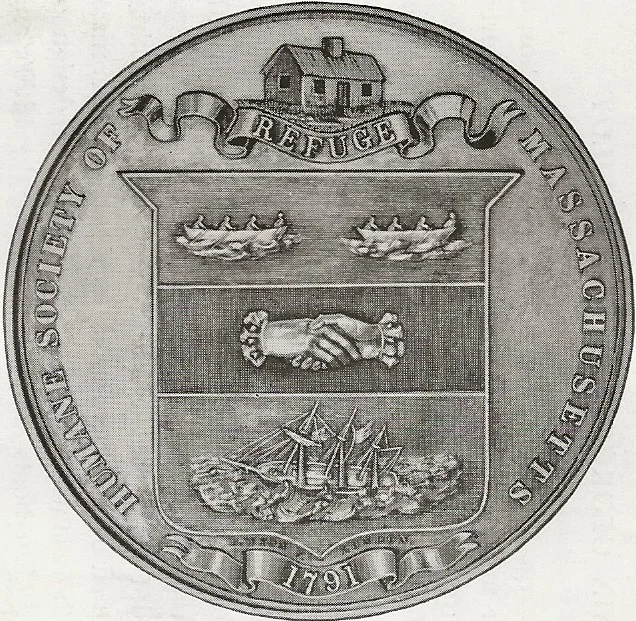
Harland and Wolff in Belfast launched Devonian on 28 April 1900 as yard number 331, completing her on 6 September for Frederick Leyland and Co. She was a working ship: eight cargo hatches, capacity for 900 head of cattle plus 125 passengers in second-class accommodation. As built, only 8,640 cubic feet of her hold was refrigerated; her career would see that capacity expand twice as the refrigerated meat trade transformed transatlantic shipping. Her usual route ran Liverpool to Boston, hauling Egyptian cotton, grain, and live animals across the North Atlantic. In February 1906, blinded by snowstorm and unable to see Minot's Ledge Light, she overshot Boston Harbor and grounded on rocks off Scituate, Massachusetts. Captain Ridley closed her watertight doors, swung out her lifeboats, and fired a Coston flare. The Massachusetts Humane Society life-saving station saw the signal. The crew chose to stay aboard. She came off the rocks alive.
Fire and Rescue
Devonian had a complicated relationship with fire. In March 1907, six railroad cars' worth of baled hay loaded as cattle feed ignited in her number 4 hold while she was docked at Charlestown, Boston. The fire ruined 20,000 bushels of corn and an unloading hose burst, drenching the Egyptian cotton with water and the firefighters with bad luck. In July 1908, fire broke out on a Boston and Albany Railroad pier next to her own dock in East Boston, fanned by a northerly wind. Within half an hour it destroyed four 800-foot piers, three warehouses, a grain elevator, and many freight cars. A 70-year-old watchman at the Cunard Line pier died. Devonian survived by being warped away from the wharf in time. Then came the rescues. In 1910 she pulled sixteen survivors from the burning cargo ship West Point off Cape Race. In 1913 she towed the disabled French cargo liner Mexico 400 nautical miles to Halifax, the salvage value reportedly more than a million dollars.
The Volturno
The Volturno was an emigrant ship sailing from Rotterdam to New York via Halifax when fire broke out in her forward holds on the morning of 9 October 1913. She broadcast a distress signal, and Devonian was one of ten or more ships that converged on her position. Volturno launched six lifeboats; four were smashed against her side and the other two were lost. Through the night the rescue ships waited for the sea to calm. The next morning, an oil tanker arrived and poured oil onto the waves to moderate them - a desperate measure that worked. The rescue ships sent their boats across, and Volturno's crew lowered women and children to them in coal baskets. Devonian's lifeboats brought back fifty-nine survivors: twenty-one children, twenty women, eighteen men. She landed them at Liverpool five days later, where they would resume their journey to America aboard the Cunard liner Carmania. The Liverpool Shipwreck and Humane Society awarded Captain Trant of Devonian its Gold Marine Medal.
The War Years
When the First World War began, Devonian carried her last load of civilian passengers, 150 Americans fleeing Europe, into Boston in September 1914. After that, the trade changed. In 1915 alone she shipped 1,100 horses in February, 1,000 in March, and another 1,017 in April, all bound for British cavalry on the Western Front. Stewardess Annie Robinson, who had survived the sinking of the Titanic three years before, was a passenger on Devonian's October 1914 westbound crossing. As the ship felt its way through thick fog with the foghorn sounding, the memory became unbearable. She jumped overboard and drowned. In September 1916, a 4-inch gun was mounted on Devonian's poop deck, with two Royal Navy gunners assigned. In November, hold-fumigation gas killed three carpenters in Boston after the port health authorities incorrectly cleared the ship as safe.
Buncrana
On 21 August 1917, U-53 torpedoed Devonian as she sailed in convoy from Liverpool toward Boston. The refrigerated cargo ship Roscommon, struck minutes earlier, sank within minutes. British submarines and aircraft engaged the U-boats while Devonian launched eight of her remaining lifeboats and her crew waited. A tug and a trawler pulled survivors from the water, then took off Captain Trant and the dozen men who had stayed with the ship. She went down at 12:45, less than an hour after the torpedo struck. The survivors were landed at Buncrana on the Inishowen peninsula. Devonian had been valued at more than a million dollars. The wreck still lies somewhere off the Donegal coast, one of countless merchantmen whose names are barely remembered now - except by the people in Boston and Halifax and Liverpool whose great-grandparents stepped off her decks alive when they might otherwise have drowned.
From the Air
Approximate wreck position 55.49 degrees N, 8.02 degrees W, about 38 nautical miles off the north coast of Ireland in the open Atlantic. Best viewed at 3,000 to 5,000 feet AGL when overflying for sense of scale; nothing visible at the surface. Survivors were landed at Buncrana on the Inishowen Peninsula. Nearest airport is Donegal Airport (EIDL) at Carrickfinn, about 50 km southeast. City of Derry Airport (EGAE) sits roughly 65 km east. Open-Atlantic weather can be poor with strong westerlies and rapidly closing visibility.
Nearby Stories
- Ards Forest Park 4.7 km away
- German submarine U-218 5.3 km away
- German submarine U-244 7.7 km away
- German submarine U-1005 10 km away
- HMS Wolverine (1910) 16 km away
- Proxy Bomb 18 km away
- SS Athelstane (1941) 33 km away
- Bruichladdich Distillery 64 km away