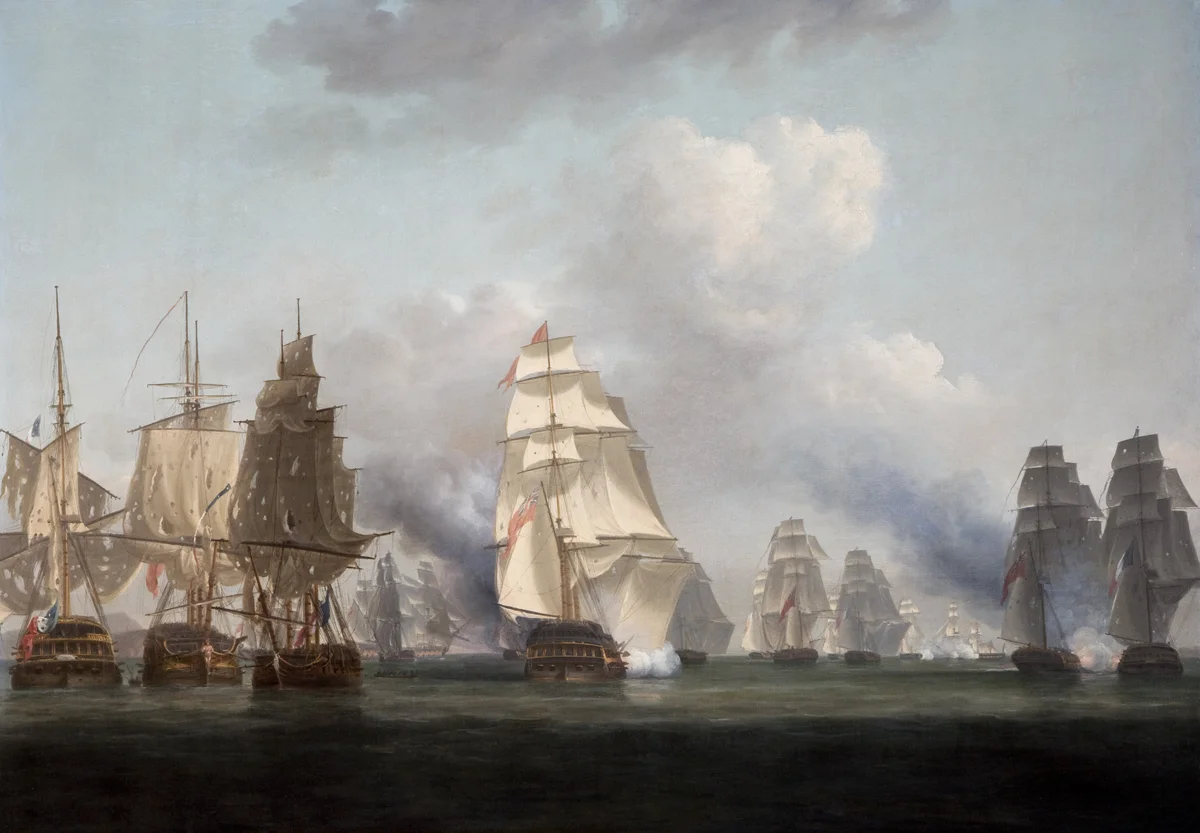

Battle of Tory Island
Wolfe Tone watched the chase from the deck of the Hoche. He had spent seven years - in Dublin, in Paris, in front of every French official who would listen - building toward this moment. A French army on Irish soil. An end to British rule. Behind him, his flagship was already crippled, her topmasts blown down in the gale of the night before, her rigging in tatters. Ahead, the British squadron under Sir John Borlase Warren was closing fast off the rugged Donegal coast, very near a small granite island called Tory. On 12 October 1798, the last hope of the United Irishmen would die in the saltwater off County Donegal. And Tone would be taken alive.
The Lawyer Who Went to France
Theobald Wolfe Tone was a Dublin lawyer who had read his Paine and his Rousseau and concluded that liberty, equality, and brotherhood meant the same thing in Cork as in Marseille. In 1791 he co-founded the Society of United Irishmen, an alliance of Protestants, Catholics, and Dissenters demanding parliamentary reform and an end to religious discrimination. When Britain went to war with revolutionary France in 1793, the society was suppressed. Tone went underground, then went to France, then began the work of his life: convincing the French government that Ireland was Britain's weakest point, and that 25,000 French soldiers landed at the right spot would set the whole country aflame. He nearly succeeded - twice.
Two Earlier Catastrophes
The Expedition d'Irlande sailed in December 1796 under Admiral Morard de Galles: seventeen ships of the line, twenty-seven smaller vessels, up to 25,000 men. The fleet reached Bantry Bay. The weather did not let them land. After a week of contrary gales, 13 ships were lost and over 2,000 men drowned, and not a single French soldier set foot on Irish soil. In August 1798 a much smaller force under General Humbert landed at Killala in Mayo - 1,150 troops, brought ashore by Daniel Savary's frigates flying false British colours. Humbert won a remarkable victory at Castlebar but was crushed at Ballinamuck three weeks later. He surrendered on 8 September. The rebellion was over before the third French expedition even sailed.
Bompart's Doomed Squadron
Commodore Jean-Baptiste-Francois Bompart left Brest on 16 September 1798 with the ship of the line Hoche and eight frigates and a schooner - 3,000 French troops aboard, Tone among them, bound for Lough Swilly to support an Irish uprising that had already been crushed. They did not know it. The Royal Navy did. Captain Richard Keats spotted them at dawn on 17 September and dispatched two frigates, Ethalion and Sylph, to shadow the French while he warned the Channel Fleet. For three weeks Captain George Countess on Ethalion stayed glued to Bompart's wake while the French tried every trick to shake him - feinting south to suggest a Caribbean destination, scattering at night, running before storms. None of it worked. By 11 October Warren's squadron had joined the chase. On the morning of the 12th, Bompart looked out from Hoche's quarterdeck and saw three ships of the line and several frigates bearing down on him.
Hoche Surrenders
The gale of the previous night had already done half of Warren's work. All three of Hoche's topmasts were down. The frigate Resolue was leaking badly. Bompart formed his battered squadron into line and turned to fight. At 0850 Captain Edward Thornbrough on HMS Robust closed with Hoche and began a close-range artillery duel. Magnanime joined minutes later. The other British ships passed Hoche and engaged the French frigates ahead. By 1050 - two hours of point-blank gunnery - Hoche was a wreck. Bompart surrendered with 270 of his crew and passengers dead or wounded. The frigates Bellone, Coquille, Embuscade, and Immortalite were captured separately over the following ten days. Of the ten French ships, only two frigates and the schooner Biche reached safety. British losses were minimal. The last French attempt to invade any part of the British Isles ended in the wind-whipped sea off a Donegal island most British sailors had never heard of.
Tone in the Inkwell
When Hoche was boarded, a French officer with red hair and a polished manner stepped forward. He gave his name as Adjutant-General Smith. An old acquaintance, Sir George Hill, was waiting at Buncrana when the prize was brought into Lough Swilly. Hill recognised Tone instantly. The pretence collapsed. Tone was put in chains and sent to Dublin for trial. He asked, as a French officer, to be shot like a soldier rather than hanged like a criminal. The British refused. Hours before he was to die on the gallows, Tone cut his own throat with a penknife in his Dublin cell. He died in agony a week later, on 19 November 1798, aged 35. The United Irishmen were finished. The Act of Union followed two years later. Wolfe Tone became Ireland's secular martyr, his Bodenstown grave a place of pilgrimage for two centuries of Irish nationalists. The granite of Tory Island still watches the sea where his last gamble was lost.
From the Air
Battle site approximately 55.30°N, 8.50°W, in the bay between Tory Island and the Donegal mainland, with the rugged Bloody Foreland to the south. Recommended viewing altitude 5,000-8,000 ft to take in Tory's distinctive elongated profile and the open sea where Warren's squadron closed from the northeast. Nearest airport: Donegal Airport (EIDL), 25 nm south-southeast. The Atlantic here is often whipped by the same kind of gale that broke Hoche's topmasts. Tory Island is now home to an Irish-speaking community of about 140 people.
Nearby Stories
- Arranmore 6.2 km away
- Glenveagh National Park 6.5 km away
- German submarine U-1005 10 km away
- Ards Forest Park 18 km away
- German submarine U-155 (1941) 28 km away
- RMS Empress of Britain (1930) 44 km away
- ST Leukos 45 km away
- Ballycastle, County Mayo 83 km away