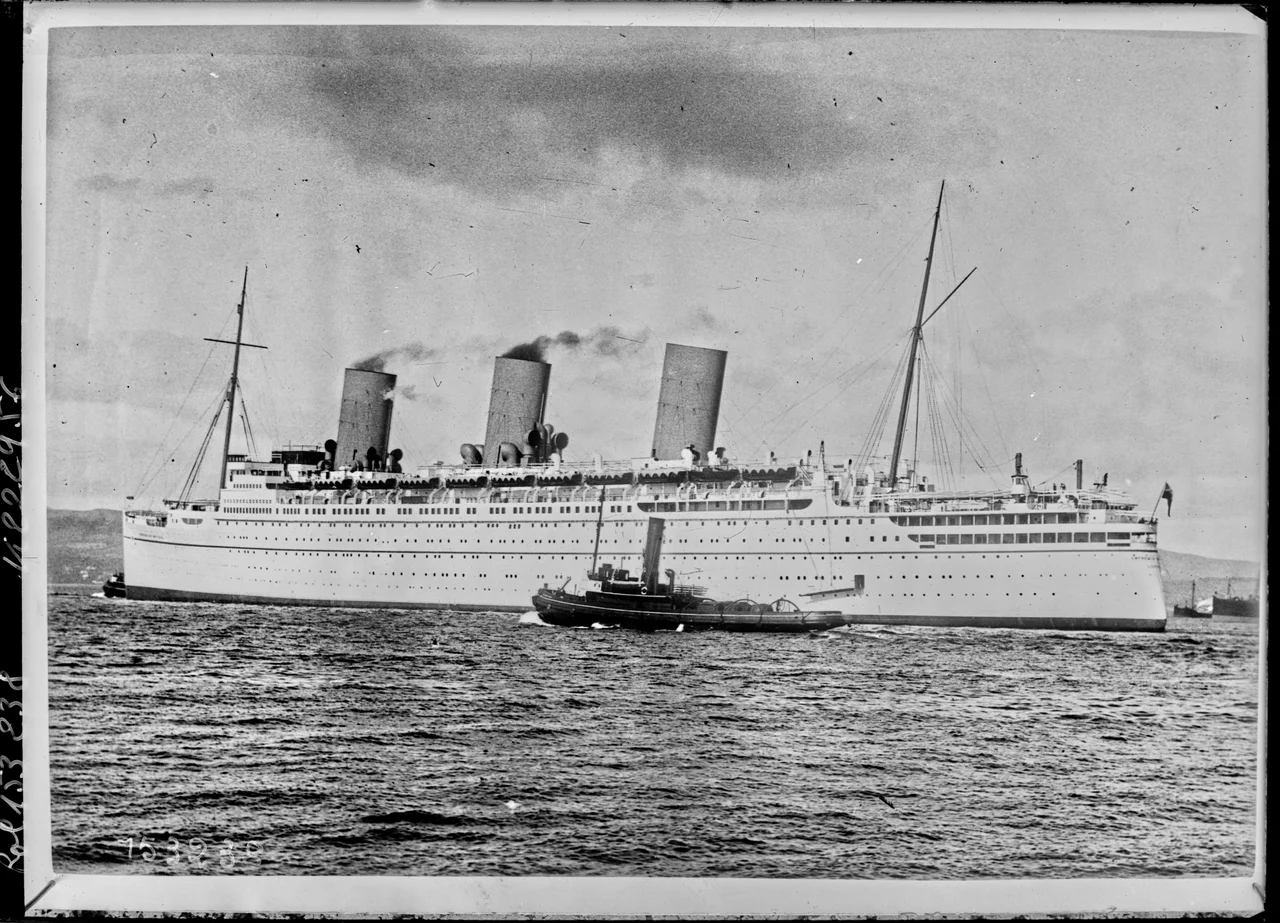

RMS Empress of Britain (1930)
On the morning of 26 October 1940, a German Focke-Wulf 200 Condor banked out of the clouds about seventy miles northwest of Ireland and found the RMS Empress of Britain alone on the grey Atlantic. She was the largest, fastest, and most luxurious ocean liner Canadian Pacific had ever built, requisitioned now as a troopship and painted naval grey. Oberleutnant Bernhard Jope, the Condor's pilot, did not at first know what he had spotted. He strafed her three times and put two bombs into her midsection, then turned for his base in occupied France. By the time he landed, fires were spreading through her decks. Two days and one U-boat later, she was gone.
The Five Day Atlantic Giantess
Her keel was laid at John Brown & Co. in Clydebank in November 1928. The Prince of Wales launched her on 11 June 1930, in the first British shipyard ceremony ever broadcast by radio to Canada and the United States. She entered service in May 1931, and Canadian Pacific advertised her shamelessly as the 'Five Day Atlantic Giantess,' 'Canada's Challenger,' the 'World's Wondership.' She carried 1,195 passengers in three classes between Southampton and Quebec from spring to autumn, and converted each winter into a 700-passenger luxury cruise ship for round-the-world voyages. She was built small enough to thread the Panama and Suez canals, with only a few feet of clearance through the Panama locks. Her three funnels were illuminated at night by floodlights so powerful she could be seen fifty miles away by aircraft and thirty miles by ships.
Apartments Instead of Cabins
She was a creature of the early thirties, all art deco grandeur and Cunard-rivalling luxury. Twelve steam turbines drove her four propeller shafts. Nine boilers, the first of their kind to combine eight Yarrow units with an experimental Johnson boiler, supplied her steam. The two inboard propellers carried two-thirds of her power. Her hull plating was double-thick at the bow because her northerly route brought her past Newfoundland ice. The Toronto Globe, in an editorial as she sailed her maiden voyage, called her 'a historic event in the record of Canadian advancement.' Each suite had a radio. One whole deck was devoted to sport and recreation. The first-class lounge was decorated by world-famous artists. She made nine round trips in her first season, carrying 4,891 passengers westbound. Then she sailed on her first 128-day world cruise, visiting the Mediterranean, India, Ceylon, Southeast Asia, China, Hong Kong, Japan, Hawaii, California, and back through Panama. She was, by all accounts, the loveliest ship on the run.
Grey Paint
On 25 November 1939, she was requisitioned as a troopship. The art deco lounges were cleared. She was painted grey. She made four transatlantic trips moving Canadian troops to England, then ran out to Wellington, New Zealand. She returned to Scotland in June 1940 as part of what the British press called the 'million dollar convoy,' a flotilla of seven luxury liners now hauling soldiers. In August 1940 she made a run to Suez via Cape Town. By October she was carrying 205 passengers and 419 crew on her return leg. Captain Charles Sapsworth had been at her wheel for years.
Condor and U-Boat
When Jope's Condor came down through the morning cloud, he hit her with two 250-kg bombs and ten machine-gun strafing runs. Fires took hold quickly in the midsection. At 9:50 am Captain Sapsworth ordered abandon ship. The fires blocked the boats amidships, so passengers and crew had to make for the bow and stern, which slowed evacuation badly. Most of the 205 passengers, 2 gunners, and 416 crew were eventually picked up by destroyers Echo and Burza and the anti-submarine trawler Cape Arcona. Forty-nine people did not survive: passengers and crew who were killed in the bombing or died in the chaos of evacuation. A skeleton crew of about 70 stayed aboard once the fires were partly contained, to attach tow lines from the oceangoing tugs Marauder and Thames. Short Sunderland flying boats provided air cover during daylight. The hulk was being towed slowly toward port. Then U-32, commanded by Hans Jenisch, found them by hydrophone after dark on 27 October. He worked his boat between the zigzagging destroyer escort and the burning liner, and fired two torpedoes. The first detonated prematurely. The second hit and triggered a massive explosion, probably as the liner's burning interior reached her fuel tanks. A third torpedo followed. At 2:05 am on 28 October 1940, Empress of Britain went down northwest of Bloody Foreland, County Donegal. She was the largest ship ever sunk by a U-boat. She remains so.
The Skeleton in the Bullion Room
The British Empire was moving gold across the Atlantic throughout 1940 to pay for war supplies, and Empress of Britain had recently been in Cape Town. The persistent rumor that she went down with a fortune in gold proved partly true and mostly not. Salvagers found the wreck in 1995, upside-down on the seabed. Saturation divers worked their way into what remained of her hull. Fire had eaten most of her interior decks, leaving a largely empty shell. The bullion room was intact. Inside the bullion room they found a human skeleton, but no gold. The Department of Transport had stated in 1985 that any gold had been recovered, possibly unloaded during the evacuation or by a wartime salvage operation. The body was probably someone involved in that operation, sealed in by accident or by collapse. He has not been identified. Hans Jenisch survived the war; Bernhard Jope survived the war; Captain Sapsworth survived the war; the man in the bullion room did not. None of the gold went down with her. She did.
From the Air
Wreck site at approximately 55.27°N, 9.83°W, northwest of Bloody Foreland, County Donegal, on the seabed in deep water. Best appreciated at 5,000-8,000 feet from offshore, looking at the empty horizon where she went down. Nearest airport is Donegal (EIDL), 50 km southeast. There is nothing to see at the surface; the wreck lies in deep water 70 miles offshore. This is open Atlantic; weather can be severe.
Nearby Stories
- HMS Wolverine (1910) 32 km away
- German submarine U-1233 37 km away
- Arranmore 39 km away
- ST Leukos 52 km away
- Glencolmcille 70 km away
- Action of 7 May 1794 77 km away
- Inishkea Islands 128 km away
- The Laki Eruption: The Volcano That Changed World History 1047 km away