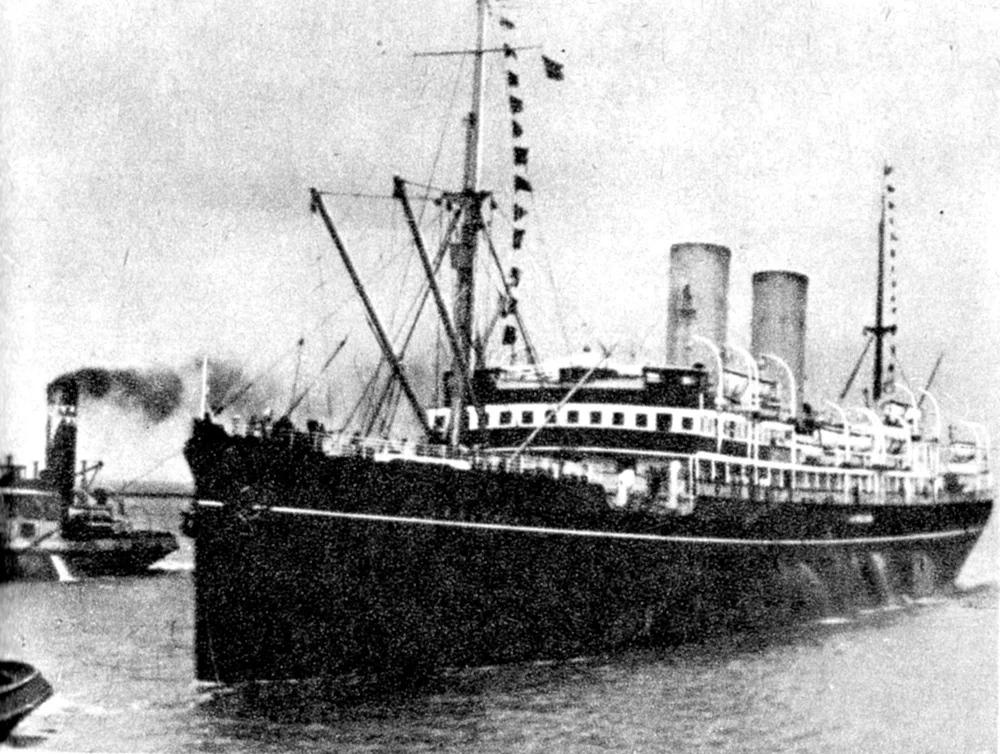

SS Polonia
She was launched in July 1910 as Kursk, registered in a Russian Empire that would not survive her first decade afloat. By the time she went to the breakers in 1939, she had carried three names, three flags, and the troops of an empire that no longer existed. The Polonia was an ordinary ship that lived through an extraordinary stretch of history, and for much of it she steamed past Barra Head Lighthouse, southbound on the great-circle track between Northern Europe and the Atlantic world.
Glasgow Iron
Barclay, Curle & Co. on the River Clyde built her as yard number 482, launched on 7 July 1910 and complete by September. She was 450 feet long, with a 56-foot beam, and powered by twin four-cylinder quadruple-expansion engines driving twin screws. The numbers read like an engineer's poem: cylinders of 33, 47, and 68 inches, fed by six single-ended boilers at 215 pounds per square inch, heated by eighteen corrugated furnaces. Together the engines produced 1,020 nominal horsepower. The Clyde was then the world's premier shipbuilding river, and Barclay Curle was one of its veterans. The Danish East Asiatic Company placed the order. They registered her in Liepaja, a Baltic port then inside the Russian Empire, and named her for the city of Kursk in western Russia.
A Troopship in the Great War
When the First World War tore through the shipping lanes, the British Shipping Controller chartered Kursk and placed her under Cunard Line management. She became one of the countless Allied troopships moving men across oceans they had never expected to cross. The October Revolution of 1917 ended Russian imperial ownership in everything but paper. By 1920 she had been returned to the East Asiatic Company, but the world she returned to was not the one she had left. She was renamed Polonia, the Latin name for Poland, and she began a second life carrying passengers between Liepaja and the ports of the new interwar order.
From Latvia to Poland
In 1930 the East Asiatic Company sold its Latvian subsidiary to Polish owners, who renamed the firm Polskie Transatlantyckie Towarzystwo Okretowe, the Polish Transatlantic Shipping Company. The ships were operated by Gdynia America Line, which restructured in 1934. Polonia carried Polish emigrants, families chasing better lives across the Atlantic, the way countless ships had carried countless families before. Gdynia America Line modernised quickly with new motor ships in 1935 and 1936. Polonia, by then twenty-six years old, was no longer competitive on the premier transatlantic run. She was sold to Francesco Pittaluga in Savona, Italy, for scrap on 5 March 1939, just months before Germany invaded Poland and ended the company's brief modern era.
Quiet Ship, Loud Century
Polonia never made headlines. No sinking, no rescue, no celebrity passenger. She was workaday tonnage, the kind of ship that builds and sustains empires without anyone noticing. But trace her register and you trace the convulsions of twentieth-century Europe. Russian Empire to Soviet aftermath. Independent Latvia to Polish acquisition. Allied troopship to emigrant carrier. Sold to Italy for scrap weeks before the next war began. Off Barra Head, where her wake once disturbed the long Atlantic swell, only the lighthouse keepers might have noted her passing. Three names, three flags, one hull, and a quiet exit just before the storm.
From the Air
Approximate site near Barra Head at 56.38 N, 7.32 W, in the Atlantic approaches west of the Outer Hebrides. This is open ocean south of Mingulay, on the southern approach to The Minch. Recommended viewing altitude 3,000-5,000 ft for sea-state observation. Nearest airports are Barra (EGPR) about 40 nm north and Benbecula (EGPL) about 90 nm north. The Atlantic here is exposed and weather changes quickly.
Nearby Stories
- Coll 7.8 km away
- Oronsay 28 km away
- Barra Head 33 km away
- SS Athelstane (1941) 40 km away
- SS Justicia 56 km away
- German submarine U-994 74 km away
- St Kilda, Scotland 144 km away