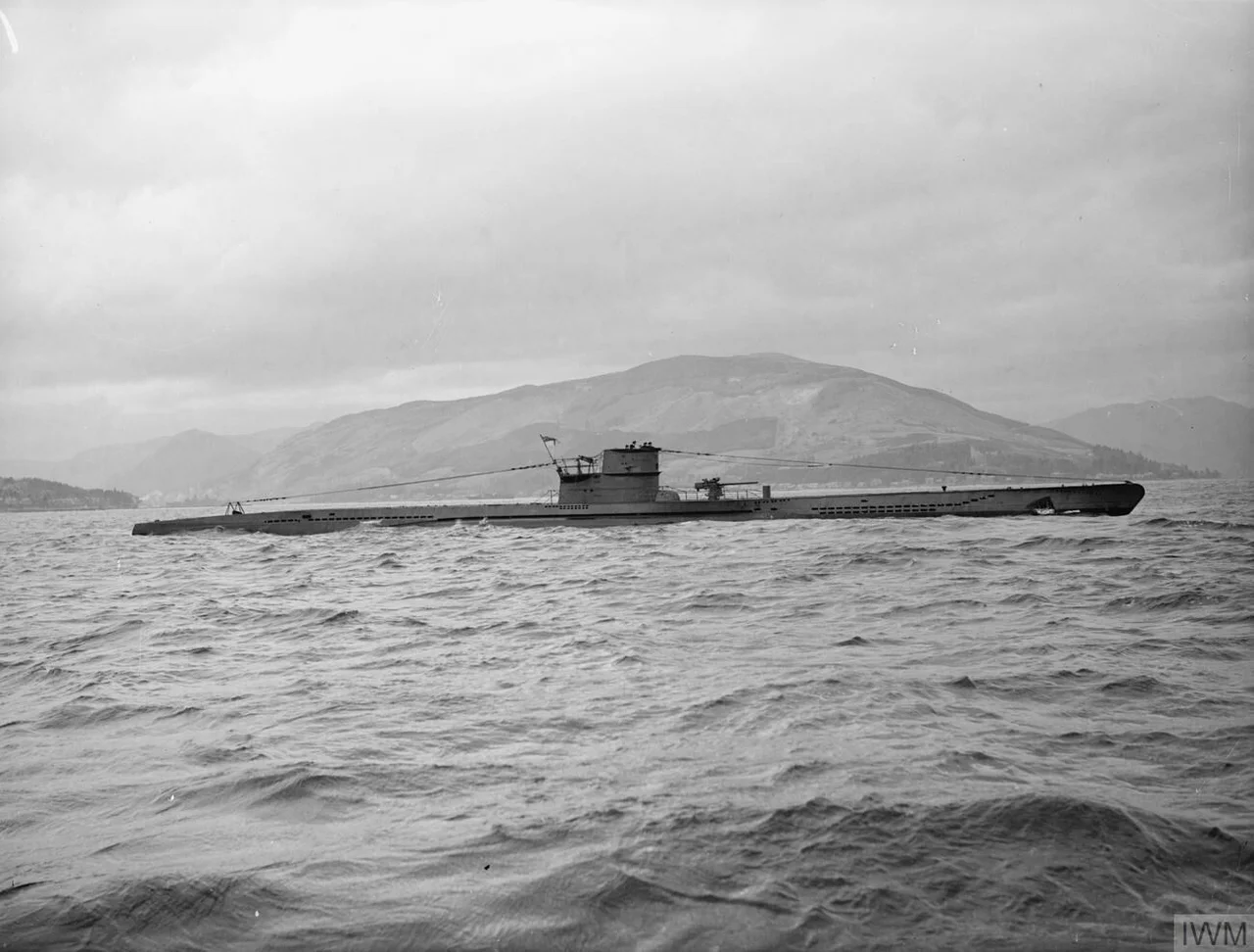

German submarine U-994
Wolf Ackermann was 23 years old when he took command of U-994 in September 1943 - a Leutnant zur See given a war machine with 44 men aboard and an average crew life expectancy in 1944 of about 60 days. He brought her through one war patrol, survived an air attack on the way home that wounded five of his men, and surrendered her at Trondheim in May 1945. The boat herself died seven months later, foundered under tow while the Royal Navy was trying to drag her out to deep water for a planned scuttling. She joined 55 other U-boats that never reached the official Operation Deadlight area.
Hamburg, July 1943
Blohm und Voss built her, the same Hamburg yard that built U-1005. Her keel was laid on 14 November 1942 as yard number 194. She was launched on 8 July 1943 - five days before the Hamburg firestorm, when RAF bombers dropped 8,300 tons of explosives in a week and killed 37,000 people. The shipyard survived. The U-boat production line never paused. She was commissioned on 2 September 1943 under Wolf Ackermann, a young officer in a service that had already begun losing experienced commanders faster than it could replace them. The Type VIIC by autumn 1943 was the most-built submarine in history, and her crews were dying in numbers that the Kriegsmarine could no longer hide from itself.
The Norwegian Mosquito
U-994 made one war patrol. On 17 July 1944, as she was returning to base, a single de Havilland Mosquito from No. 333 (Norwegian) Squadron RAF found her on the surface and attacked. The Mosquito was an all-wood twin-engine aircraft - so fast that for much of the war it could outrun German fighters - and No. 333 was the squadron of Norwegian exiles who flew anti-shipping patrols over their occupied country. Cannon fire raked the U-boat's conning tower. Five of Ackermann's men were wounded. The boat itself was damaged but stayed afloat. Ackermann limped into Bergen later the same day, unloaded his casualties, and put U-994 into the dock for repairs. That was her entire combat career. One patrol. One Mosquito. Five wounded sailors. No targets sunk.
Trondheim Surrender
On 9 May 1945, the day after the European war ended, U-994 surrendered at Trondheim in central Norway. Trondheim had been one of the largest U-boat bases outside Germany, with a vast bunker complex called DORA that the Allies could not destroy with conventional bombs. (Most of it still stands today, repurposed as commercial archive storage; the concrete is too thick to economically demolish.) Ackermann handed over his boat and his crew. They were processed, interned briefly, and sent home. The boat herself was moved to Loch Ryan in Scotland on 29 May, where she joined the gathering fleet of surrendered submarines waiting for Operation Deadlight.
Foundered in the Atlantic
Of the 156 U-boats that surrendered, 116 were assigned to Deadlight - the deliberate scuttling programme that would erase the German submarine force from the world's oceans. U-994 was towed out from Loch Ryan on 5 December 1945. She foundered before reaching the scuttling ground - one of fifty-six U-boats that simply sank under tow when the cable parted or the hull flooded faster than anyone expected. The North Atlantic in early December has no patience for derelict boats. The Royal Navy tugs made what attempts they could to refloat or recover them, but for most, including U-994, the sea took the decision out of human hands.
What She Left
She rests today on the muddy Atlantic floor somewhere around 55.83 degrees north, 8.50 degrees west - one neighbour among many in the densely populated U-boat cemetery off Donegal. Her wreck has been located on side-scan sonar by maritime archaeologists tracking the Operation Deadlight boats. Her hull is mostly intact, sitting upright in roughly 200 metres of water. Wolf Ackermann survived the war. So did the 49 men he commanded on her single patrol. Their boat had spent most of her commissioned life in dock, on training exercises, or running from Allied aircraft. She had killed no one. The Mosquito that wounded her crew flew home, the Norwegian airmen aboard returning eventually to a country liberated by the same Allied effort that had defeated the U-boat fleet.
From the Air
Wreck site approximately 55.83°N, 8.50°W, in the Operation Deadlight area west of County Donegal. Recommended viewing altitude 4,000-6,000 ft. The Donegal coast lies 25 nm east as a visual reference, with Bloody Foreland and Aranmore Island visible on clear days. Nearest airport: Donegal Airport (EIDL), 25 nm east-southeast. The seabed beneath here holds the largest concentration of submarine wrecks in the world - a quiet aftermath of the war that nearly strangled Britain.
Nearby Stories
- SS Devonian (1900) 7.7 km away
- ST Leukos 17 km away
- German submarine U-516 24 km away
- Battle of Tory Island 28 km away
- SS Justicia 34 km away
- RMS Empress of Britain (1930) 54 km away
- SS Polonia 59 km away
- The Laki Eruption: The Volcano That Changed World History 1020 km away