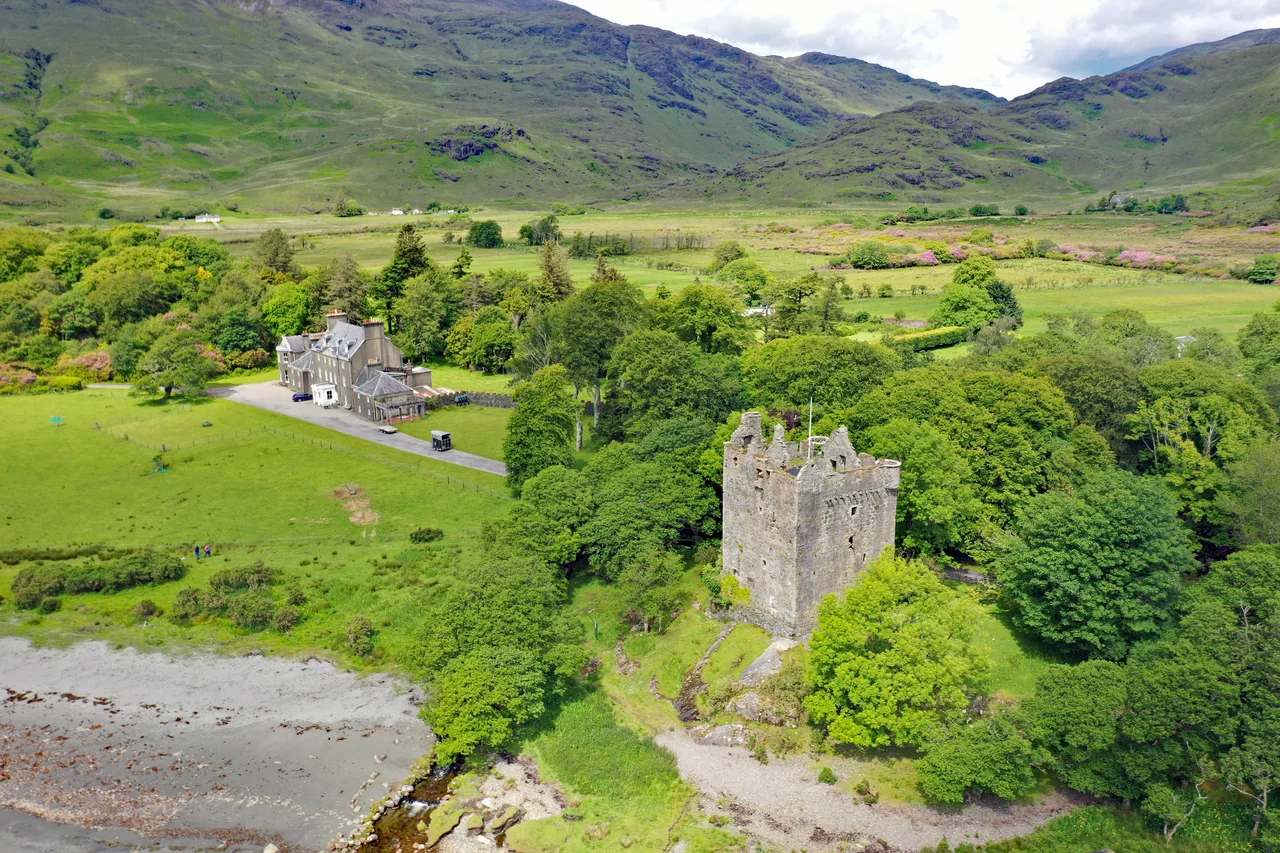

Moy Castle
The walls still rise to gable height. The crenellated parapet is mostly intact. A ground-floor well still holds water. What is missing is the roof, which has been gone for nearly three hundred years, and most of the people who once knew this building from the inside, who have been gone almost as long. Moy Castle stands above Lochbuie on the southern coast of Mull, a three-storey tower house of stone built in the early fifteenth century. It is a scheduled monument now, which means the law protects what remains. Between 2006 and 2015 conservation engineers stabilised the masonry; further work continues. A castle that was abandoned in 1752 is, by 2026, more carefully looked after than at any time since the Macleans left.
The Charter and the Brothers
Two Maclean brothers built the empire that produced Moy Castle. Lachlan Lubanach Maclean took Duart on Mull's east coast. His brother Hector Reaganach Maclean received the lands at Lochbuie, granted to him in 1360. The construction of Moy Castle probably began under John Maclean, the third Laird of Lochbuie, and was completed by his son Hector, the fourth Laird. The first surviving documentary mention of the castle is a royal charter dated March 1494, in which John Maclean, the fifth Laird, holds his lands from the Lord of the Isles. By then the building was already perhaps a century old. The Lord of the Isles was the semi-independent ruler of the Hebrides, a Gaelic kingdom that operated effectively as a separate power until the Scottish Crown forfeited the title in 1493. Moy Castle was built into that older Hebridean world, when sea lochs were highways and royal authority arrived by ship if it arrived at all.
Tower House Architecture
Moy is a tower house, the dominant defensive form of late-medieval Scotland. The plan is compact: three storeys and an attic, contained within walls thick enough to absorb most direct attack. Most of the surviving stonework dates to the early fifteenth century, with later alterations from the end of the sixteenth. The walls survive to the height of the gables and parapet. The crenellated parapet and the remains of two cap-houses, the small turret rooms at the upper level, still stand. A small enclosure or barmkin on the southeast side once served as a courtyard for animals and visitors. The well in the ground floor was essential, providing water during siege. The Macleans of Lochbuie were not the most powerful Hebridean clan, but Moy was a substantial seat: solid enough to hold against feuding neighbours, comfortable enough to occupy as a family home for three and a half centuries.
Captured and Returned
The castle was taken at least once by Clan Campbell, the rising power of the western Highlands, before being returned to the Macleans. The seventeenth century brought the Campbells repeated dominance over their Maclean neighbours, both militarily and through legal acquisition of debts. The Macleans of Lochbuie kept Moy through most of these conflicts, though not without losses. By the mid-eighteenth century the tower house was outdated. Comfort had moved on. Defensive considerations had eased. In 1752 the family abandoned Moy and built a new house nearby. The castle was left to weather. For the next 250 years it slowly lost its roof timbers, its floors, its window glass. The stone shell remained because stone outlasts neglect when nothing actively dismantles it. The remains of cap-houses at the parapet still mark where the family once watched their loch.
I Know Where I'm Going
Moy Castle appears in the 1945 Powell and Pressburger film I Know Where I'm Going!, where it serves as the supposedly cursed castle that the heroine cannot enter until she has matured emotionally. The film's directors, Michael Powell and Emeric Pressburger, used Mull and the Sound of Mull for their location work, and the gnarly silhouette of Moy provided exactly the romantic ruin the script required. Sixty years later, in 2005, the Oban Times noted the film's anniversary and the renewed interest it brought to the castle. By then conservation work was actively underway. The castle is described in the Wikivoyage guide to Mull as an impressive tower but unsafe to enter; visitors approach but do not go inside. The walls hold the building together. Engineers monitor the stones. A castle built for a clan that no longer governs continues to exist because Scotland decided it should.
From the Air
Coordinates 56.355°N, 5.859°W on the south coast of Mull at the head of Loch Buie. Best viewed at 800-1,500 feet AGL approaching from the south, with the roofless tower house standing on the shoreline, Loch Buie reaching inland and the Lochbuie Standing Stones visible nearby. Nearest airports: Glenforsa Airfield (grass) 12 nm north on Mull, Oban (EGEO) 20 nm east on the mainland, Tiree (EGPU) 40 nm west. The Ross of Mull cliffs and Atlantic exposure to the south can produce sudden weather changes.
Nearby Stories
- Iona Abbey 3.9 km away
- Loch Awe 5.8 km away
- Cowal 11 km away
- Ballachulish 12 km away
- Coll 15 km away
- Tobermory Lifeboat Station 16 km away
- Colonsay 26 km away
- Bruichladdich Distillery 34 km away