
Ballachulish
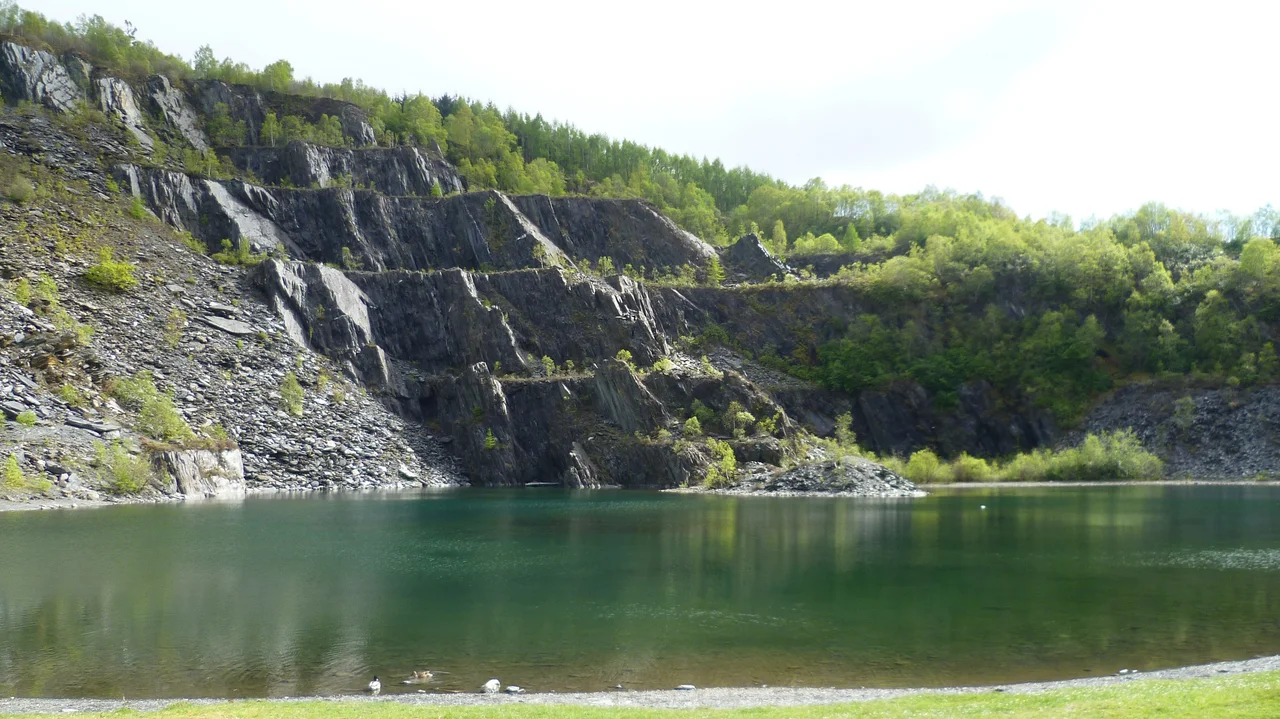
In 1693, slate quarrying started at East Laroch, exactly one year after the Glencoe Massacre had reordered who lived in the surrounding glens. For the next two and a half centuries the Ballachulish slate roofed much of Edinburgh and Glasgow. By the time the quarries closed in 1955 they had cut so much rock that the mountains around the village were ringed with waste tips. The slate also has a quiet tell: pyrite crystals embedded in the rock rust and fall out when exposed to weather, leaving clean square holes and brown streaks. Over three-quarters of what came out of the ground was never usable. Look at a Victorian Edinburgh roof and the slate is from here. Look at the holes where pyrite used to be.
Village by the Narrows
In Gaelic, Baile a' Chaolais means the village by the narrows, and the narrows in question are Caolas Mhic Phadraig, Peter or Patrick's son's narrows, at the mouth of Loch Leven. Until 1927 no road reached the head of the loch, so getting east-west across this country meant the Ballachulish Ferry, established in 1733 and operating for the next 242 years. It closed in December 1975, the day the Ballachulish Bridge finally opened. The village stretches along the south shore in a thin line. Beinn a' Bheithir, the mountain of the thunderbolt, rises behind it, holding two Munros: Sgorr Dhearg, the red peak, and Sgorr Dhonuill, Donald's peak. The fields of Gleann a' Chaolais have been turned into a nine-hole golf course called Dragon's Tooth, in honour of the local legend that Beinn a' Bheithir was the lair of a serpent.
The Slate and the Strike
Ballachulish slate is good slate. It split cleanly, weathered well, and lasted on a roof for the better part of a century. The two great Scottish cities, Edinburgh and Glasgow, used it on their tenements and townhouses through the entire Victorian era. The quarrymen who cut it lived hard. Between 1902 and 1905, two prolonged industrial disputes paralysed the village. The first began in July 1902 over the summary dismissal of Dr Lachlan Grant, the quarry's medical officer, and grew into a twelve-month lockout that lasted eighteen months in total. The workers also objected to unsatisfactory contracts, inadequate wages, and the inflated prices the company charged for powder, coal, and the other materials they were required to buy. A second dispute broke out in 1905 against the quarry manager. A new company was formed in December 1907 and quarrying continued until 1955. When the pits finally closed, the village was abruptly impoverished, and the slate mountains the quarries had piled up around the houses were left for the unemployed to face every morning.
The Red Fox and James of the Glen
Overlooking the narrows is a monument to James Stewart of Acharn, known as James of the Glen, hanged on the spot for a crime of which he was not guilty. The crime was the assassination of Colin Roy Campbell of Glenure, the Red Fox, government factor on the forfeited Stewart estates, shot from cover near Ballachulish in 1752. James Stewart was tried at Inveraray before a jury of Campbells and convicted on circumstantial evidence. He went to the gallows insisting he was innocent. Robert Louis Stevenson built his novel Kidnapped around the case, and the question of who actually pulled the trigger has stayed open for more than two and a half centuries. In 2001, an eighty-nine-year-old descendant of the Stewarts of Appin named Amanda Penman alleged that the killing had been planned in retaliation for the Red Fox's role in the local Highland Clearances by four young Stewart tacksmen, without James Stewart's knowledge, and carried out by their best marksman, Donald Stewart of Ballachulish. The monument still says hanged on this spot for a crime of which he was not guilty. The village has not forgotten.
Trains, Ferries, and Ghost Stories
In 1903 the Callander and Oban Railway opened a branch to Ballachulish. The line closed in 1966, the year the village's slate mountains and the post-war Highland economy were both running down. The old terminus at Laroch is now the doctor's surgery. The station at Kentallen, five miles south, included a pier and afterwards became the Holly Tree Hotel. The old railway line is now National Cycle Route 78, returning the view to a slower kind of traveller. South Ballachulish also has Ballachulish House, a country house that for years served as a hotel and was reputed to be haunted, its drive ridden, in local belief, by a headless horseman. The graveyard of the former St John's Episcopal Church holds an exceptional collection of nineteenth-century gravestones, each carved from the village slate. Even the dead here are roofed by what came out of the quarry.
From the Air
Ballachulish sits at 56.676 N, 5.134 W in Lochaber at the western mouth of Loch Leven. Recommended viewing altitude 1,500-3,000 ft AGL. Visual references: the Ballachulish Bridge spanning the narrows where Loch Leven meets Loch Linnhe, Beinn a' Bheithir's twin Munros rising sharply south of the village, and Glen Coe opening to the east. Nearest ICAO airport is Oban (EGEO) about 20 nm southwest; Inverness (EGPE) is the regional alternate to the northeast. Expect rapid weather changes off Loch Linnhe and orographic cloud on Beinn a' Bheithir.
Nearby Stories
- Falls of Cruachan derailment 3.6 km away
- River Morar 12 km away
- Morvern 12 km away
- Great Glen Way 13 km away
- Easdale 15 km away
- Ben Alder 15 km away
- Glendoe Hydro Scheme 16 km away
- Lochearnhead 18 km away