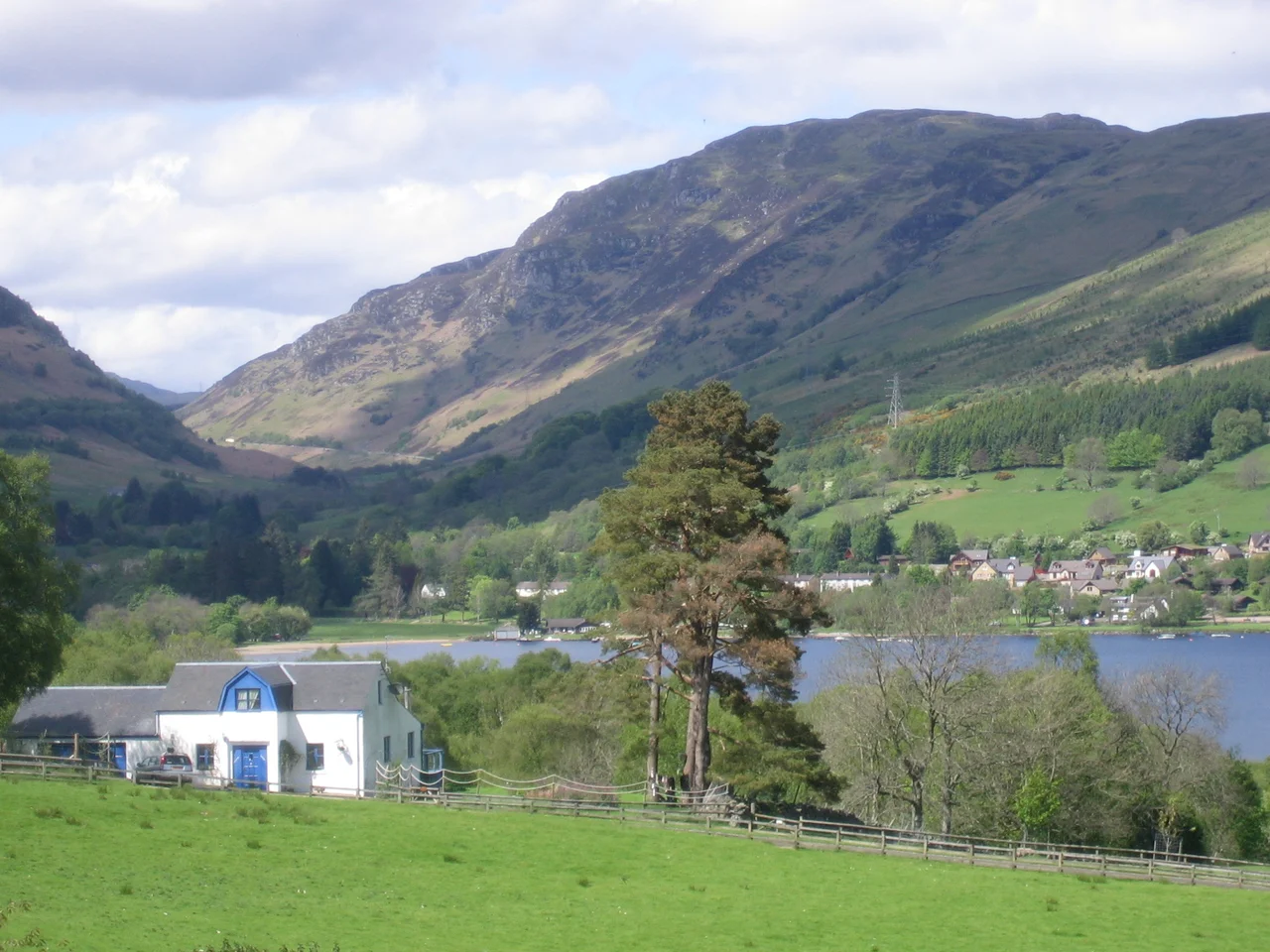

Lochearnhead
A severed head on a silver platter. That is the image that haunts Lochearnhead's old stories, and the strangest part is that it actually happened. When Lady Margaret Stewart of Ardvorlich opened the door to travelling MacGregors and offered them food, she did not know they had just murdered her brother. They left his head propped at the table with her own cold victuals stuffed into the mouth. She ran into the hills, gave birth on the side of Beinn Domhnuill, and her son grew up to become Major James Stewart, hero of Sir Walter Scott's A Legend of Montrose. The lochan where she labored still bears the name Lochan na Mna, the Lochan of the Woman. This is the kind of place Lochearnhead is. A small Perthshire village at the western tip of Loch Earn, 14 miles north of the Highland Boundary Fault, where the A84 from Stirling meets the A85 from Crieff at the foot of Glen Ogle. Behind every quiet hedge sits a story you did not see coming.
The Frontier Loch
Loch Earn was once a borderline. On its eastern shore stood Dundurn, a Pictish frontier fort facing the Gaels of Dál Riata across the water. The Annals of Ulster record that the Scots laid siege to it in 683 AD, and that Giric, sometimes called Grig, King of Picts and Scots, was killed at Dundurn in 889 and carried to Iona for burial. Even the loch's name carries the echo of that frontier. Earn likely derives from Eireann, the loch of the Irish, named for the Gaels who pushed east into Pictish territory. Two crannogs are still visible in the water, man-made islets dating from the Bronze Age. The one at the eastern end, Neish Island, was inhabited by Clan Neish until 1612. People have been living and arguing and fortifying themselves on these shores for somewhere close to four thousand years.
The Water Horse
Loch Earn has unpredictable currents, the kind that pull boats sideways without warning. The old people had an explanation. An each-uisge, a water horse, lived in the loch. It had been chased out of Loch Tay by Fingal himself and had settled here. The creature would appear on the shore looking benign, even friendly, and entice the unwary to climb on its back. Once mounted, the rider's hands would stick fast to its neck, and the horse would plunge into the deep water, drowning its passenger. The legend is just a legend. The currents are real, and they have killed real people. There is a tidy folkloric logic to that: every dangerous loch gets a kelpie, every fairy hill its green light. The hillock in the Games Field, known as the Shian, was said to be such a knoll. In quieter times, people swore they could hear faint music coming from inside it.
Black Duncan's Castle
A kilometre along the south Loch Earn road stands Edinample Castle, built in 1630 by 'Black' Duncan Campbell of Glenorchy. Duncan was a man of fury and ornery temperament, and he had asked his architect to build the castle with a parapet around the roof. When the work was finished and Duncan discovered there was no parapet, he threw the architect off the roof to his death. The ghost of that hapless builder is said to wander the rooftop where the parapet should have been. Other legends pile on. The castle is cursed, depending on which version you hear, either by a witch's malediction or because gravestones were used in its construction. A few say the 6th-century Saint Blane cursed the ground itself. Three kilometres east stands Ardvorlich House, home to the Stewarts since 1582. A tombstone nearby marks seven Macdonalds of Glencoe killed during a failed raid in 1620. The land remembers.
The Drove Road and the Rails
Until the military road came through, Lochearnhead was a scatter of crofts and farms. Work on the road from Stirling to Fort William began in 1750, in the aftermath of the Jacobite risings, and the village rose with it. The Lochearnhead Hotel went up in 1746. A Post Office opened in 1800. Then the railway arrived. The Callander and Oban line was completed in 1870, and in 1904 a branch was extended along Loch Earn to St Fillans and Crieff, making Lochearnhead an easy day-trip from the cities. A motor vessel called the Queen of Loch Earn worked the water from 1922 to 1936. The branch line closed in 1951, the main line in 1965 after landslides in Glen Ogle. In August 2004, more landslides came after heavy rain. Mud engulfed the road, motorists were trapped, and the world's media descended to argue about climate change. The hills have not stopped moving.
The Lifting Stone
Outside Ardvorlich House sits a granite boulder that weighs 152 kilograms, smooth and round and almost ungrippable. This is the Ardvorlich Lifting Stone. As of 2023, fewer than twenty stone lifters have managed to raise it to the chest. Only four have shouldered it. To Scottish strongmen, it sits in the same rare company as Iceland's Husafell Stone, the pinnacle of the discipline. The custom is gentle: make yourself known to the house, respect the stone as the historic artifact it is, and lower it carefully when you are done. The village holds an annual sheep-shearing competition, the Lochearnhead Shears, established in 1993 and now one of the largest in the UK. The Highland Games celebrated their 200th anniversary in 2007. Loch Earn itself hosts water-skiing championships. None of it ever quite leaves the past behind. The boulder, the bagpipes, the ceilidh after the shears: all rituals of a place that still measures itself against what came before.
From the Air
Lochearnhead sits at 56.385°N, 4.287°W at the western tip of Loch Earn, 14 miles north of the Highland Boundary Fault. The loch is 317 ft above sea level, oriented east-west, with the village at the western end where the A84 and A85 roads meet at the foot of Glen Ogle. Visual landmarks include Ben Vorlich and Stùc a' Chroin (two Munros on the south shore), the steep cleft of Glen Ogle running north, and Edinample Castle on the south shore. Nearest airports: Glasgow (EGPF) approximately 60 nm southwest, Edinburgh (EGPH) approximately 50 nm southeast. Recommended viewing altitude 4,000-6,000 ft AGL for the full sweep of the Trossachs into the southern Highlands. Weather can deteriorate rapidly in the glens; mist and rain are common, and downdrafts off the Munros can be substantial in unstable conditions.
Nearby Stories
- Crieff 4.2 km away
- Buchanan Castle 4.9 km away
- Benmore Botanic Garden 6.5 km away
- Shira Hydro-Electric Scheme 6.7 km away
- Coire Gabhail 7.3 km away
- Falkirk Wheel 8.4 km away
- Pitlochry Festival Theatre 13 km away
- Rannoch Railway Station 15 km away