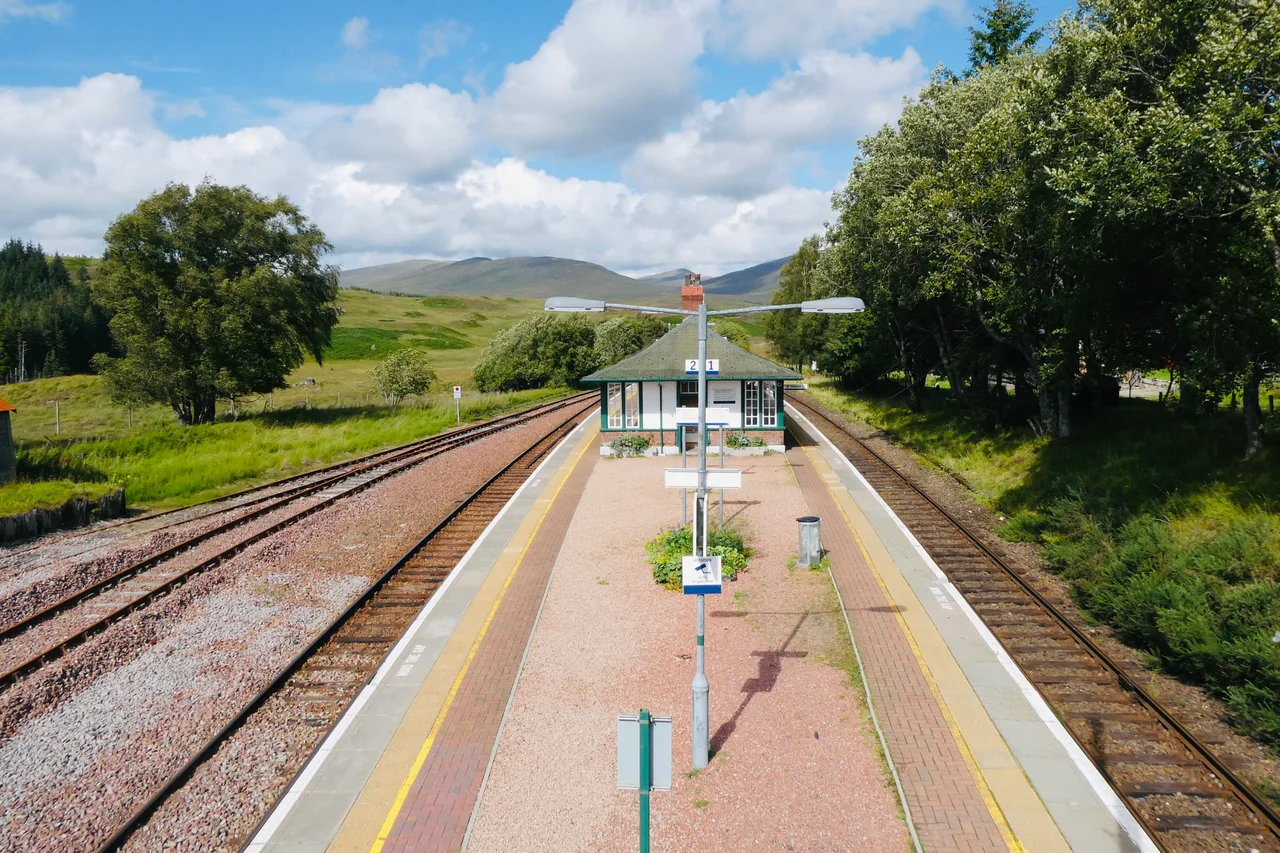

Rannoch Railway Station
In 2017, the writer Simon Jenkins published a guide to the best railway stations in Britain. He included Rannoch on his shortlist of ten. The choice was a small editorial provocation. Rannoch has no town, no village, no public road of consequence. It is an unstaffed island platform in the middle of a fifty-square-mile peat bog, sixty-four miles by rail from Helensburgh and unreachable by any other practical means. It has a tearoom and a stepped footbridge. Tickets must be bought from the guard on the train. And the platform itself sits on a foundation that should not really work: a raft of tree roots, brushwood, and thousands of tons of earth and ashes floating on the soft bog. The engineers who built the West Highland Line in the 1890s had to invent that solution as they went. They are why James Renton's stone-carved head looks out over the rails today.
The Floating Foundation
When the West Highland Railway was built across Rannoch Moor, the builders ran into a problem the surveyors had warned them about. The bog was effectively bottomless. Anything heavy would sink. The engineering answer was to build a raft. Tree roots, brushwood, and thousands of tons of earth and ashes were piled into the line of the railway, creating a flexible mat that would distribute the weight of the rails over a larger area. The trains do not so much cross Rannoch Moor as float across it. The station opened to passengers on 7 August 1894, with a crossing loop and an island platform, sidings on both sides, and a turntable on the east side of the line. There was a 17-lever signal box on the island platform. The original arrangement lasted nearly a century until, on 25 January 1987, the crossing loop was altered to right-hand running, which simplified shunting at the station by removing the need to hand-pump the train-operated loop points to access the sidings. From 1937 to 1939 the station hosted an LNER camping coach, an old railway carriage parked on a siding and let out as Highland holiday accommodation.
James Renton
At the north end of the platform stands a sculptured head, carved in stone by the navvies who built the line. It commemorates a director of the West Highland Railway named James Renton, who gave a substantial part of his personal fortune to keep the project alive when the bankruptcy court was closing in. The brushwood raft kept sinking. The cost overruns kept piling up. The line was on the verge of being abandoned when Renton stepped in. The men who actually pushed the trolleys and laid the sleepers knew what that meant. They carved his portrait into stone and set it where every passing train would see it. It is one of the more moving small monuments on the British railway network: a director who put his own money down to save a project, remembered by the workers who would otherwise have been laid off. The head has watched the trains pass for over 130 years.
Tokens and Tokenless Block
Single-track railways have always had the same fundamental problem: how do you prevent two trains from running head-on into each other on the same stretch of line? The West Highland Railway used the electric token system from the day it opened in 1894. Drivers carried a physical token, exchanged at signal boxes, that proved they had exclusive right to the next section of track. In 1967 the line moved to Tokenless Block working between Crianlarich and Rannoch, a more modern system but with the same essential safety logic. In August 1985 it reverted to electric token block, and in November the semaphore signals were removed, in preparation for the introduction of Radio Electronic Token Block. RETB was commissioned on 29 May 1988 between Helensburgh Upper and Fort William Junction, closing Rannoch signal box and the others on the line. The whole stretch is now controlled remotely from a signalling centre at Banavie. The Train Protection and Warning System was installed in 2003. There was once a fourth station at Gorton, nine miles south of Rannoch, but it has been reduced to an engineer's siding.
Services Today
Three ScotRail services run northbound to Mallaig and three southbound to Glasgow Queen Street on weekdays and Saturdays. On Sundays the count drops to two each way. The Caledonian Sleeper runs six nights a week (not Saturday) between Fort William and London Euston via Edinburgh, also picking up seated passengers if you want to use it as a regular train. Otherwise the station is famously quiet. The café and visitor centre keep busier than you might expect, mostly serving walkers off the trains and motorists who have driven up the dead-end B846 road from Pitlochry. The footbridge is stepped, so the station has no step-free access; this is a working piece of late-Victorian infrastructure still doing its job. Whether it is one of the ten best in Britain depends on what you are measuring. If the measure is sheer improbability, Rannoch is hard to beat.
From the Air
Rannoch Station sits at 56.686°N, 4.577°W on the eastern edge of Rannoch Moor in Perth and Kinross. The station is a single island platform on the West Highland Line, with the railway running roughly north-south through the moor. From the air look for the line cutting straight across the otherwise unmarked expanse of bog, with the station itself a small group of buildings at the eastern edge where the B846 road from Pitlochry terminates. Loch Eigheach Gaur Reservoir is immediately to the east. Nearest airports: Glasgow (EGPF) approximately 60 nm south-southwest, Inverness (EGPE) approximately 55 nm north-northeast. Recommended viewing altitude 4,000-6,000 ft AGL for a clear view of the railway crossing the moor toward Corrour. The terrain is low (around 270 m) but exposed; weather changes fast.
Nearby Stories
- Battle of Dalrigh 3.6 km away
- Battle of the Shirts 9.6 km away
- McCaig's Tower 12 km away
- Fortingall 14 km away
- Highland Folk Museum 15 km away
- Castle Stalker 15 km away
- Comrie 15 km away
- Battle of Glen Shiel 24 km away