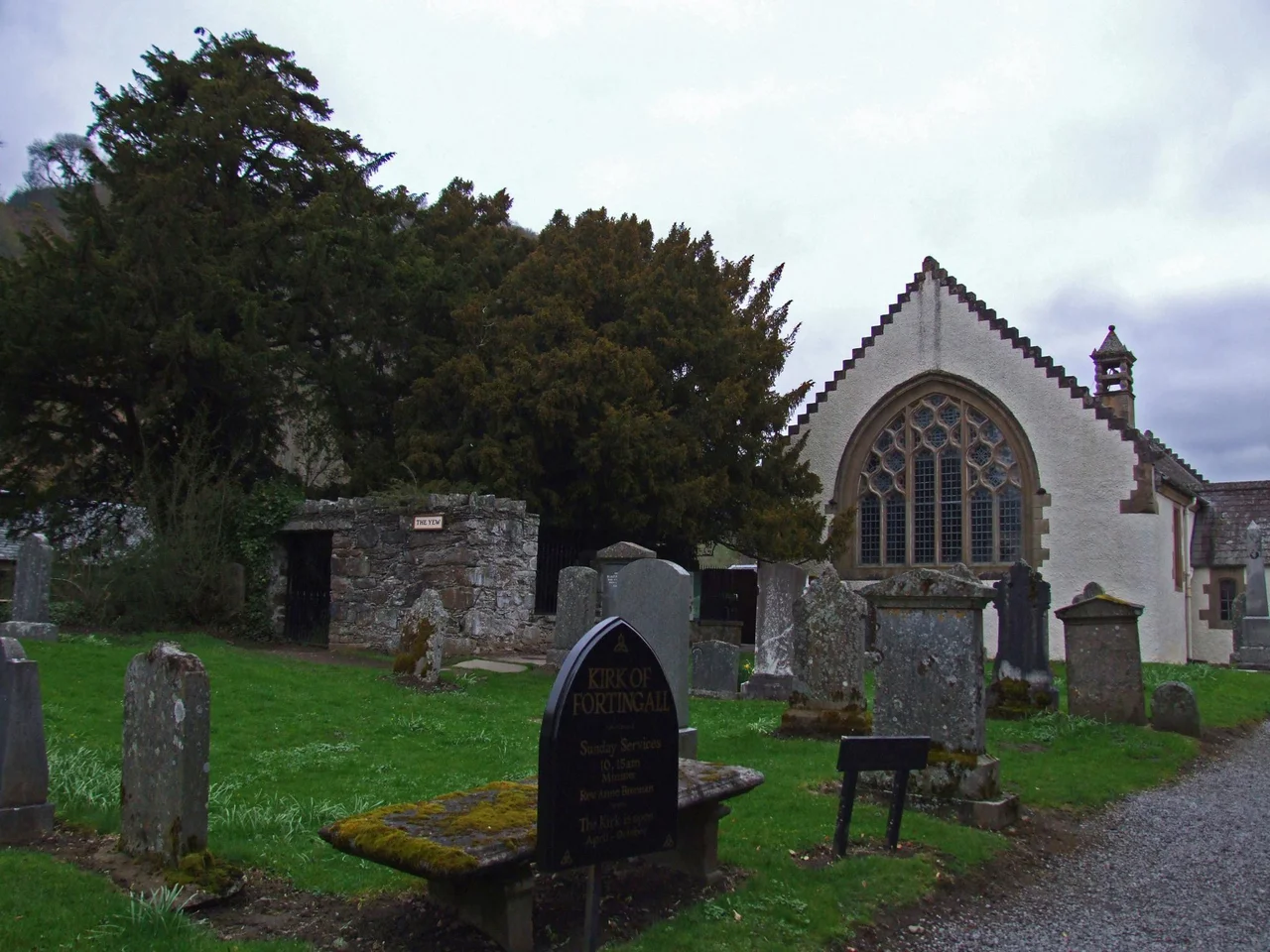

Fortingall
Local tradition holds that Pontius Pilate, the Roman prefect who oversaw the crucifixion of Jesus, was born here. He almost certainly wasn't. Pilate was born several decades before any Roman set foot in this corner of Scotland, and a clutch of other villages from Spain to Germany claim him too. But the legend persists at Fortingall for a particular reason: the village sits beside a yew tree so old that anything seems possible. Estimates of the Fortingall Yew's age range from two thousand to nine thousand years, and even the lower figure makes it one of the oldest living things in Europe. A tree like that gives a village permission to dream big.
The Iron Age Sacred Place
Place-name evidence and archaeology together suggest Fortingall was an Iron Age cult centre, and the yew tree may have been its focus. When Christianity arrived, around AD 700, a daughter monastery of Iona was founded here, dedicated to Coeddi, a bishop of Iona who died in 712. The Christians built on top of the pagan sacred site, as Christians often did, possibly because it was already holy ground. The parish church preserves an early Irish-style hand-bell of iron coated with bronze, dating from the 7th or 8th century, one of several to have survived in highland Perthshire. The bell was stolen in 2017, an unsentimental footnote to a thousand years of survival.
Carved Stones in the Churchyard
Fortingall has one of the largest collections of early medieval sculpture in Scotland. The churchyard holds slabs with simple incised crosses paralleled at Iona and other sites on Scotland's west coast, and a massive early font. The current parish church, built in 1901 and 1902, is white-harled and notable for fine woodwork; its Arts and Crafts style was deliberately chosen to harmonise with the rest of the village. Inside, a permanent display interprets the cross-slabs and the early Christian site they came from. The village exists today essentially because pilgrims and antiquaries kept coming to see what was here.
Sir Donald Currie's Village
The Fortingall you walk through today is a planned village, built between 1890 and 1891 by Sir Donald Currie, a shipping magnate and Unionist MP who bought the Glenlyon Estate in 1885. The architect was James MacLaren, working in a vernacular style that drew on both Lowland Scots and English influences, notably from Devon. The thatched cottages are now considered one of the most important examples of arts and crafts vernacular architecture in Scotland. Several thatched roofs were converted to tiles after fires in the 1970s and 1980s. The Fortingall Hotel, restored to its original appearance in 2006 and 2007, is an important example of Scottish vernacular revival, anticipating the work of Charles Rennie Mackintosh, whose own designs MacLaren influenced.
The Cairn of the Dead
The area immediately around Fortingall holds one of the richest concentrations of prehistoric sites in Scotland. Càrn nam Marbh, Gaelic for Cairn of the Dead, is a reused Bronze Age burial mound that according to local tradition served as a mass grave for plague victims in the 14th century. The cairn was also a focus for the village's Samhain festival, the Celtic ancestor of Halloween. The Fortingall stone circles stand nearby. Standing stones rise at the Bridge of Lyon. There are four-poster stone settings, ring-forts that are really massive Iron Age house enclosures, cup and ring marked stones, and a medieval homestead moat so geometrically regular that early antiquaries assumed it had to be Roman. People have been doing meaningful things in this glen for at least five thousand years, and the yew tree has watched all of it.
From the Air
Located at 56.5979 N, 4.0554 W at the eastern end of Glen Lyon, Perthshire, the longest enclosed glen in Scotland. The village is just north of the River Lyon, about 8 miles south-west of Aberfeldy. Loch Tay lies to the south-east. Best viewed at 3,000-5,000 feet AGL; the white-harled cottages and church stand out against the green glen floor, with the steep slopes of Glen Lyon climbing on either side. Nearest major airports: Glasgow (EGPF) about 50 miles south-west, Edinburgh (EGPH) about 55 miles south-east, EGPN (Dundee) about 40 miles east.
Nearby Stories
- Doune 6.7 km away
- Ben Lomond 7.7 km away
- Lochleven Castle 9.4 km away
- Lochaber Narrow Gauge Railway 10 km away
- Scone Abbey 11 km away
- Battle of Dalrigh 12 km away
- Battle of Dalnaspidal 13 km away
- Lochnagar 26 km away