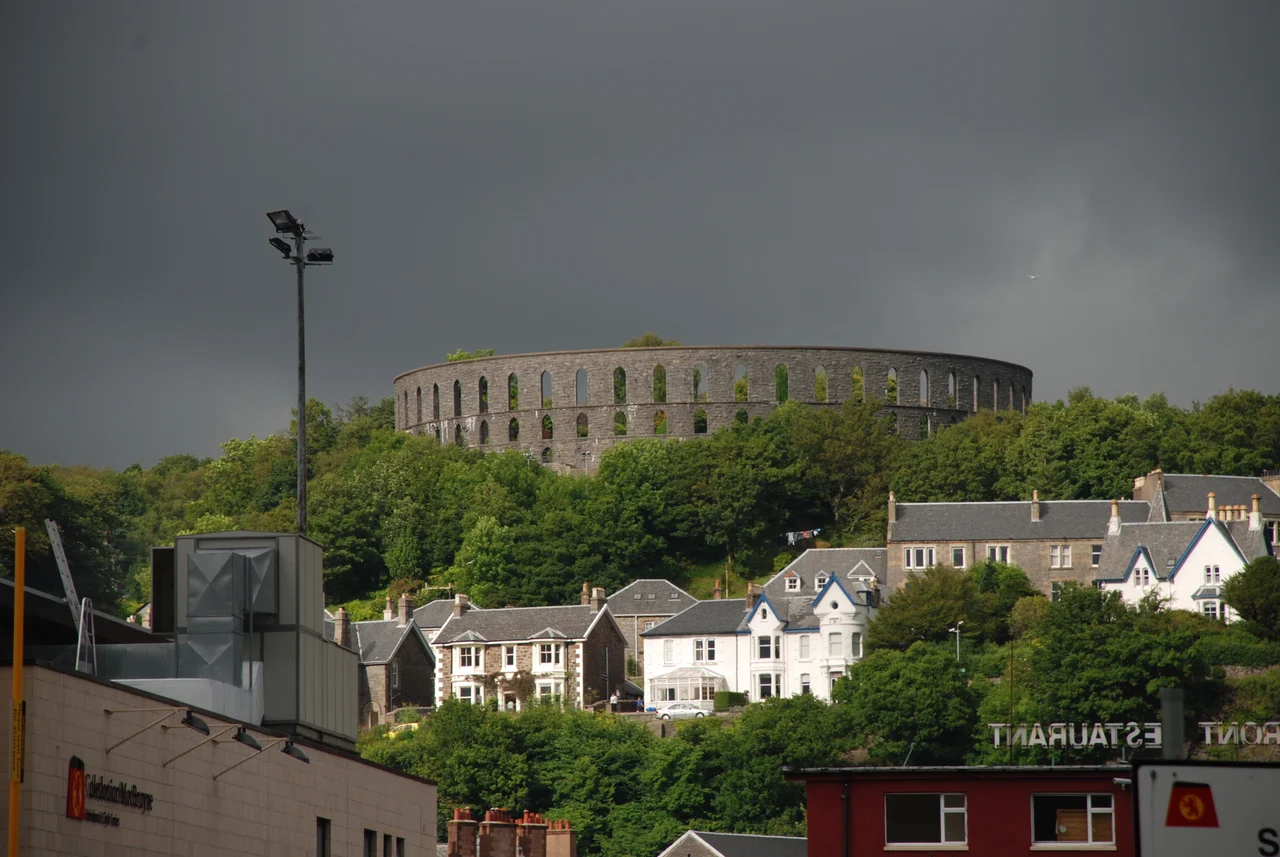

McCaig's Tower
John Stuart McCaig wanted a Colosseum. Not a small one, not a tasteful Roman echo - the actual Colosseum, rebuilt in granite on a hill above the port town of Oban, with statues of himself and his family staring out across the Sound of Mull. He got the outer ring. Then in June 1902 he died of cardiac arrest at the age of 78, his heirs went straight to court, and the will that would have funded the inside was overturned. The shell is still up there, ninety-four lancet arches catching the sea wind, waiting for the museum and the gallery and the tower that never came.
The Banker With Roman Dreams
McCaig made his money quietly, as bankers tend to. He worked for the North of Scotland Bank, accumulated wealth, and developed an obsession with classical architecture that most of his neighbours probably regarded as harmless eccentricity. By the time he was in his seventies he had a plan: a monument on Battery Hill that would house an art gallery, a museum, and a central tower lined with statues of himself, his siblings, and his parents. He acted as his own architect. The estimated cost was five thousand pounds sterling - serious money in 1897, when construction began. He also had a softer motive woven into the grand one. The local stonemasons needed winter work, and the project would keep them employed during the months when the building trade in Oban normally went quiet.
Ninety-Four Arches
What got built is what survives: a ring of Bonawe granite roughly two hundred metres in circumference, with two tiers of lancet arches stacked on top of each other - forty-four below, fifty above. The granite came across Airds Bay from Loch Etive, the same quarries that supplied much of nineteenth-century Glasgow. McCaig kept raising his ambitions as construction went on; Dean of Guild Court records show drawings from 1895 for the original wall, a second set from 1896 adding to it, and a 1897 instruction to raise the whole thing another fifteen feet. Then his heart gave out at John Square House on 29 June 1902. The will set aside a thousand pounds a year for maintenance and completion. The heirs sued, the heirs won, and the inside of the tower has been open sky ever since.
What Sits Inside the Shell
The empty ring is now a public garden. You reach it by climbing the 144 steps known as Jacob's Ladder, or by squeezing into the rather small car park. From the lawn inside, the arches frame views west across the water to Kerrera, Lismore, and Mull - which is, perhaps unintentionally, exactly the kind of dramatic prospect McCaig's classical sources would have prized. It became a Grade B Listed monument in 1971. The first wedding held inside took place on 26 May 1992, when Keith Hirsch of Dundee, then living in Canada, married Dora Fuchihara of Toronto; the Oban Times put it on the front page. Local by-laws prohibit drinking alcohol inside the tower - a rule announced in 2004 with what one suspects was Scottish exasperation.
Folly Or Monument
Locals split the naming. Some call it McCaig's Tower. Plenty call it McCaig's Folly. Both are accurate, in the way that the same artefact can be a tribute to ambition and a warning about it at the same time. The thing about a folly is that it tends to outlast the financier who built it, and the disappointment of an unfinished plan slowly turns into a feature of the skyline. The Colosseum itself is a ruin too. McCaig got closer to it than he intended.
From the Air
McCaig's Tower stands at 56.4157 N, 5.4692 W on Battery Hill above Oban, at roughly 90 metres elevation. The unmistakable circular ring of arches sits directly over the harbour and is visible from cruising altitude in clear weather, particularly from the west where the tower silhouettes against the lower town. Oban Airport (EGEO) lies 5 nautical miles north at Connel. Inverness (EGPE) is 80 nm northeast and Glasgow (EGPF) 65 nm southeast. From the air the tower works as an instant Oban fix - look for the bright limestone-coloured ring on the green hill above the ferry pier and the Sound of Kerrera. Western Highland weather is famously changeable; visibility drops fast when fronts come in off the Atlantic.
Nearby Stories
- 2009 Buachaille Etive Mòr Avalanche 5.3 km away
- Tobermory Lifeboat Station 5.9 km away
- Carsaig Arches 6.8 km away
- HMS K13 8.7 km away
- Loch Fyne 10 km away
- West Highland Line 12 km away
- Strontian 12 km away
- Colonsay 15 km away