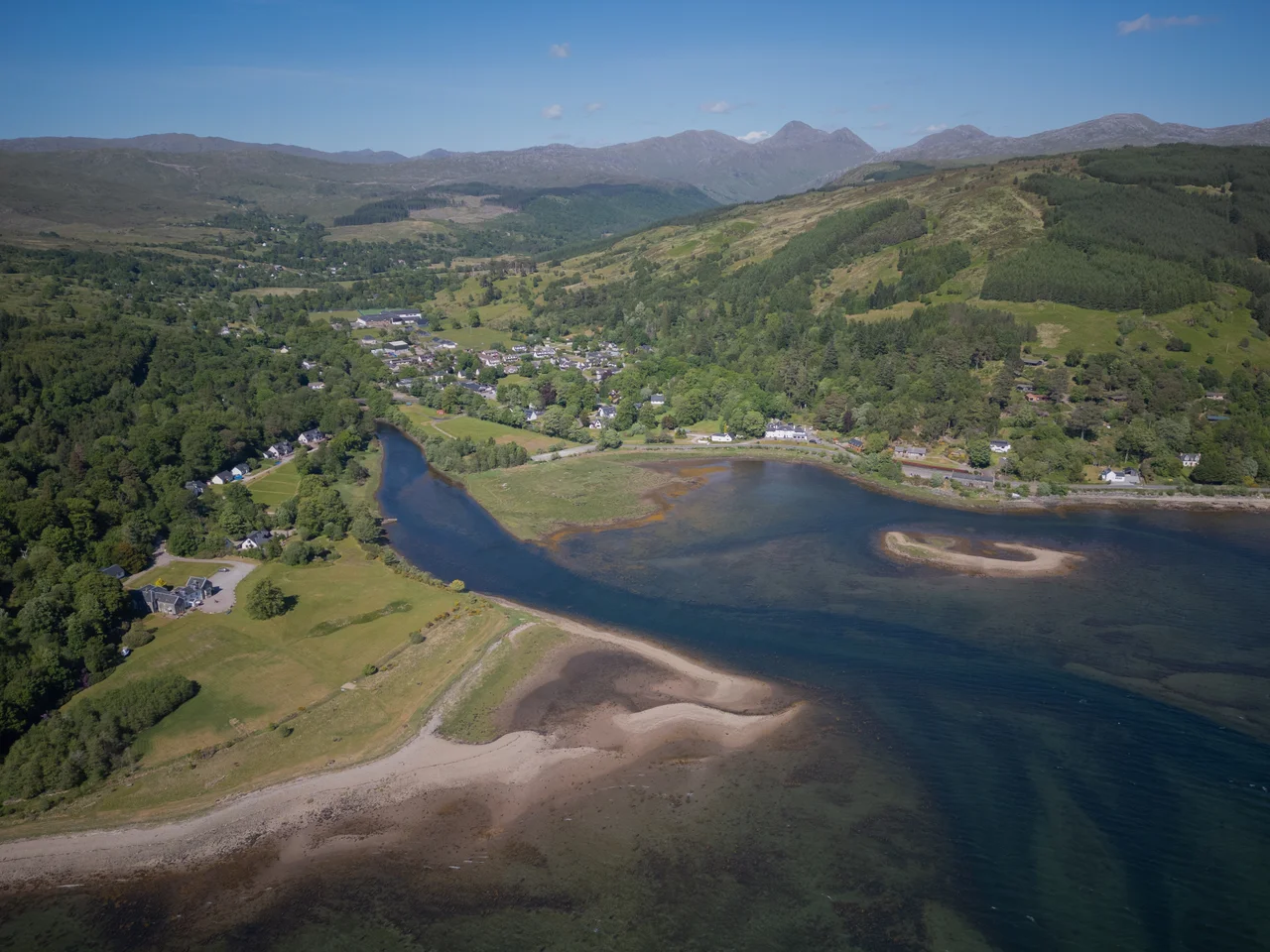

Strontian
Open a periodic table. Find element 38. Strontium. That name comes from here, from a village on the north shore of Loch Sunart with a population that has never quite reached a thousand. In 1790, a doctor named Adair Crawford examined a mineral pulled out of the lead mines above Strontian and decided it was a new species of earth. Three years later, a Glasgow chemist named the substance after the place. Fifteen years after that, Humphry Davy isolated the element by electrolysis and renamed it strontium. Strontian is the only village in the United Kingdom whose name lives on the periodic table.
The Name and the Loch
In Gaelic the village is Sron an t-Sithein, the nose, or point, of the fairy hill. The fairy hill is a low rounded knoll said to be inhabited by the sidhe, the mythological people who underlie so much of Highland topography. The English-language spelling sands the edges off the Gaelic into something a chemist could pronounce. Strontian sits at the head of Loch Sunart, a sea loch that reaches inland from the Atlantic, and its road is the A861, a thin grey line through wild country. North of the village rises Sgurr Dhomhnuill, sharp and conical. The settlement as it exists today was founded in 1724 to house lead miners. Everything else followed from the rocks.
Lead, War, and a Periodic-Table Entry
Sir Alexander Murray discovered galena, the principal ore of lead, in the hills here in 1722. A mine opened in 1725 in partnership with Thomas Howard, 8th Duke of Norfolk, and General Wade, the same Wade then building the military roads through Highland Scotland. The lead went into bullets for the Napoleonic Wars. By a strange symmetry, part of the workforce later included captured French soldiers from Napoleon's own imperial army. Among the ore the miners pulled out was a heavy mineral that did not behave like the others. Adair Crawford studied it in 1790. Thomas Charles Hope, professor of chemistry at the University of Glasgow, named it strontites in 1793. Humphry Davy isolated the metal in 1808 by electrolysis of strontium chloride and mercuric oxide, and announced the discovery to the Royal Society on 30 June. He changed the name to strontium to match the other alkaline earths. The first large-scale industrial use was the German sugar-beet industry, which used strontium hydroxide to crystallise sugar from beet juice. Before World War One, Europe's beet sugar industry was consuming up to 150,000 tonnes of strontium hydroxide a year, all of it traceable back to a mineral first noticed in this Highland village.
A Floating Church
In 1843 a third of the Church of Scotland walked out in protest at state interference in clerical appointments, founding the Free Church. The local Free Church congregation around Strontian, five hundred strong, asked Sir James Riddell, who owned the entire Ardnamurchan peninsula, for a piece of land. Riddell refused. He wrote that he could not in conscience grant sites for what he believed to be an anti-social and anti-Christian system. Worshippers were holding services outdoors in bad weather, and witnesses testified to the illnesses that followed. So the congregation raised £1,400, had a boat built on the Clyde, and moored it 150 metres offshore in Loch Sunart. Their floating church opened in 1846, reputedly the first in the country. They held services on the water for years, beyond Riddell's land and beyond his ability to refuse them. A proper site was eventually secured in nearby Acharacle in 1868.
A Miner Named Duncan Cameron
In 1851 a rockfall in the Strontian lead mine killed a miner named Duncan Cameron. The inquest that followed pulled together testimony from workers who had been warning for years that the workings were unsafe. One miner stated plainly that the supporting partitions left by the previous company had been removed, that the props were inadequate, and that men had quit rather than continue. He himself, he said, had to choose between working there and starving: necessity with me had no law. A culpable homicide case was brought against the mine superintendent, James Floyd. In 1854 the miners tried again to take the company to court. The action was ruled out of order by the sheriff substitute and the workmen were ordered to pay four pounds and fifteen shillings in costs. Strontian gave the world an element. The men who pulled the ore out lived in conditions that another set of records, the legal ones, has preserved with terrible clarity.
From the Air
Strontian sits at 56.693 N, 5.567 W at the head of Loch Sunart in western Lochaber. Recommended viewing altitude 2,000-3,500 ft AGL. Visual references: Loch Sunart running west-southwest toward the Atlantic, the Ardnamurchan peninsula extending further west, and Sgurr Dhomhnuill rising sharply north of the village. Nearest ICAO airport is Oban (EGEO) about 35 nm south; Inverness (EGPE) is the wider regional alternate well to the northeast. Atlantic weather rolls in directly off the loch; expect rapid visibility changes and orographic cloud on the surrounding peaks.
Nearby Stories
- McCaig's Tower 1.7 km away
- Great Glen Way 4 km away
- Ardnamurchan 4.9 km away
- Buachaille Etive Mòr 4.9 km away
- Battle of Dalrigh 14 km away
- Carsaig Arches 16 km away
- The Rough Bounds 18 km away
- Tarskavaig 18 km away