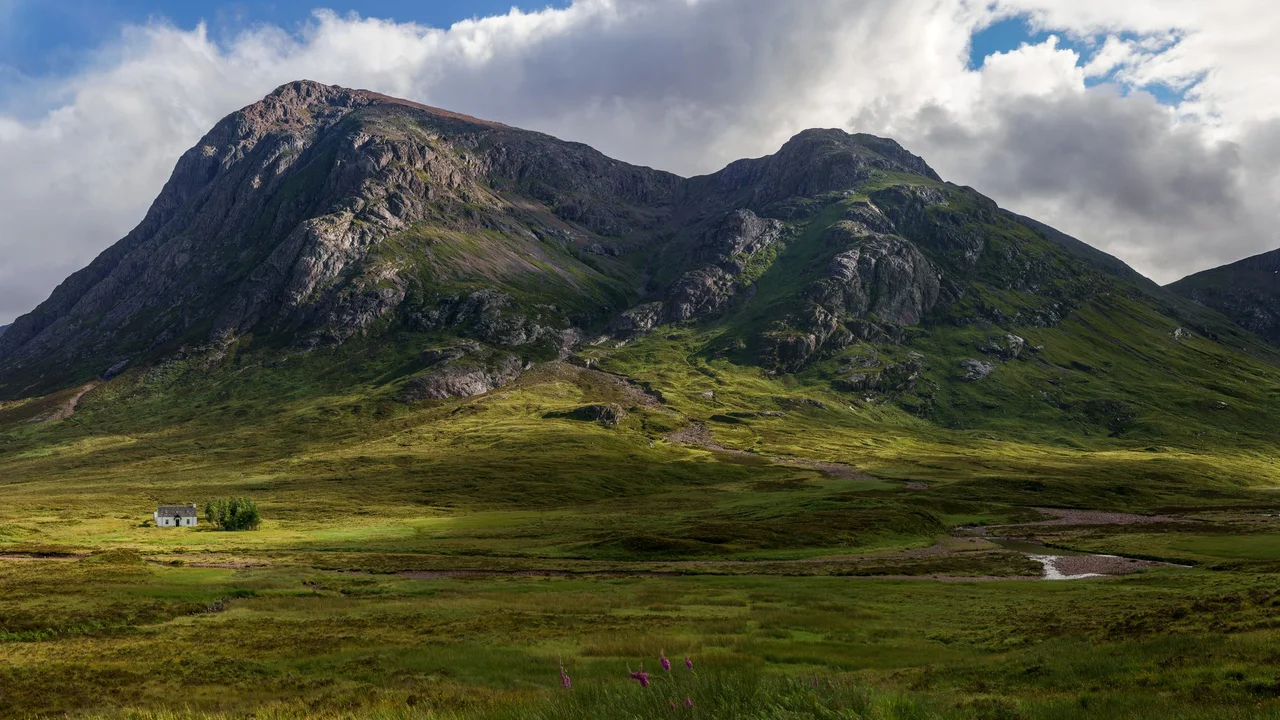

Buachaille Etive Mòr
Drive north on the A82 from Tyndrum, past the long grey expanse of Rannoch Moor, and a shape comes up on your left that you will recognize even if you have never been to Scotland. It is a near-perfect pyramid of dark rock, rising out of the moor with the kind of geometric clarity normally seen only in volcanoes or pre-school drawings. This is Stob Dearg, the highest point on Buachaille Etive Mòr, the great herdsman of Etive. The locals just call it the Buachaille. It is probably the most photographed mountain in Scotland, the obligatory backdrop on a thousand postcards and calendars, a wedding-photo cliché, the establishing shot in Skyfall when James Bond turns the Aston Martin off the road and looks at M and says, almost apologetically, that this is where he grew up.
The Ridge
The Buachaille is not a single peak but a long ridge, nearly five miles end to end, almost entirely encircled by the River Etive and its tributary the River Coupall. It contains four main peaks. From north-east to south-west they are Stob Dearg at 1,021.4 metres, Stob na Doire at 1,011 metres, Stob Coire Altruim at 941 metres, and Stob na Bròige at 956 metres. Two of them are Munros: Stob Dearg, the pyramid you see from the road, and Stob na Bròige at the far end, which was promoted to Munro status by the Scottish Mountaineering Club in 1997. To the west sits the smaller ridge of Buachaille Etive Beag, the little herdsman, separated from its big brother by the valley of Lairig Gartain. The two herdsmen flank Glen Etive, watching over the river that runs south toward Loch Etive.
Crowberry Ridge
Climbers come for the north-east face of Stob Dearg, the steep wall of crags that gives the mountain its iconic profile from the Kings House Hotel below. Crowberry Ridge, a classic graded severe, was first climbed direct in 1900 by the Abraham brothers from Keswick with two companions named Puttrell and Baker. They photographed the ascent, helping launch a tradition of British rock-climbing photography that the Buachaille has carried ever since. Curved Ridge sits immediately to the left of Crowberry, one of the most famous scrambling routes in the country. For walkers without climbing gear, an eroded path leads up the steep bowl of Coire na Tulaich, reaching the ridge about half a kilometre west of Stob Dearg in summer conditions. Alternative routes climb from Glen Etive to the south, including a circular route that ascends via Coire na Tulaich and descends via Lairig Gartain. The choice of route matters here. Conditions matter even more.
The Cost of the Mountain
Mountains kill people. Buachaille Etive Mòr has seen up to thirteen deaths in a single twelve-month period. A 1994 avalanche in Coire na Tulaich killed one climber. In January 2009 a much larger slide in the same corrie killed three. In 2019, Terance Rooney died of hypothermia and exposure while hillwalking. In April 2023, Royal Marine Reggie Melia fell fifty metres to his death. Each of these was a person with family, with experience, with a love of the hills strong enough to bring them here in the first place. The mountain does not punish carelessness specifically. It punishes the gap between what a climber prepares for and what the weather actually does. Conditions in Glen Coe can change inside an hour. A clear morning becomes whiteout afternoon. The Buachaille rewards humility and patience, and even those are not always enough.
Lagangarbh and the Photographers
The only building anywhere near the mountain is Lagangarbh Hut, which sits at the foot of the Buachaille beside the River Coupall, just off the A82. Locals call it a cottage because that is what it looks like, a small white building with a slate roof that has become as photographed as the mountain behind it. It is owned by the National Trust for Scotland and managed by the Scottish Mountaineering Club, who rent it out as accommodation for up to thirty people. Below the hut sit the small waterfalls on the River Coupall, the spot where every landscape photographer in Scotland eventually plants a tripod. The ground around the falls has been worn down by foot traffic to the point that some photographers now openly discourage other visitors from going there, hoping the vegetation can recover. The Buachaille has appeared in the 1998 Bollywood film Kuch Kuch Hota Hai. It is in the music video for Nick Heyward's Whistle Down the Wind. Dominic Fike used it in his video Politics and Violence. Every few years another film crew arrives at Kings House Hotel and points a camera at the same pyramid the Abraham brothers photographed in 1900.
From the Air
Buachaille Etive Mòr sits at 56.647°N, 4.898°W at the head of Glen Etive in the Highlands. The ridge runs roughly north-east to south-west, with Stob Dearg (1,021 m) at the north-east end and Stob na Bròige (956 m) at the south-west. From the air the pyramid shape of Stob Dearg is unmistakable, especially when seen from above the A82 at the Kings House Hotel. The mountain marks the western edge of Rannoch Moor, where the A82 descends into Glen Coe. Lagangarbh Hut is visible as a small white building at the foot of the mountain near the River Coupall. Nearest airports: Glasgow (EGPF) approximately 65 nm south, Oban (EGEO) approximately 30 nm west. Recommended viewing altitude 5,000-7,000 ft AGL for the full Glen Coe range. Mountain weather is notoriously volatile here: severe turbulence, icing in winter, and rapid visibility loss are routine, and downdrafts in lee of the ridge can be substantial.
Nearby Stories
- Battle of Dalrigh 3.6 km away
- Battle of the Shirts 9.6 km away
- McCaig's Tower 12 km away
- Fortingall 14 km away
- Highland Folk Museum 15 km away
- Castle Stalker 15 km away
- Comrie 15 km away
- Battle of Glen Shiel 24 km away