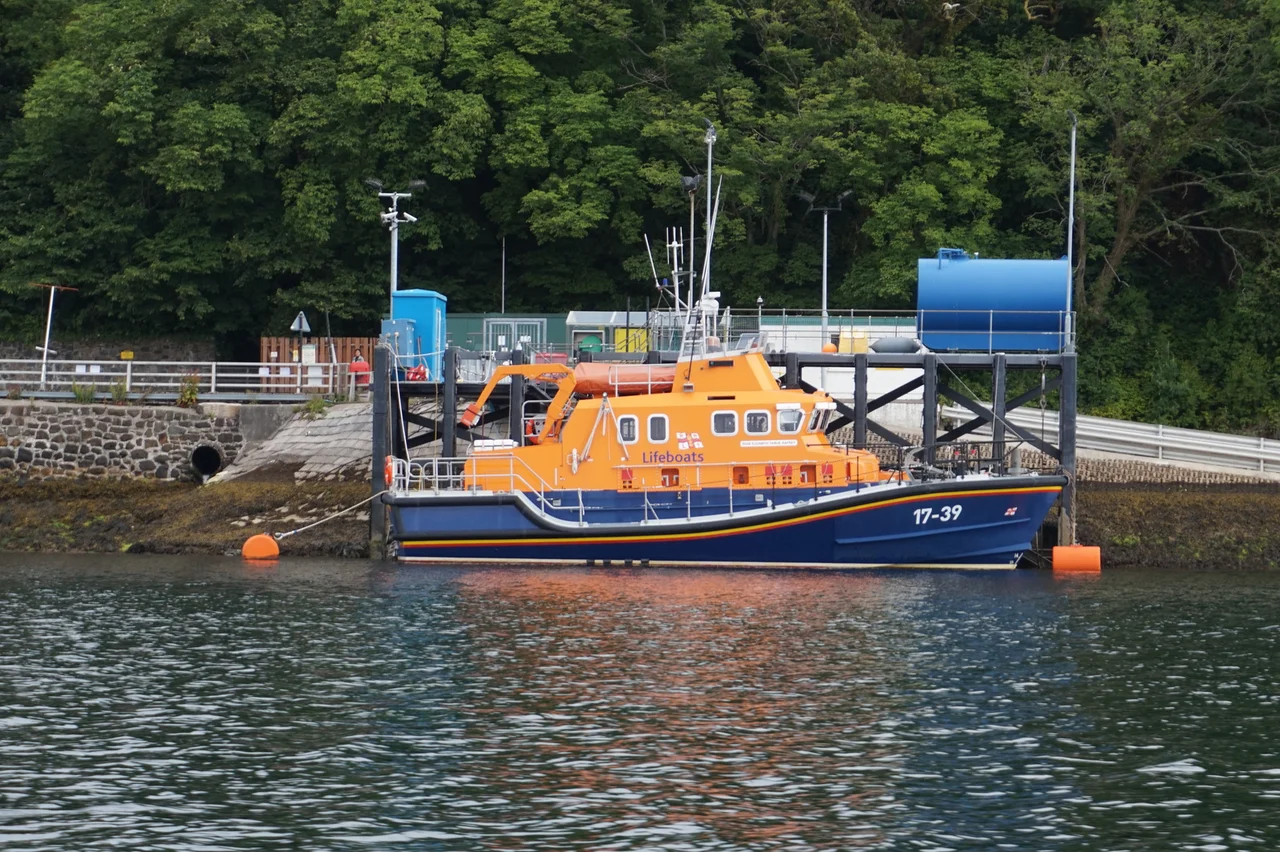

Tobermory Lifeboat Station
In May 1938, a brand-new lifeboat sat on display at the Empire Exhibition in Glasgow's Bellahouston Park, gleaming under the lights of an event that drew thirteen million visitors. When the exhibition closed in October, the boat was loaded onto its trailer and dispatched on a strange voyage west: out into the Clyde, north up Loch Gilp to Ardrishaig, where three hundred more people came to see her, then through the Crinan Canal and up the Sound of Mull to the bright-coloured harbour at Tobermory. On 28 November 1938, at a ceremony beside Main Street, she was named Sir Arthur Rose. A lifeboat had arrived on the Isle of Mull, and the long hard work of pulling sailors off rocks could begin.
Western Isles and the Terror
The lifeboat's first big call came on a Sunday morning, 31 March 1940. The steamship Nydalen, running from Runcorn to Methil via Kirkwall, slammed at full speed onto a reef at Arinagour on the Isle of Coll. She was driven so hard aground that her own lifeboats could not be launched until high water. Captain Jensen and thirteen crew clustered in the open boats beneath her stern, waiting. Sir Arthur Rose arrived from Tobermory and lifted all fourteen men back to Arinagour. By then the war was reshaping the bay itself. HMS Western Isles, the Royal Navy's Anti-Submarine Training School, made Tobermory its flagship base. Its commander, Vice-Admiral Sir Gilbert Stephenson, was nicknamed the Terror of Tobermory for the merciless drills he inflicted on green crews bound for the Atlantic. Many of those Royal Navy personnel almost certainly crewed the lifeboat too.
Forty-Three Years of Silence
When the war ended and the Navy left Tobermory, the lifeboat crew thinned out. By December 1947 the station could not find enough volunteers and was closed. The lifeboat was transferred to a new station at Mallaig on the mainland. With her went a small silver cross, a replica of St John's Cross of Iona, presented in 1940 by the Reverend George MacLeod, later Lord MacLeod of Fuinary, the founder of the Iona Community. The cross was supposed to be carried on every service launch from Tobermory. After the closure it sailed instead on the Mallaig boats for forty-three years, a small token of a station that no longer existed. Tobermory's harbour stayed busy with fishing boats and yachts, but the orange hull was gone.
Bobby MacLeod and the Reopening
By 1990, leisure sailing in the Hebrides had exploded. Yachts crowded the Sound of Mull. Mishaps multiplied. A local campaign argued that Tobermory needed its own lifeboat again, and the RNLI agreed. The first replacement boat, Ralph and Joy Swan, went on service that year, replaced the next year by the larger City of Bradford IV. On 26 May 1991, the Mallaig lifeboat stopped at Tobermory and, in a ceremony at the pier, handed back the silver Iona cross. It would once again sail on every Tobermory call-out. Two years later, the station bought a row of five lock-up garages by Mishnish Pier and converted them into proper crew quarters, an office for the Coastguard, and a workshop. The £61,000 appeal that paid for it was launched in memory of Bobby MacLeod, a veteran of the 1947 crew who had spent his last years campaigning for the station's return.
Eleven Hours West of Coll
The current lifeboat, the all-weather 17-39 Elizabeth Fairlie Ramsey, has been on station since 2003. On 27 January 2013 she answered a call from a fishing boat with a failed gearbox seven miles west of Coll. The lifeboat hauled the boat toward Tiree, where another vessel was waiting to take up the tow. The rope parted. The fishing boat drifted onto rocks. Lines went out again, came taut, parted, went out again. After eleven hours of work in the winter dark, the lifeboat finally brought the boat safely back to Tobermory. That single rescue captures the rhythm of a Hebridean lifeboat station: long quiet weeks, then a call, then hours of cold, methodical work on a black sea, then the boat returning to the painted harbour at dawn.
From the Air
Tobermory Lifeboat Station is at the end of Main Street, on the south side of Tobermory Harbour, at 56.6233 degrees north, 6.0644 degrees west. From the air the station appears as a low building on the seafront just beyond the row of brightly painted shops. Recommended viewing altitude 1,500-2,500 feet for harbour detail. The boat moors at an alongside berth completed in 2000. Nearest airport is Oban (EGEO) about 30 nautical miles southeast; Glasgow (EGPF) is 80 nautical miles south. Visual landmarks include the clock tower on the harbour wall and the Mishnish Pier.
Nearby Stories
- Strontian 3.6 km away
- Gylen Castle 6.7 km away
- Kinloch Castle 10 km away
- Carsaig Arches 16 km away
- Tiree 24 km away
- German submarine U-722 26 km away
- Dun Telve 27 km away
- Skerryvore 29 km away