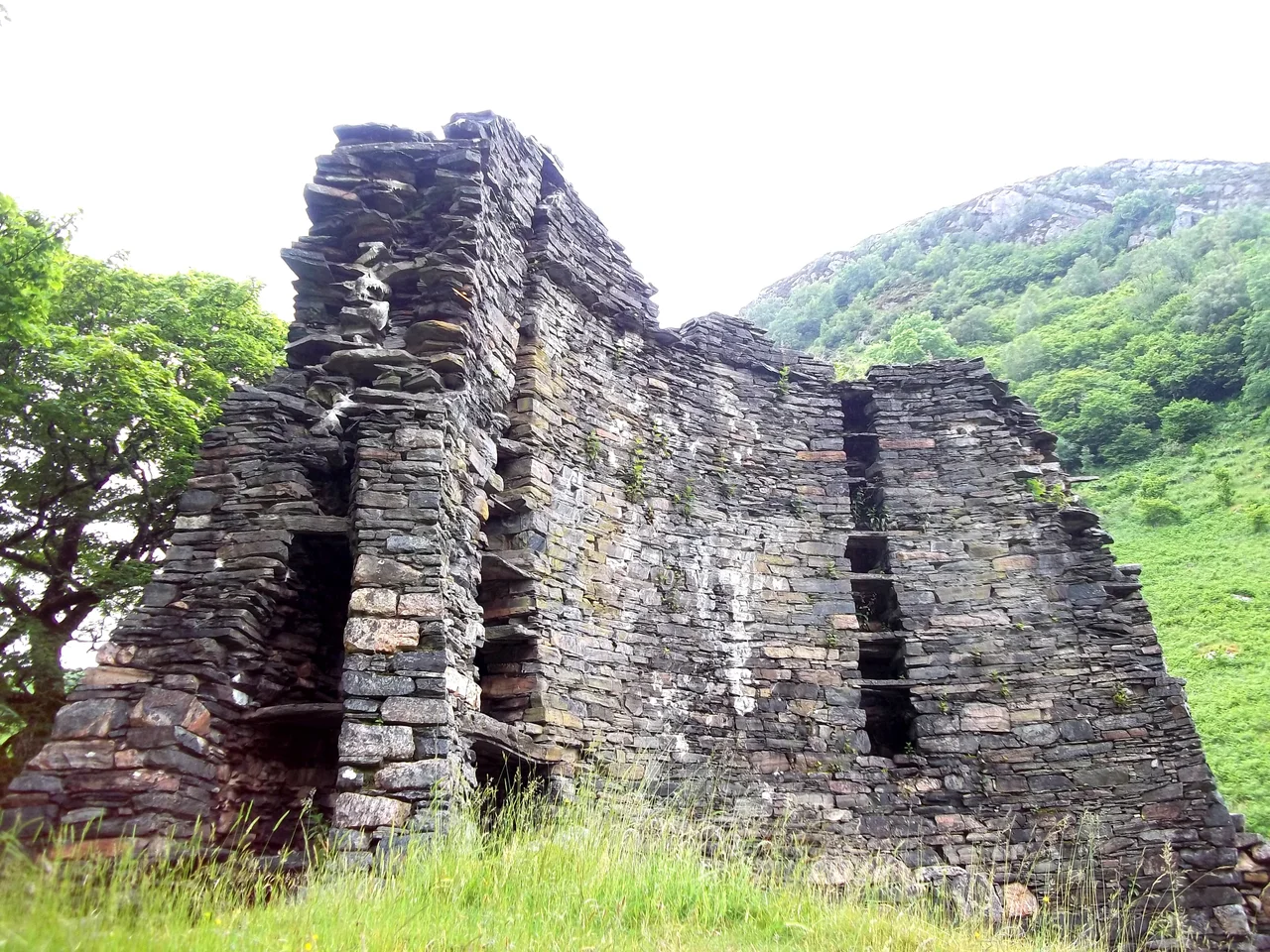

Dun Telve
Drystone, no mortar, two concentric walls with a void between them - and yet a third of the original tower still stands after twenty centuries. Dun Telve sits in the bottom of Gleann Beag, a narrow Glenelg side valley most people would drive past without a second glance, and inside its remaining wall you can still climb a stone staircase built before Rome had finished conquering Britain. Whoever designed and raised this tower understood load-paths and lateral stresses with a sophistication that European cathedral builders would not fully recapture for another thousand years. They left no written record. The building is the record.
What A Broch Actually Is
A broch is an Iron Age drystone tower unique to northern and western Scotland - roughly 500 of them once existed, mostly built between 200 BC and 200 AD. The defining feature is the hollow-wall construction: two concentric circles of unmortared stone, the gap between them braced by horizontal lintels and used for stairs, galleries, and small chambers. The outer wall might rise to twelve metres or more, tapering inward like a cooling tower. The interior is a single open court, usually with a central hearth and one low entrance passage carefully oriented to limit defenders' exposure. Nobody is sure exactly what brochs were for. Probably high-status dwellings, possibly with defensive function, possibly displays of clan power. Most have collapsed to rubble piles. Dun Telve is one of only a handful where you can still see the engineering working.
Standing After Two Millennia
Dun Telve sits on the north bank of the Abhainn a' Ghlinne Bhig, the small river of Gleann Beag, four kilometres southeast of Kirkton in Glenelg. The neighbouring broch Dun Troddan stands 470 metres east, and the semi-broch Dun Grugaig lies about 2.5 kilometres further on - a remarkable density of Iron Age architecture in one small valley. The surviving section of Dun Telve's wall rises about 10 metres above the surrounding ground. A doorway on the north side of the interior leads first to a small cell within the wall thickness, then to the intramural gallery that spirals upward as the wall tapers. A winding stone stair climbs through this space, with openings at intervals where upper wooden floors once met the stonework. Two scarcement ledges - horizontal stone shelves running around the interior - show where two timber upper floors were supported. The topmost original floor stood roughly nine metres above the central court.
Robbed For A Hanoverian Garrison
The brochs of Glenelg seem to have survived more or less intact through most of recorded history. Then, around 1722, Dun Telve was systematically robbed of its upper stones, almost certainly to provide cut and dressed material for the new Bernera Barracks rising a few miles north along the coast. Whoever supervised the quarrying took the easiest building material first, leaving the lower courses where they sat. By the late eighteenth century the broch had become a tourist curiosity. Antiquarian travellers sketched it. Local guides led parties out from the inn at Glenelg. The damage was already done, but what remained was enough to fascinate visitors, who recognised that they were standing inside something older than almost any other roofless ruin they had seen.
The Engineering Speaks For Itself
Climbing the surviving stair today, you can put your hand on stones laid roughly two thousand years ago by people whose names are entirely lost. The walls are thicker at the base, narrower at the top, the way a sensible designer would build any tall structure that has to stand on its own without mortar. The hollow-wall gallery distributes load and resists outward thrust. The narrow entrance passage limits how many attackers could approach at once. Built against the broch's western and northwestern sides are at least one rectangular building from later periods, when iron-age architecture had given way to something simpler. The broch outlived those additions too. Historic Environment Scotland now manages the site, fenced and signposted but unstaffed, free to enter at any reasonable hour. The wind moves through the empty entrance just as it did when the tower had a roof.
From the Air
Located at 57.1945 N, 5.5949 W in Gleann Beag, a side valley of Glenelg in the West Highlands. Dun Telve appears as a small circular stone tower in the floor of a narrow east-west glen, roughly 4 km southeast of Glenelg village. Its companion broch Dun Troddan stands just 470 metres east - both visible in a single low pass. The brochs are best identified by their isolation in a sparsely settled valley with grazed pasture and a single narrow road. Nearest aerodrome: Inverness (EGPE) approximately 105 km east-northeast. Surrounding terrain: Beinn a' Chapuill rises 760 m to the south, Beinn Sgritheall 974 m further southwest, the Sound of Sleat 4 km west. Approach altitude 1500-2500 ft AGL gives good visual identification in clear weather. Avoid the Glenelg area in low cloud - the surrounding peaks are unforgiving and the valley is narrow enough that turning room is limited. Best photographed in low morning sun when the tower casts its full circular shadow.
Nearby Stories
- High Pasture Cave 2.5 km away
- South Rona 6 km away
- Battle of Mulroy 7.5 km away
- Glenmoriston 8.2 km away
- Torridon 8.5 km away
- Glenfinnan Viaduct 8.6 km away
- Eigg 13 km away
- Conon Hydro Scheme 21 km away