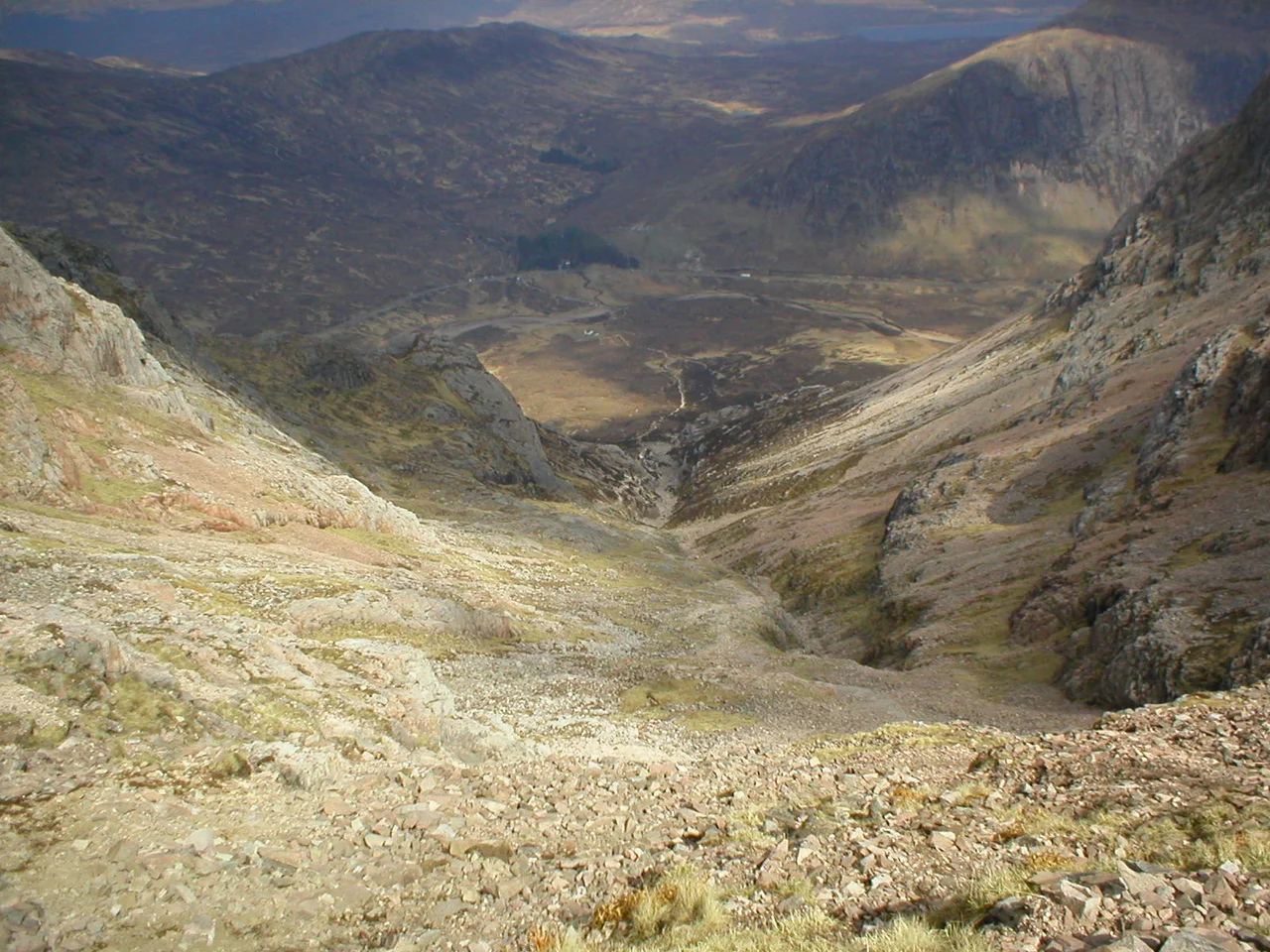

2009 Buachaille Etive Mòr Avalanche
At noon on Saturday 24 January 2009, a climber digging his way up Coire na Tulaich on Buachaille Etive Mòr put his weight on the wrong patch of snow. A huge sheet released beneath him. He managed to drive his ice axe into the slope and hold on as the slab broke away around him, but it swept down on the nine climbers below. Five hundred feet of fall, hundreds of tons of snow. Eamonn Murphy was 61. John Murphy was 63. They were from Northern Ireland. Brian Murray was from Scotland. The three of them died on the mountain that day. A fourth man was airlifted out with a serious shoulder injury. The other five were rescued, dazed but uninjured, after John Grieve and the Glencoe Mountain Rescue Team worked in blizzard conditions to reach them. This is the story of a winter day in Glen Coe, and of a place that has always rewarded skill and humility and sometimes still takes lives despite both.
Coire na Tulaich
Coire na Tulaich is the standard ascent route up Buachaille Etive Mòr, the most popular way up one of the most popular mountains in the Highlands. In summer it is a steep but straightforward walk to the ridge, a couple of kilometres west of the peak of Stob Dearg. In winter it becomes something else entirely. The corrie is bowl-shaped, scooped out by glacial erosion, and snow accumulates on its upper slopes in deep, loaded layers. Wind drifts pile fresh snow onto the lee side. The angle is right for slab avalanches. The corrie has a history of them. Climbers who have walked the route a dozen times in summer can find themselves in a different mountain in January, where the route they know is buried under conditions they cannot read from below. The Murphy brothers and Brian Murray were experienced climbers in a party of seven friends, Scottish and English. A separate pair of climbers was also on the slope. Nine people were in the corrie when the slab released.
The Rescue
The avalanche happened at twelve noon UTC. The blizzard had not let up. Glencoe Mountain Rescue scrambled, with rescue helicopters launching into weather that would normally ground them. The first machine to reach the scene was RAF Rescue 137, which had been on an exercise nearby and was diverted to Buachaille Etive Mòr. The team brought detection dogs onto the slope to search for buried climbers. John Grieve, the leader of Glencoe Mountain Rescue, later described what they found: hundreds of tons of snow scattered across the corrie, and survivors who had been carried five hundred feet down the mountain. Three of the climbers could not be saved. A fourth was lifted to hospital with shoulder injuries. The remaining five were found alive and reportedly uninjured, though the rescuers had to leave them on the mountain for a stretch when the weather closed in again and the helicopters had to retreat. The Scotsman headline the next day quoted Grieve: There were hundreds of tons of snow.
The Mountain Remembers
Buachaille Etive Mòr is photographed more often than almost any peak in Scotland. Its pyramid shape, the steep north-east face of Stob Dearg rising above the A82 as you drive from Tyndrum toward Glencoe, is one of the iconic images of the Highlands. Bollywood films have used it as a backdrop. The mountain appears in Skyfall, where Bond drives M away from the villain along the road beneath it. Wedding photographers bring couples to the little waterfalls on the River Coupall. None of that softens what the mountain can do. Buachaille Etive Mòr has seen up to thirteen people die in a twelve-month period. A 1994 avalanche in the same Coire na Tulaich killed one climber. In 2019, Terance Rooney died of exposure on the mountain. In April 2023, a Royal Marine, Reggie Melia, fell 50 metres. The 2009 avalanche remains the deadliest single incident, described in the days that followed as one of the worst disasters in the Scottish mountains for decades. Three families lost someone they loved. The Buachaille still stands.
From the Air
The avalanche occurred at approximately 56.647°N, 4.898°W in Coire na Tulaich on the north side of Buachaille Etive Mòr, at the head of Glen Etive in the Highlands. The mountain rises directly above the A82 road as it descends into Glen Coe from Rannoch Moor. From the air, look for the distinctive pyramid shape of Stob Dearg (1,021 m) at the north-east end of the ridge, with the lower summit of Stob na Bròige (956 m) at the south-west end. Lagangarbh Hut sits at the foot of the mountain near the River Coupall. Nearest airports: Glasgow (EGPF) approximately 65 nm south, Oban (EGEO) approximately 30 nm west. Recommended viewing altitude 5,000-7,000 ft AGL for a full view of the Glen Coe range. Winter conditions can be extreme: severe turbulence, icing, and rapid deterioration of visibility are routine in unsettled weather, and the mountain creates its own micro-conditions in northerly flows.
Nearby Stories
- Battle of Dalrigh 3.6 km away
- Battle of the Shirts 9.6 km away
- McCaig's Tower 12 km away
- Fortingall 14 km away
- Highland Folk Museum 15 km away
- Castle Stalker 15 km away
- Comrie 15 km away
- Battle of Glen Shiel 24 km away