
Benmore Botanic Garden
The trees announce themselves before the gate does. Forty-nine giant sequoias, planted in twin rows in 1863, form a corridor of red-barked columns rising more than 150 feet above the road, and walking beneath them on the approach to Benmore feels less like entering a garden than entering a cathedral. The Cowal Peninsula receives more than 2,500 millimetres of rain a year in places, and that wetness, draining off Beinn Mhor into Strath Eachaig, is the reason these California giants take so naturally to a Scottish glen. Benmore is what happens when an obsessive plantsman, a Greenock sugar fortune, and one of the wettest hillsides in Britain meet on the same map.
Strath of the Sheltered Valley
Long before the sequoia avenue, this place had another name. Old maps record the area as Innasraugh, often translated as the sheltered valley, and for centuries it was hunting ground for the Campbells of Ballochyle, a cadet branch of a clan whose power crept across Cowal after 1400. A ford across the River Eachaig at Uig connected the strath to the rest of the peninsula. Around 1820, a man named Ross Wilson planted what is recorded as the first coniferous plantation of forest trees in Cowal here, a small act with long shadows. By 1862 the estate had passed to James Piers Patrick, a wealthy American who rebuilt Benmore House and added its distinctive tower. None of this would have predicted what came next.
Six Million Trees and a Lost Fortune
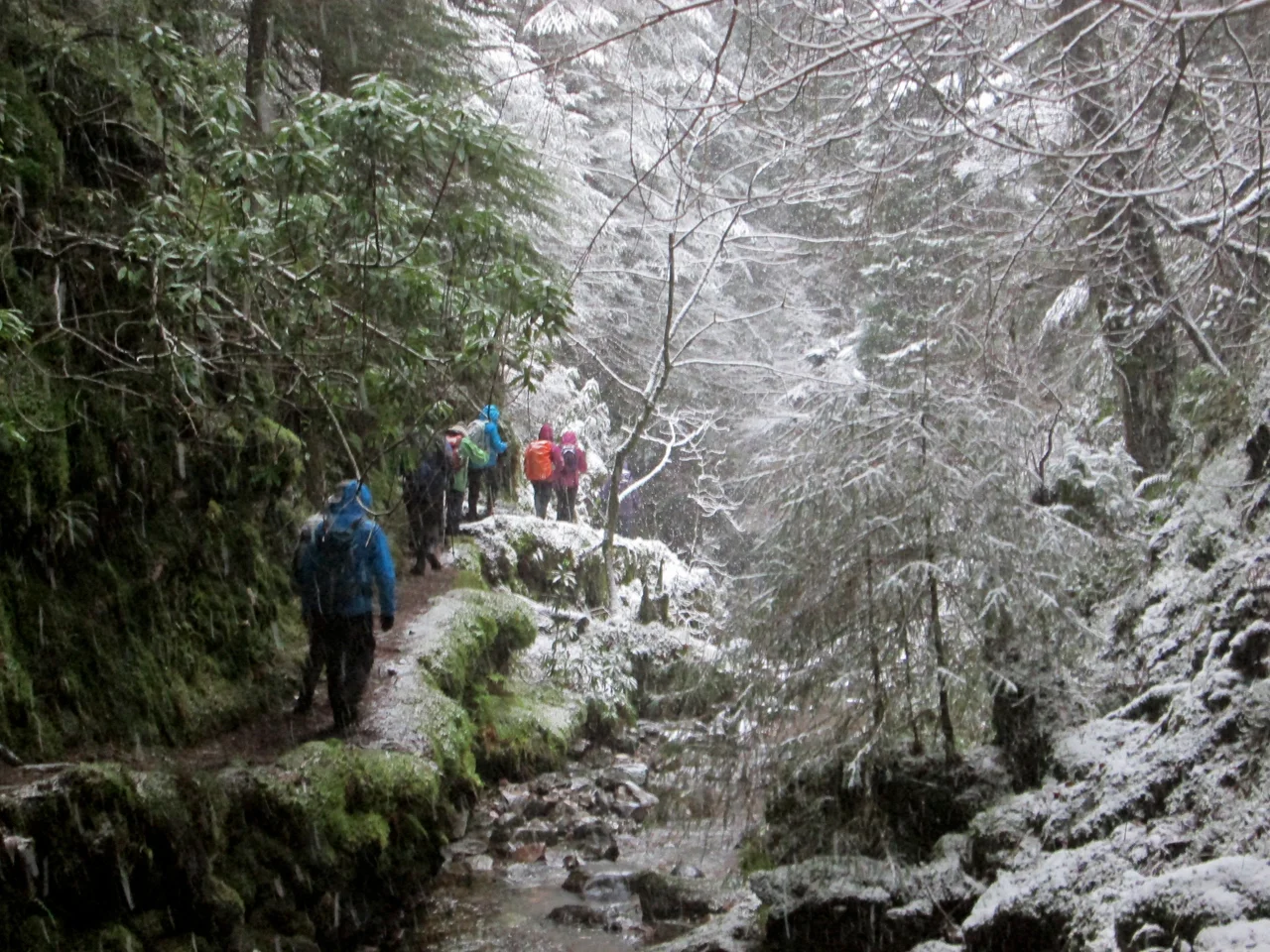
James Duncan changed everything. A Greenock sugar refiner and philanthropist who bought Benmore in 1870, Duncan absorbed the neighbouring Kilmun and Bernice estates and set about planting on a scale that still defines the landscape: more than six million trees, by the estate's own count. He cut a path up a ravine a kilometre south of the road and turned it into the scenic walk now known as Puck's Glen. He extended the east wing of the house to hold a major picture collection, and during the summers of 1881 and 1882 more than 8,000 visitors came to see it. Then, in 1889, his fortune collapsed and he was forced to sell. The trees stayed. The paintings did not.
The Brewers and Their Botanist
Henry Younger of the Edinburgh brewing family stepped in that same year, and with his son Harry George Younger he poured forty staff and decades of work into the woods and walled gardens. In memory of James Duncan's earlier improvements, the Youngers commissioned the architect Sir Robert Lorimer to design a small hut high above the gorge of Puck's Glen. They dedicated it to Sir Isaac Bayley Balfour, the botanist who had pushed for Scotland to take in the great plant collections then arriving from Asia. By the late 1920s, the Royal Botanic Garden Edinburgh was looking for somewhere wet enough to house the Himalayan rhododendrons and Chinese conifers brought back by the plant hunter George Forrest. Benmore, sodden and sheltered, was almost custom-made. In 1929 it opened as the RBGE's first outstation.
The Fernery and the Red Squirrels
Walk uphill from the formal gardens and the path crosses footbridges over the Eachaig, climbs through rhododendron thickets, and arrives at the Fernery, a glass-roofed grotto built into the hillside in the early 1870s. When Duncan's money collapsed, so did the fernery; it fell into ruin and stayed ruined for over a century. Historic Scotland listed it as a category B structure in 1992, calling it a rare survival, and after a careful restoration it reopened to the public in September 2009. Above the gardens, the path keeps climbing to viewpoints over the Holy Loch where, on clear days, the whole sweep of the Firth of Clyde opens up below. Red squirrels still live among the conifers, one of the strongholds left to a species pushed out of much of mainland Britain. The garden runs from March through October each year, closing for the wettest, darkest part of the Scottish winter.
From the Air
Benmore Botanic Garden sits at 56.026 north, 4.981 west, in Strath Eachaig between the Holy Loch and Loch Eck. From altitude the giant sequoia avenue is a thin dark line along the A815, with the glen of the Eachaig running northwest into the bulk of Beinn Mhor. EGPF Glasgow lies roughly 35 nautical miles east-southeast; EGPK Prestwick is about 45 nautical miles south-southeast. Recommended viewing altitude 2,500 to 4,000 feet for the Cowal valleys; expect frequent low cloud and orographic rain over Beinn Mhor.
Nearby Stories
- Loch Katrine 3.4 km away
- Dumbarton 4.4 km away
- Easdale 5.1 km away
- Stewarton 5.9 km away
- Gigha 9 km away
- Loch Awe 9.4 km away
- HMS Dasher (D37) 12 km away
- Jura, Scotland 13 km away