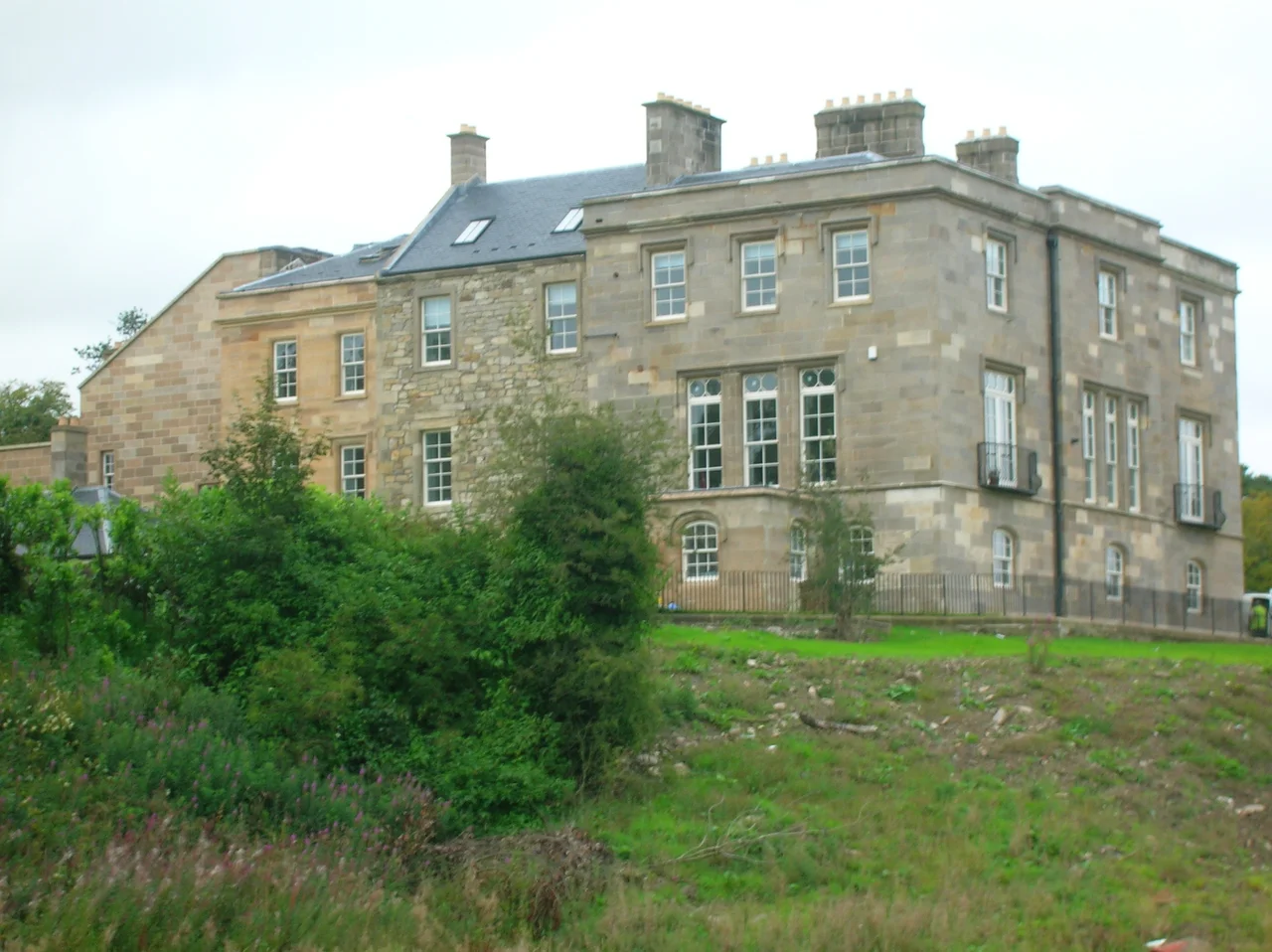

Stewarton
David Dale was born here in 1739, son of a Stewarton general dealer. He grew up to become an industrialist, a philanthropist and the founder of the cotton mills at New Lanark - a model industrial community that would later, under his son-in-law Robert Owen, become a template for humane factory work studied around the world. Two centuries after Dale's birth, the same Ayrshire town watched another of its own, Rose Reilly, become an international women's footballer of such standing that the local sports centre was renamed in her honour. A town of 7,400 has produced more than its share of people who changed lives elsewhere.
The Friskin Legend
Stewarton is recorded from at least the twelfth century. Its founding legend reaches further back, to the early eleventh, and to a story about how a farmer with a hay-fork saved a future king of Scots. According to the tale, Mael Coluim - later Malcolm III - was fleeing the assassins of Mac Bethad, the usurper who had killed his father Donnchad I. On the estate of Corsehill at the edge of Stewarton, Mael Coluim found a farmer named Friskin (or Mael Coluim, accounts differ) forking hay. The farmer hid the prince in the haystack. The pursuers passed by. After Mael Coluim defeated Mac Bethad at the Battle of Lumphanan in 1057 and became King of Scots, he rewarded Friskin's family with the Baillie of Cunninghame. The Cunninghame family logo - a Y-shaped fork with the words "over fork over" - still appears around Stewarton today, including on the logos of two local primary schools.
The Murder at the Ford
In 1586 the long-running feud between the Cunninghame and Montgomery families of Ayrshire came to a bloody head at the ford on the Annick Water. Hugh, the 4th Earl of Eglinton, was on his way to attend the court of King James VI at Stirling when he stopped at Lainshaw House (then called Langshaw) to dine. The lady of the house, Lady Montgomery, sent word to her Cunninghame associates. About thirty members of the Cunninghame clan ambushed the Earl at the ford. John Cunninghame of Clonbeith shot him dead. The Montgomery family declared they would kill every Cunninghame who had been at the river that day, and a series of tit-for-tat killings followed. John Cunninghame of Clonbeith was eventually slain in Hamilton. Several of those responsible fled to Denmark and were eventually pardoned by King James upon his marriage to Anne of Denmark.
The Highland Host
To suppress the Covenanter conventicles in the seventeenth century, King Charles II sent Highland troops - the Highland Host - into the western lowlands of Ayrshire. Contemporary accounts describe the experience in stark terms: "They took free quarters; they robbed people on the high road; they knocked down and wounded those who complained; they stole, and wantonly destroyed, cattle; they subjected people to the torture of fire to discover to them where their money was hidden; they threatened to burn down houses if their demands were not at once complied with." The cost in Stewarton parish alone was recorded as £6,062 12s 8d Scots - a staggering sum representing the wealth wrung from a small Ayrshire community by an army quartered on it against its will. The Covenanters were ordinary people whose religious convictions made them targets of state violence, and Stewarton paid a heavy price for keeping faith.
Bonnets, Cheese and Cotton
Stewarton's traditional trade was bonnet-making, and the annual Bonnet Guild still organises the town's gala festival at the start of summer. The festival proclaims a Corsehill Queen - traditionally the most academically successful girl in second year at Stewarton Academy. The Cadgers' Fair was a unique 18th-century event, when horses and cattle were traded in the Avenue Square. Dunlop cheese was made here, as well as in many other Ayrshire localities like Beith. Robert Burns's uncle Robert Burnes is recorded as having helped guard the Stewarton Laigh Church graveyard against the activities of body snatchers - the so-called resurrectionists who supplied corpses to medical schools. It was an ordinary act of community vigilance during a period when fresh graves were not always safe.
The Stewarton Flower
On the banks of the Corsehill Burn grows the Stewarton Flower - Pink Purslane, Claytonia sibirica - introduced from North America in Victorian times, probably at the Robertland Estate. It was recorded by the Kilmarnock Glenfield Ramblers in 1915 as having been in the area for over sixty years and abundant on the burn below Robertland. Strangely, the Stewarton population has held onto the white-flowered variety rather than the pink that dominates elsewhere in lowland Britain. The plant reproduces by asexual plantlets, which maintains the local white gene pool against the pink variety's broader spread. It is a botanical curiosity, a Victorian aesthetic decision that has become a tiny stubborn pocket of preserved difference - and it is a piece of Stewarton you cannot see from the road.
From the Air
Stewarton sits at 55.68°N, 4.52°W, about six miles north of Kilmarnock in East Ayrshire, at an elevation of 300 feet above sea level. Recommended viewing altitude 2,500-3,500 feet. The Annick Water flows through the town and Cairnduff Hill rises to the southeast. Nearest airports: Glasgow Prestwick (EGPK) about 15 nm southwest and Glasgow (EGPF) about 17 nm north. The M77 motorway bypasses the town - the old route through Stewarton is known locally as the Auld Glesga Road.
Nearby Stories
- Clydebank 0.4 km away
- Dunoon 5.5 km away
- HMS Dasher (D37) 6.1 km away
- New Lanark 6.3 km away
- Falkirk Wheel 11 km away
- Drumlanrig Castle 11 km away
- Ailsa Craig 18 km away
- Maybole Castle 18 km away