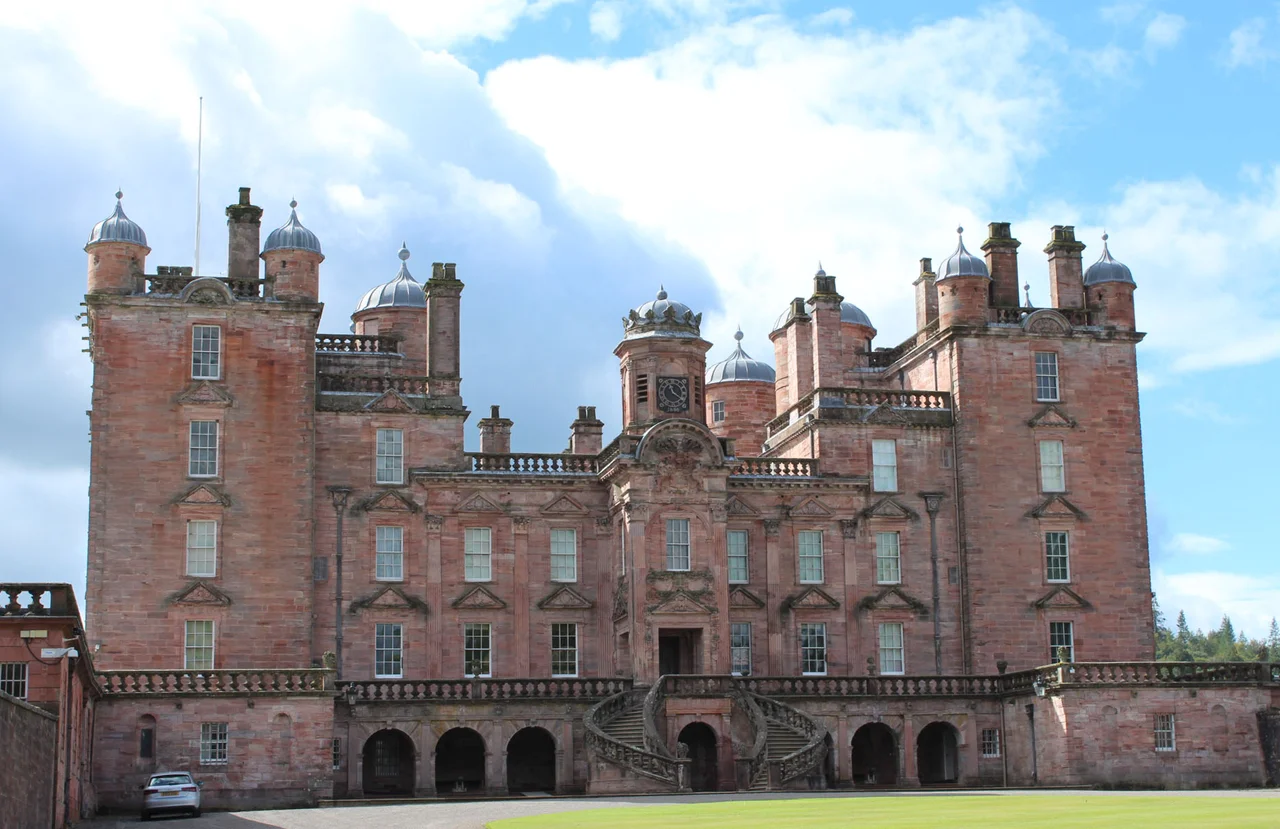

Drumlanrig Castle
It is called the Pink Palace, and the colour is no marketing flourish. The sandstone quarried locally takes a distinctive rose tint, and when William Douglas, first Duke of Queensberry, built his vast Renaissance pile between 1679 and 1689, he chose the warm pink stone as his signature. The result has 120 rooms, 17 turrets, and four towers, all rising from an ancient Douglas stronghold site overlooking the Nith Valley. Drumlanrig is the Dumfriesshire home of the Duke of Buccleuch and Queensberry, the head of the House of Douglas line that has held this land for more than seven centuries.
Built in Ten Years
Construction ran from 1679 to 1689, ambitious by any standard for a private house of that scale. The castle is an example of late 17th-century Renaissance architecture, drawing on the new continental fashions then sweeping aristocratic Britain. The first Duke of Queensberry placed his new palace on the site of an older Douglas stronghold, choosing the prominent rise above the Nith Valley to assert lineage as much as command the view. The pink sandstone came from local quarries, the same warm material that tints buildings throughout the region. The earliest record of the name Drumlanrig appears in 1374, spelled Drumlangryg. Etymologists suggest a Cumbric origin meaning ridge plus a small area of cleared woodland, or possibly Gaelic druim, ridge, joined to Scots lang-rigg, long ridge.
Gardens of Three Dukes
Between 1675 and 1697 a formal garden took shape around the new house, designed to principles set out by the architect Sir William Bruce. The plans resembled those Bruce had drawn for Kinross House and Balcaskie. Stone walls enclosed the gardens, and six stone pavilions stood within, each topped with lead ogee roofs matching the main building. Water features included a 'clanging clock'. In 1695 the second duke inherited and sent gardener James Wood to London for further training. Wood failed to return, and the duke hired the Dutch gardener Cornelius van Nerven instead. The third duke employed David Low as head gardener from 1714 to 1747, and during that period Sir John Clerk of Penicuik designed the water cascades added between 1728 and 1732. A bowling green was created here too, an early example.
The Yarnwinder Heist
Among the paintings hanging at Drumlanrig was Leonardo da Vinci's Madonna of the Yarnwinder. On 27 August 2003, two men posing as tourists overpowered a guide during a public tour, lifted the painting off the wall, and escaped. The Renaissance masterpiece, one of fewer than twenty surviving paintings attributed in part to Leonardo's own hand, vanished into the criminal underworld. It stayed missing for four years. In October 2007 police recovered the painting in Glasgow, where it had been brought as part of a sting operation. The Madonna of the Yarnwinder now lives on loan at the Scottish National Gallery in Edinburgh, no longer easy prey on a quiet Wednesday tour. The castle's collection also holds many other paintings, tapestries, and objects of art accumulated by ten generations of dukes.
Gardens Lost, Then Reclaimed
When David Low died in 1747, the number of gardeners fell to eight or ten men and the new head gardener was paid less. The formal gardens grew less perfectly maintained year by year. By 1810, the family decided to remove the formal gardens altogether. Some of what Bruce had laid out vanished forever. The current gardens reflect a long, ongoing recovery, returning the grounds to something of their original ambition while accepting the layered history of three centuries. Today the castle itself opens to the public only on limited dates each year, though the stableyard, adventure playground, and walking and cycling routes remain accessible nearly all year round. Storm Arwen closed many of those routes in 2021. Repairs continued for months afterward.
The Buccleuch Estate
The Duke of Buccleuch holds extensive landholdings across the United Kingdom, and Drumlanrig sits at the heart of the Queensberry Estate. The Stableyard Studios, in the former working stables next to the castle, now host a range of local businesses, a tearoom, and an adventure playground for visiting families. Walking, hiking, and cycling routes thread the surrounding parkland and forest. The cumulative effect is unusual: a private aristocratic residence partially opened to the public, with the working stableyard turned over to local enterprise while the main house preserves its rooms for limited tours. Drumlanrig is a category A listed building. The Pink Palace, three centuries on from William Douglas's grand idea, still glows rose in the Nithsdale afternoon.
From the Air
Drumlanrig Castle sits at 55.27 degrees north, 3.81 degrees west, in the Nith Valley about 18 miles north of Dumfries near Thornhill. The pink sandstone palace is unmistakable from the air, with its symmetrical Renaissance layout and 17 turrets standing on a prominent rise. Cruise at 3,000 to 4,500 feet to take in the castle, its surrounding parkland, the meandering River Nith, and the surrounding forestry. Dumfries Aerodrome (EGCO) lies about 20 miles south. Glasgow Prestwick (EGPK) is roughly 35 miles northwest, and Carlisle Lake District Airport (EGNC) sits 45 miles south. The A76 runs north-south along the Nith Valley past the estate.
Nearby Stories
- National Museum of Costume 5.8 km away
- Quintinshill Rail Disaster 6.3 km away
- Darvel 8 km away
- Traquair House 9.3 km away
- Douglas Castle 9.4 km away
- Battle of Arkinholm 18 km away
- Cumnock 19 km away
- Kirkinner 26 km away