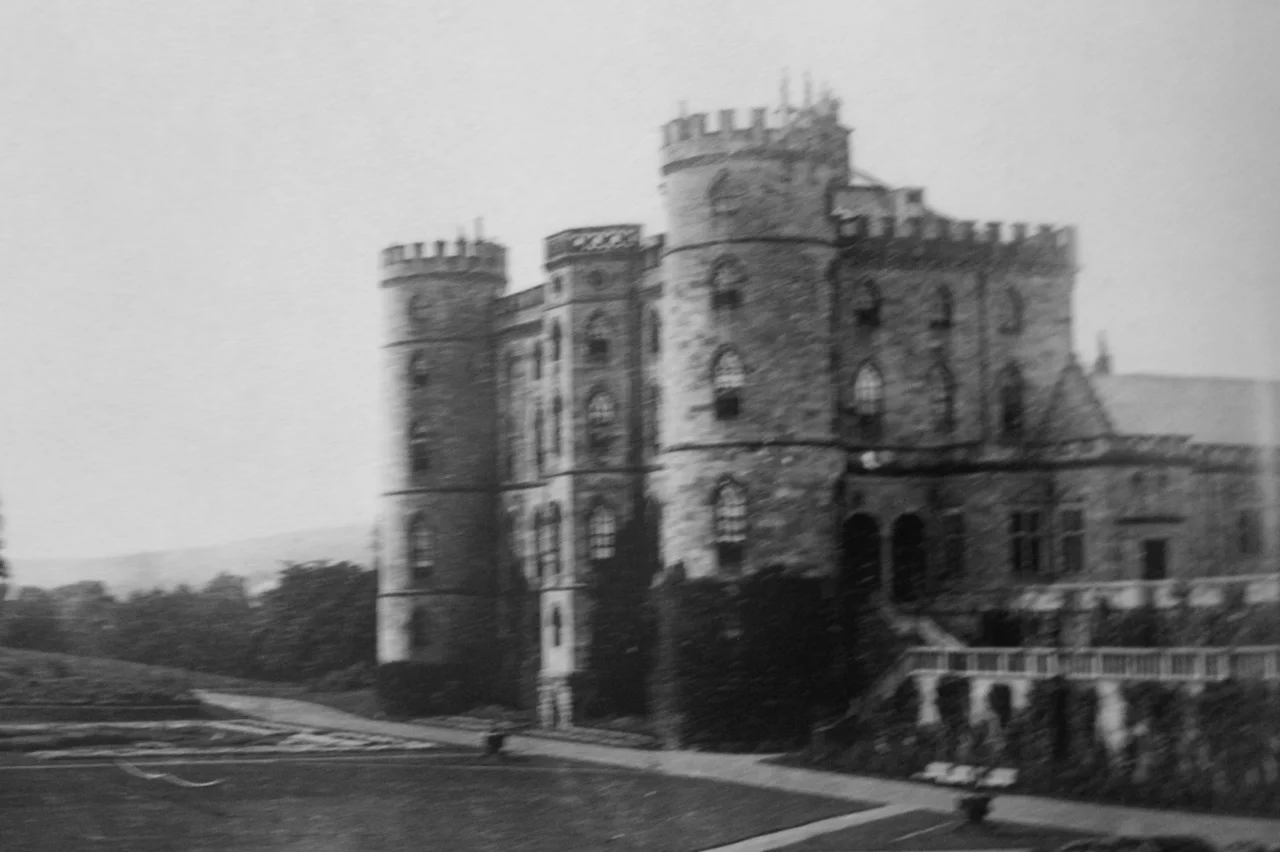

Douglas Castle
On Palm Sunday 1307, Sir James Douglas walked into a chapel where the English garrison occupying his family's castle were at worship. They had taken it during the Wars of Scottish Independence, and Sir James — Robert the Bruce's loyal companion, soon to be known across Christendom as the 'Black Douglas' — wanted it back. He killed the garrison, threw the bodies into a cellar, and set the building on fire. Soldiers afterward called the act 'Douglas's Larder,' a grim joke about a meat-store full of dead men. The castle was rebuilt. Then sacked. Then rebuilt. Then burned in 1755. Then rebuilt, again, by the Adam brothers as what would have been the largest castle in Scotland. Then half-finished. Then demolished in 1938 — undermined by the very coal pits its last owner had opened to keep his desperate tenants employed during the Depression. Today a single corner tower remains, three storeys of weathered stone on a rise above the Douglas Water.
The Family the Bruce Made Rich
Robert the Bruce rewarded Sir James's loyalty with vast holdings, and the Douglases became one of the great noble houses of Scotland. In 1357 Sir James's nephew was created the first Earl of Douglas. In 1384 his illegitimate son Sir Archibald Douglas became the third Earl, and the castle at Douglas was rebuilt as a primary stronghold of the family. Through the next century, the 'Black' Douglases grew so powerful they came to threaten the Stewart monarchy itself. In 1455 King James II marched against the rebellious ninth Earl and crushed his forces at the Battle of Arkinholm. The castle was sacked. The lands and titles were forfeited. They passed to the 'Red' Douglases, the Earls of Angus, who had sided with the king — and who, by some accounts, may have been just as glad to see their senior cousins humbled. The castle was rebuilt, of course. They always were.
The Last and Greatest Castle
In 1703 Archibald Douglas became the first Duke of Douglas, with his principal seat at the castle. A new tower house with an enclosed courtyard went up, and a corner tower at its edge — the same tower that still stands today. In 1755 fire swept through and destroyed everything except that one tower. From 1757 the Duke commissioned the Adam brothers — James, John, and Robert, the most famous architectural family in eighteenth-century Britain — to design something extraordinary. The plan was a five-storey castellated mansion with round towers on the front, square towers on the rear, and an enormous park spanning the valley of the Douglas Water. Had it been completed it would have been the largest castle in Scotland. But the Duke died in 1761, and only about half the design was ever built. A famous legal dispute called the Douglas Cause then erupted between his nephew and the Duke of Hamilton over who would inherit. The nephew won, was ennobled as Baron Douglas in 1790, and the estate passed through his daughter and granddaughter to the Earls of Home.
Undermined
By the 1930s Lanarkshire was a place of catastrophic unemployment. Coal pits were closing, men with families had no work, and Charles Douglas-Home, the thirteenth Earl of Home, faced a choice that would have been agonising for any landowner with a sense of duty to his tenants. He allowed coal mining in the park immediately adjacent to the castle. It was a way to provide jobs — desperate, necessary jobs — but the mining caused subsidence. The ground beneath the great Adam-designed mansion began to shift. By 1938 the structure was dangerous, and it had to be demolished. The decision is hard to second-guess. The castle was a single building; the unemployment was a whole community.
Castle Dangerous
Today only the seventeenth-century corner tower remains, three storeys and nine metres tall, standing on a rise to the south of the river. It was retained as a garden folly when the great mansion was built around it. Below, a small cellar block survives with glazed tiles still on the interior walls. Nothing visible remains of the Adam mansion itself. Sir Walter Scott used the castle and its early history as the inspiration for his novel Castle Dangerous, and locals still sometimes use that name. A former lodge from the estate has been preserved at the Cairn Lodge service area on the M74 — for many drivers heading south, an unremarkable petrol stop that is in fact the last fragment of a great family seat. The remains are protected as a Category C listed building. The Earls of Home, who became Douglas-Home, still hold the family name; one of them, Sir Alec Douglas-Home, briefly served as British Prime Minister from 1963 to 1964.
From the Air
Douglas Castle's surviving tower sits at 55.57°N, 3.84°W, about one kilometre northeast of the village of Douglas in South Lanarkshire. At cruising altitude of 3,000 feet AGL the rolling moorland of southern Lanarkshire opens out below: the Douglas Water valley winds northeast toward Lanark and the upper Clyde, and the M74 motorway runs to the west, with Cairn Lodge services (which preserves a former castle lodge) visible on the carriageway. Glasgow Airport (EGPF) is 25 nm north-northwest; Edinburgh (EGPH) is 35 nm northeast; Glasgow Prestwick (EGPK) is 22 nm west. The tower itself is small — a single three-storey ruin on a low rise — and easy to miss from the air; the village of Douglas to the southwest and the surviving curve of the Douglas Water to the north are better landmarks.
Nearby Stories
- Craigmillar Castle 3.4 km away
- Darvel 4.8 km away
- Innerleithen 6.8 km away
- Battle of Linlithgow Bridge 8.8 km away
- Mugdock Castle 10 km away
- Morton Castle 11 km away
- Battle of Arkinholm 27 km away
- Maybole Castle 29 km away