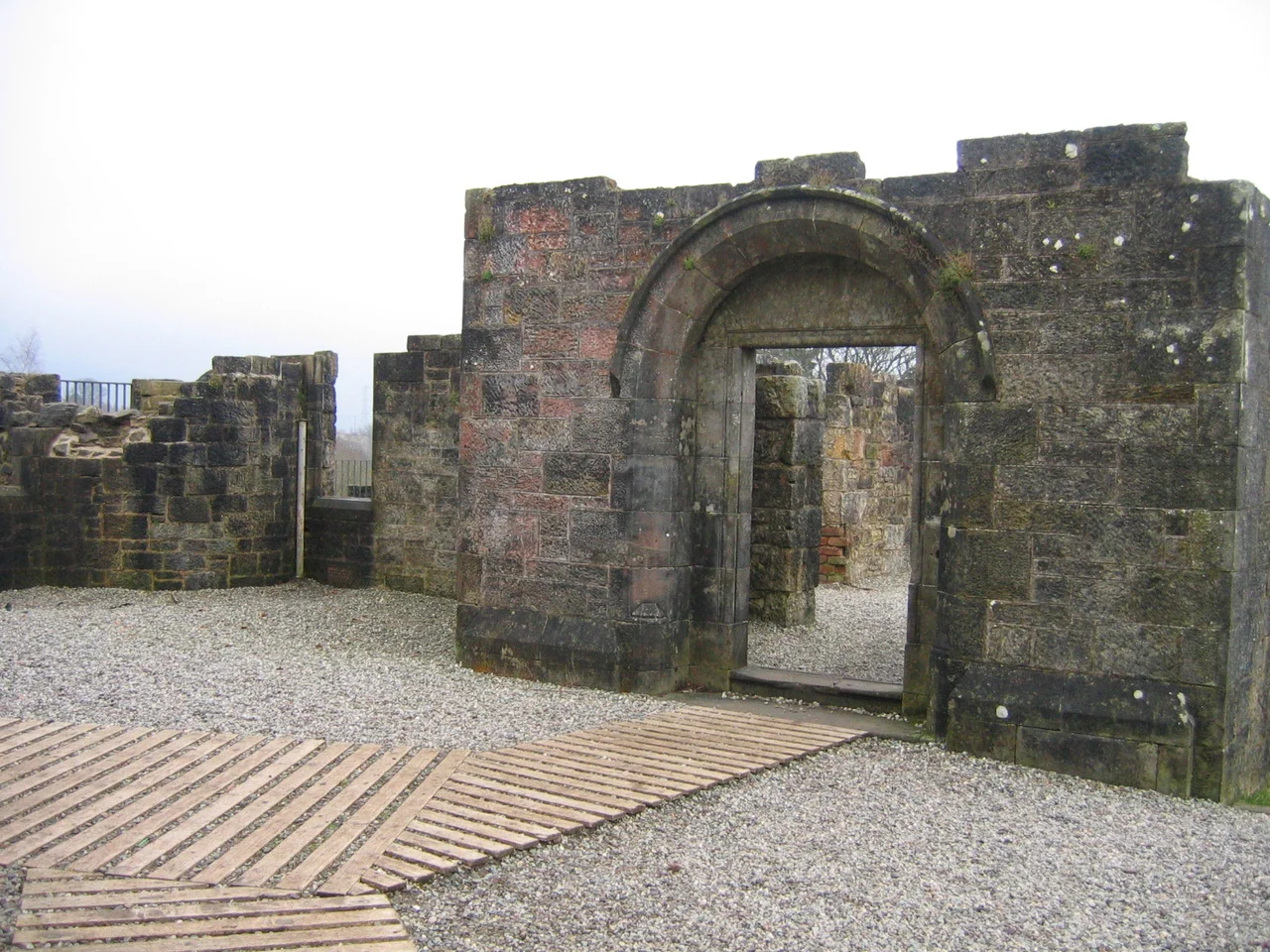

Mugdock Castle
By 1644, the south-west tower of Mugdock Castle had already watched four centuries pass. It would shortly watch a sacking, the second in three years. James Graham, 1st Marquess of Montrose, had switched sides in the religious wars then convulsing Scotland - first supporting the Covenanters against Charles I, then turning Royalist and becoming the King's commander north of the border. While Montrose had been briefly imprisoned in Edinburgh in 1641 for his intrigues against Archibald Campbell, 1st Marquess of Argyll, his rival Lord Sinclair had sacked Mugdock. Now, with Montrose back in the field, the castle was sacked again. The tower stood. It is still standing today, on a low ridge in the woods two kilometres north of Milngavie, the most recognisable surviving fragment of a complex that has been rebuilt, demolished, and rebuilt again at least four times in seven centuries.
Clan Graham's First Stronghold
The lands of Mugdock came to the Grahams in the mid-thirteenth century, when David de Graham of Dundaff acquired them from the Earl of Lennox. The castle itself was probably built by his descendant Sir David de Graham, who died in 1376, or by his son around 1372. It may have been shield-shaped on plan: towers arranged around a courtyard, linked by curtain walls. Only the south-west tower survives complete. It is four storeys tall, narrow, with the entrance on the first floor accessed by exterior steps. Inside, the basement is vaulted, and a single room occupies each storey. A line of corbels projects the upper two storeys out beyond the lower walls, giving the tower its distinctive top-heavy silhouette. Only the basement of the north-west tower remains, along with part of the gatehouse and stretches of curtain wall. In the mid-fifteenth century, around the time the barony was created, an outer wall was built to enclose the rest of the mound as a courtyard.
Two Executions, One Castle
After Charles I was defeated and executed in 1649, Montrose was hunted down and hanged in Edinburgh in May 1650. The Graham lands, including Mugdock, were forfeited to the Marquess of Argyll. The reversal was short. In 1661, with the restoration of Charles II, Argyll himself was tried for treason and executed. Mugdock returned to the Grahams, who spent two years repairing the war damage and built a new mansion within the old castle walls. In 1682 they bought Buchanan Auld House near Drymen, a dwelling deemed more fitting to the title of Marquess, but they kept Mugdock as the official clan seat for some time after. The castle had passed back and forth between two families whose heads had been executed within eleven years of each other, and somehow it had stayed structurally intact through it all.
John Guthrie Smith Reinvents It
By the 1870s, the castle was a quiet curiosity in the Lennox countryside. John Guthrie Smith, a local historian (1834-1894) and a relative of the Smith family of nearby Craigend Castle, leased the property from 1874. He demolished the seventeenth-century mansion and commissioned a new house in the Scottish baronial style, designed by the architects Campbell Douglas and Sellars and built within the medieval ruins. James Sellars extended the design in the 1880s. The new house was L-shaped, three storeys high, with its front door facing the surviving south-west tower across a small courtyard. The tower itself was incorporated into the new building by a first-floor covered passage carried over a wide-arched bridge. It was an act of historical theatre that worked surprisingly well, a Victorian fantasy of a Scottish castle built into the bones of an actual one.
Burnt, Bought, Donated
During the Second World War the house was requisitioned by the government. In 1945, Hugh Fraser - later Lord Fraser of Allander, owner of the retail empire House of Fraser - bought Mugdock Castle from the Duke of Montrose. In 1966 the Victorian house burned down, along with the remaining sixteenth-century outbuildings. Mugdock House was effectively over. What remains is the original medieval south-west tower, parts of the outer wall, the basement of the north-west tower, fragments of the chapel and domestic range from the sixteenth century, and the foundations of the Victorian house. Some walls of the 1860s mansion still stand to first-floor level. The Smith family had laid out terraced walled gardens to the east of the castle in the 1820s; sections of those survive too.
Mugdock Country Park
The estate is now Mugdock Country Park, a 750-acre publicly accessible green space two kilometres north of Milngavie on the northern edge of Greater Glasgow. The remaining tower of the fourteenth-century castle has been renovated as a small museum. The ruins are protected as a scheduled monument. The park draws walkers, dog-owners, picnickers, and orienteers from across the city, and on weekends the path past the south-west tower is busy. Almost none of those visitors know that the tower once watched a Royalist commander ride out to fight his arch-enemy, that it survived two sackings inside the same war, that it was once joined to a Victorian house that burned, or that the man it was built for died over six hundred years ago. The tower does not advertise its history. It just stands there, top-heavy and improbable, while the country park lives around it.
From the Air
Located at 55.97N, 4.32W, in Mugdock Country Park about 2 km north of Milngavie on the northern edge of Greater Glasgow. The surviving south-west tower of the fourteenth-century castle and the country park's woodlands are visible from altitude as a green island in suburban surroundings. Best viewed at 2,000-3,000 ft AGL. Loch Lomond lies about 13 nm north-northwest; the Campsie Fells rise to the north. Glasgow International (EGPF) is ~7 nm south-southwest and Glasgow Prestwick (EGPK) ~26 nm south. Glasgow CTR (Class D) is close - check airspace before low flight. Nearest GA: Cumbernauld (EGPG) ~10 nm east-southeast.
Nearby Stories
- Holy Loch 0.7 km away
- Falkirk Wheel 2.2 km away
- Battle of Loup Hill 2.4 km away
- Tullibardine Distillery 5.1 km away
- Loch Katrine 7.5 km away
- New Lanark 8.5 km away
- Stewarton 8.9 km away
- HMS Dasher (D37) 12 km away