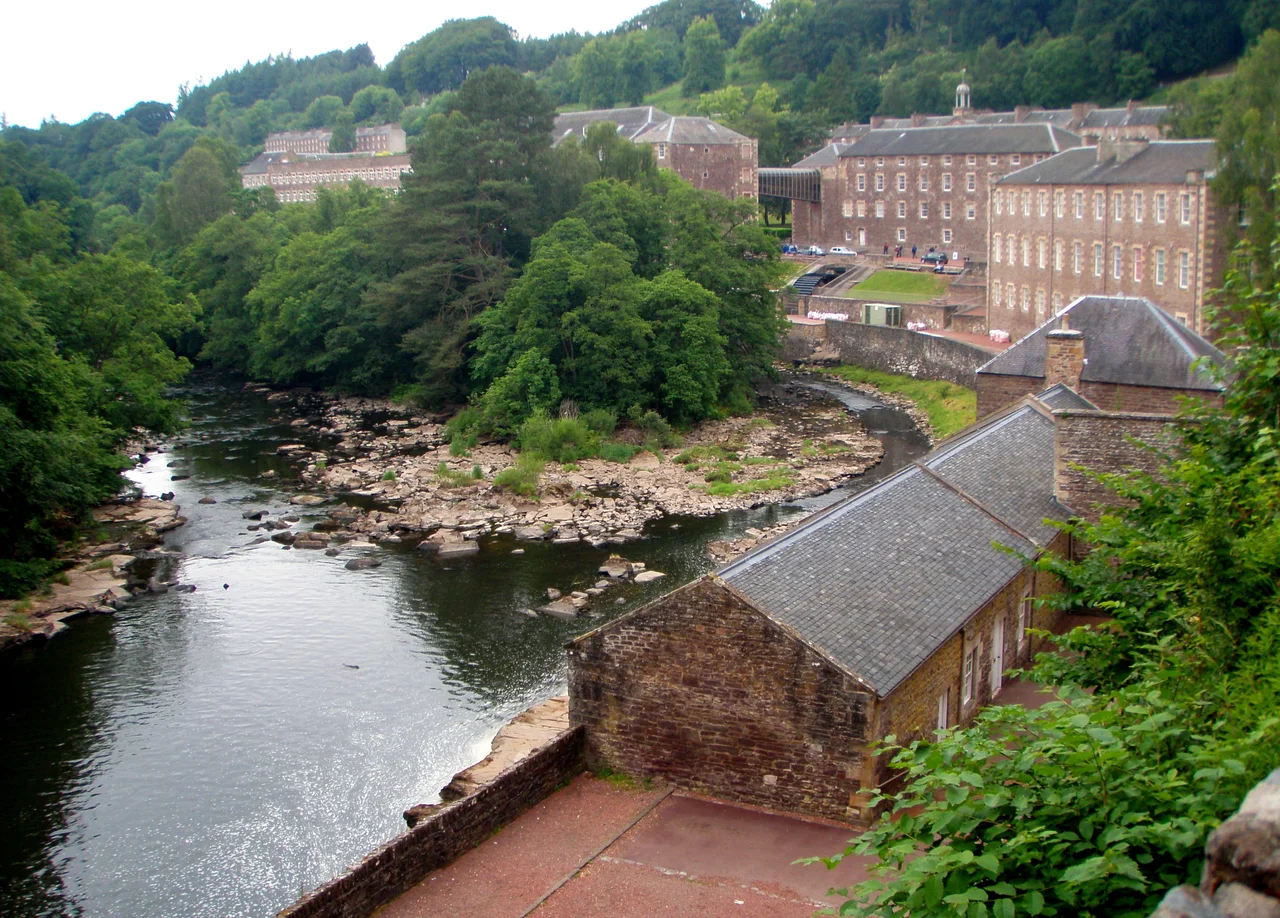

New Lanark
Robert Owen did not believe people had to suffer in order for cotton to be cheap. This was, in 1800, an unusual position to hold. The conventional wisdom of the early Industrial Revolution was that the new factories required exhausted children working sixteen-hour days, families crammed into single rooms, and overseers with sticks. Owen became manager of the New Lanark cotton mills, married the founder's daughter, and set about proving the conventional wisdom wrong. He shortened the working day. He built a school for the workers' children — the first school for working-class children in Scotland. He banned beating. He paid wages when the mills were idle. And, against the predictions of every other industrialist in Britain, the mills kept making money. New Lanark became famous across Europe as the place where industry and human dignity were not, after all, incompatible.
Why Here
The village exists because of the only set of waterfalls on the River Clyde — the Falls of Clyde, painted by J. M. W. Turner and a generation of Romantic artists. In 1785 the Glasgow merchant David Dale and the English inventor Richard Arkwright, whose water-powered spinning machinery had revolutionised cotton manufacture, decided to put a mill where the water power was free for the taking. A dam was built upstream. Water was drawn through a tunnel and then through an open channel — the lade — to the waterwheels in each mill building. The first spindles turned in March 1786. The partnership between Dale and Arkwright lasted only briefly, but Dale built four mills and the tenement rows to house the workers — Braxfield Row, Long Row, Caithness Row (named for a group of Highlanders recruited from the far north). By 1800 some 2,500 people lived at New Lanark, many of them taken from the poorhouses of Glasgow and Edinburgh. They had nowhere else to go.
Owen's Experiment
Dale sold the mills, lands, and village in 1799 for £60,000, payable over twenty years, to a partnership that included his son-in-law Robert Owen. Owen became mill manager in 1800. He was a Welsh-born industrialist who became, through what he saw at New Lanark, one of the most influential social reformers of the nineteenth century. The 'Institute for the Formation of Character,' built in 1816, contained classrooms, lecture halls, and dance floors. The school in 1817 took in children too young for the mills and taught them. The Nursery Buildings of 1809 housed orphan children who worked at the mills, but housed them — by the standards of the time — well. Owen's partners disliked the expense. In 1813, when they tried to force the mills to revert to the old ways, Owen bought them out with the help of a new board that included the philosopher Jeremy Bentham. The experiment continued. Owen would go on to attempt similar communities in America at New Harmony, Indiana, where the model failed; New Lanark survived because Owen was, before he was a visionary, a competent mill manager.
How They Lived
It is easy to romanticise New Lanark, because compared to the average mill town of 1820 it was a paradise. But people still lived hard. In the mid-nineteenth century an entire family occupied a single room. Children slept in trundle beds pulled out from beneath the parents' bed. The communal toilets were outside, and stayed outside until 1933, when interior cold-water taps and indoor toilets finally arrived. From 1938 the village had free electricity — but only enough power for one dim bulb per room, switched off at 10 pm Sunday through Friday, 11 pm Saturday. Not until 1955 was New Lanark connected to the National Grid. The mills themselves kept running until 1968, then closed. The village began to decay. Mantilla Row had to be demolished when it became structurally unsafe. In 1974 the New Lanark Conservation Trust was formed specifically to prevent the entire place being torn down.
World Heritage
By 2006 most of the buildings had been restored, including Mill Number One — which began life in 1785, burned down in 1788, was rebuilt, lost its top two floors in 1945, sat derelict for decades, and reopened in 1998 as the four-star New Lanark Mill Hotel. Mill Number Three, the old jeanies' house that contained dozens of water-powered spinning jennies, now houses a modern water turbine that generates electricity for the tourist village. Around 400,000 people visit each year. UNESCO designated New Lanark a World Heritage Site in 2001, recognising both its place in the Industrial Revolution and its role as an early experiment in planned community. About 130 people still live in the village. The 2009 Clydesdale Bank twenty-pound note features New Lanark on its reverse. Owen would, one suspects, have been quietly satisfied — though he would also have noticed that the conditions he fought to provide for cotton workers in 1815 are still not provided, in 2026, to workers in many parts of the world where the cotton goes now.
From the Air
New Lanark is at 55.66°N, 3.78°W, on the River Clyde about 1.4 miles southeast of the town of Lanark and 25 miles southeast of Glasgow. From altitude the village shows as a tight cluster of multi-storey mill buildings and tenement rows in a steep wooded gorge — a striking contrast to the rolling farmland around it. The Falls of Clyde lie just upstream. Nearest airports: Glasgow (EGPF) 25 nm northwest, Edinburgh (EGPH) 28 nm northeast, Glasgow Prestwick (EGPK) 32 nm west-southwest. The M74 motorway runs about 4 miles to the southwest. For pilots approaching from the west, the river bend at Bonnington and the Falls give a memorable navigational landmark; the village itself is best seen from 2,000-3,000 feet AGL where the geometry of Owen's planned settlement is legible against the wooded valley.
Nearby Stories
- Craigmillar Castle 3.4 km away
- Darvel 4.8 km away
- Innerleithen 6.8 km away
- Battle of Linlithgow Bridge 8.8 km away
- Mugdock Castle 10 km away
- Morton Castle 11 km away
- Battle of Arkinholm 27 km away
- Maybole Castle 29 km away