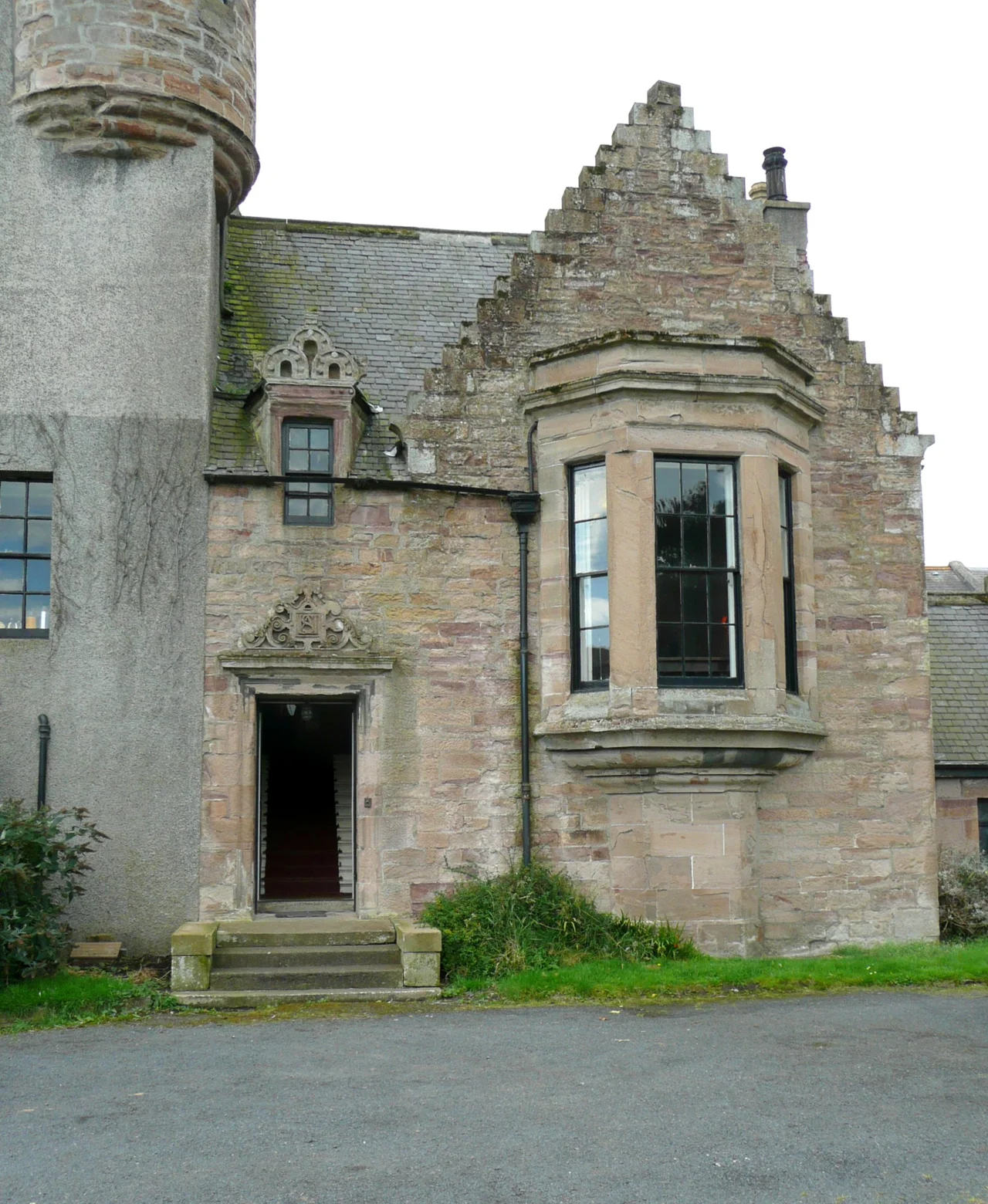

Maybole Castle
Walls seven feet thick will outlast a great deal of bad luck. Maybole Castle has had centuries of it. Built around 1560 for the Earls of Cassillis - the Kennedy clan that ran Ayrshire for generations - it survived a blood feud, a demolition in 1805, a long Victorian afterlife as a town mansion, and a slow twenty-first-century slide onto Scotland's Buildings at Risk Register. It is still, against the odds, the oldest inhabited dwelling in the town.
The L-Shape on High Street
Maybole Castle is built in an L-shape, with Victorian two-storey extensions added to the original tower. The lower floor holds vaulted cellars, a kitchen and a scullery. The exterior carries a great deal of decorative stonework: faces around an oriel window on the south-west side, a recessed panel that once held the Cassillis coat of arms. The first owners may have been Gilbert Kennedy, 4th Earl of Cassillis, or his son John, the 5th Earl. We know that Margaret Kennedy, Countess of Cassillis, was writing letters from the castle in 1578 - listing the luxuries she wanted: velvet for a cloak, a locket, various other small extravagances. The castle was a town house for one of Scotland's most powerful families, the place they kept up appearances when they were not at Cassillis House itself.
Feud and Ambush
Late in the sixteenth century, a feud broke out between the Cassillis Kennedys and the Bargany Kennedys - the same surname, different branch, mutual hatred. The flashpoint was an episode in which Thomas Kennedy had effectively tortured the landowner Allan Stewart into signing over an abbey lease. In 1601, John Kennedy, 5th Earl of Cassillis, rode out from Maybole Castle with 200 armed followers and intercepted Gilbert Kennedy of Bargany and Ardstinchar returning from Ayr. Gilbert and some of his followers were killed. The 5th Earl's party was acquitted of murder; the court, in a piece of legal reasoning that says a great deal about the period, ruled it an act of service to the King. The castle then carried on as the headquarters of a clan that had just gotten away with murder.
The Countess and the Gypsy
The most famous story attached to Maybole Castle is almost certainly fiction. The legend of John Faa - sometimes called "King of the Gypsies" - is a Scottish version of the ballad The Raggle Taggle Gypsy. In the story, the Countess of Cassillis runs away with Faa, her husband the Earl hangs Faa from a dule tree, and then locks his wife in the castle for the rest of her life. The Earl is supposed to have built the famous oriel window so she could look out, decorating it with carvings of Faa and his accomplices' faces. Historians usually identify the Earl as John Kennedy, 6th Earl of Cassillis - but the oriel window predates him, which rather undermines the legend. The room is still called "The Countess's Room." Stories sometimes outlive evidence.
Mackintosh's Notebook
By the start of the nineteenth century the castle had fallen into disrepair, and in 1805 part of the original structure was demolished and the main entrance modified. In the 1890s, the architect Charles Rennie Mackintosh - then still a young man, still pursuing what he called his "perpetual interest in recording the decorative details of the buildings of the old national style" - examined the castle and drew it. His sketches show where the harling had fallen away to reveal the masonry beneath, and document the decorative stonework in close detail. By the 21st century the castle had landed on the Buildings at Risk Register; in 2009 the Maybole Castle Community Trust was registered as a charity, and grants began to flow. In 2021, the Scottish Government's Regeneration Capital Grant Fund added 729,000 pounds to a wider Maybole regeneration scheme. Construction work began. Nearly five hundred years on, the L-shape on the High Street is still being repaired.
From the Air
Maybole Castle sits at 55.35 degrees north, 4.68 degrees west, in the centre of Maybole in South Ayrshire's Carrick district. The town is inland, about 4 miles east of the coast. The Carrick hills form the backdrop, and Culzean Castle's headland is visible to the west. Glasgow Prestwick (EGPK) lies approximately 12 nautical miles to the north; the Isle of Man's Ronaldsway (EGNS) is about 95 nautical miles to the south.
Nearby Stories
- Troon Lifeboat Station 4.1 km away
- Battle of Drumclog 9.7 km away
- Knockshinnoch Disaster 13 km away
- Lochranza 18 km away
- Threave Castle 18 km away
- Wigtownshire 21 km away
- Dunaverty Castle 24 km away
- SM UB-85 27 km away