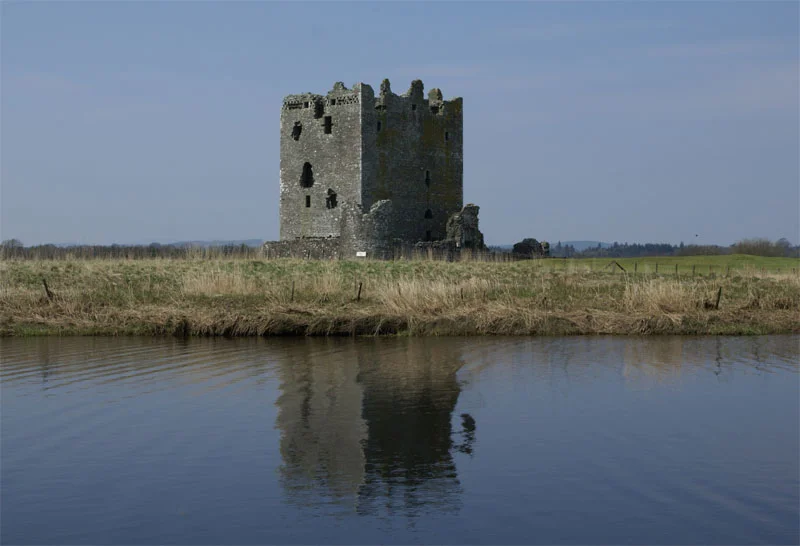

Threave Castle
You reach Threave the way besiegers had to: by water. The keep stands alone on a low island in the River Dee, two and a half kilometres west of Castle Douglas, and the only way across is the small ferry that runs from the National Trust estate on the east bank. The boatman rings a bell to summon it. The walls rise out of marsh-grass and reflected sky, blunt and unornamented, the colour of old iron. Five storeys of grey stone, twenty-one metres high, broken by narrow windows. For most of the 15th century, this was the seat of the most powerful family in Scotland - and the place where their power finally cracked.
Archibald the Grim's New Tower
The man who built Threave earned his nickname in war. Archibald Douglas, illegitimate son of Good Sir James Douglas, was made Lord of Galloway in 1369 after he and Edward Bruce had broken the local resistance to the Bruce cause. He spent the next decade attacking the English on both sides of the border as Warden of the West March, and in 1372 he absorbed the lands of the Earl of Galloway, bringing the whole province under his hand. He needed a stronghold. The island in the Dee suited - defensible by water, central to Galloway, far from English raiders. The keep he raised in the 1370s was one of the first true tower houses in Scotland, a rectangular block with walls two metres thick, a kitchen and reception hall on the first floor, the lord's chamber above, and vaulted cellars with a well and a prison beneath. Archibald died here in 1400, the first historical mention of the castle, by then 3rd Earl of Douglas and the most powerful magnate in the country.
The Duchess Who Ruled
When Archibald's son the 4th Earl was killed fighting the English at the Battle of Verneuil in 1424, his widow Margaret took on the Lordship of Galloway. She was Princess Margaret, daughter of Robert III, and she ruled from Threave as Countess of Douglas and Duchess of Touraine for the next twenty-three years. She outlived her son and her grandsons. A lead seal matrix found in 20th-century excavations carries her coat of arms, the Douglas arms quartered with the royal arms of Scotland - the workmanship is rough, possibly a trial piece, possibly a forgery, but the seal itself is a rare survival. In 1447 the 8th Earl forced her to give up Threave and retire to Lincluden, where her monument still stands. She died at Threave soon after. The artillery house her successor began that same year - a curtain wall with three round towers, gun ports cut in dumb-bell and inverted-keyhole shapes - is considered one of the first purpose-built artillery defences in Britain.
Black Dinner, Black Douglas
The fall of the Black Douglases reads like a sequence of escalating betrayals. In 1440, William and David Douglas - children of the 5th Earl - were summoned to Edinburgh Castle, dined alongside the ten-year-old King James II, and then summarily beheaded on trumped-up charges over the boy king's protests. The conspirators included James Douglas, Earl of Avondale, Archibald the Grim's own son, who inherited the earldom as the principal beneficiary. The next generation pushed the king harder still. In 1452 the 8th Earl seized Patrick Maclellan of Bombie, Sheriff of Galloway, and imprisoned him at Threave; despite a royal request for his release, Maclellan was murdered. Days later King James personally stabbed the 8th Earl at Stirling Castle and had his body thrown from a window. The 9th Earl took up the cause, intrigued with Henry VI of England for money, and was finally broken at the Battle of Arkinholm in May 1455.
The Bombard from Linlithgow
Threave was the last Douglas stronghold to fall. The royal army arrived in June 1455. King James resided at Tongland Abbey nearby and settled in for a siege that ran more than two months. The new artillery house worked: the king's men could not take the castle by force, even after a massive bombard - the kind of cannon that throws stone balls the size of barrels - was dragged up from Linlithgow Palace at a cost of over fifty-nine pounds. (A persistent myth credits Mons Meg with the work, claiming a Kirkcudbright smith named Mollance built it and the first ball took off the Fair Maid's hand as she drank. Mons Meg was actually made in Burgundy and only arrived in Scotland in 1454. The siege took it down, but not by gunpowder.) In the end James persuaded the garrison out with grants of land and quiet payments to Douglas supporters.
Royal Castle, Covenanter Ruin
Threave became Crown property and a long series of keepers passed through. James IV visited in 1502, when royal accounts record cloth, wine, and falconers brought to the island. From 1526 the keepership was made hereditary to the Maxwells of Caerlaverock, who held it through Scotland's Reformation crises. The end came in 1640 during the Bishops' Wars, when the Maxwells installed a hundred-man royalist garrison. The Covenanter army arrived that summer and laid siege for thirteen weeks. On the orders of King Charles, the garrison surrendered. The Covenanters dismantled the buildings, scattering stone to the use of the public. The keep and the southeast tower of the artillery house survived; the other towers collapsed. After 1913 the ruin came into state care, and Historic Environment Scotland maintains it today. The island, now a National Trust nature reserve, is home to bats and ospreys. Access is still by boat.
From the Air
Threave sits at 54.94 N, 3.97 W on an island in the River Dee, two and a half kilometres west of Castle Douglas. The nearest airport is Dumfries (formerly RAF Dumfries, now general aviation only) about 20 nm northeast. Carlisle (EGNC) is roughly 40 nm southeast across the Solway Firth, and Prestwick (EGPK) about 50 nm northwest. From 1,500 to 3,000 feet AGL the island reads as a green tear-drop in the Dee floodplain, the grey keep standing sharply against the surrounding marsh. The Solway estuary opens to the south. Watch for low cloud rolling in off the firth on westerly winds, and for grass-strip traffic at nearby private fields.
Nearby Stories
- Moniaive 7.7 km away
- Jennings Brewery 9.8 km away
- Ruthwell Cross 10 km away
- Wigtownshire 16 km away
- Crossraguel Abbey 19 km away
- Mull of Galloway 19 km away
- Workington Lifeboat Station 31 km away
- Oliver Castle 35 km away