
Moniaive
The Times once called Moniaive one of the coolest villages in Britain. That was 2004, an unlikely accolade for a 10th-century settlement pronounced 'monny-IVE' and tucked into the soft hills where the Cairn and Dalwhat Waters meet, 16 miles northwest of Dumfries. Five years running from 2006 to 2011 it took best overall small village in the Nithsdale in Bloom competition. The streetscape played itself in Peter Mullan's 2002 film The Magdalene Sisters. And the painter who put it most famously on canvas, James Paterson of the Glasgow Boys, settled here in 1884 and stayed twenty-two years. Some places earn their reputations slowly, then accumulate them all at once.
Charter from a King
On 4 July 1636, Charles I granted a charter in favour of William, Earl of Dumfries, making Moniaive a free Burgh of Barony. With the charter came rights to a market cross, a tolbooth, a weekly Tuesday market, and two annual three-day fairs: the Midsummer Fair from 16 June, and the Michaelmas Fair on the last day of September. The mercat cross still stands. The fairs evolved into festivals. Look around the village and you will find the Moniaive Folk Festival, the Moniaive Michaelmas Bluegrass Festival, the Moniaive Comic Festival, the Scottish Autoharp Weekend, the Horse Show, the Horticultural Society show, the annual Arts Association exhibition, and the Moniaive Gala. In 2015 the village rebranded itself Moniaive Festival Village and won a Creative Place Award from Creative Scotland. A 10th-century settlement of 400 souls had become Britain's coolest comic-book-and-bluegrass crossroads.
The Covenanter and the Scaffold
In the seventeenth century, Moniaive became a refuge for the Covenanters, Presbyterians who refused to accept the Episcopalian religion forced on them by the last three Stuart kings: Charles I, Charles II, and James VII. James Renwick was born in the village, became a Covenanter leader, and went south to face the consequences. He was hanged in Edinburgh's Grassmarket in 1688. He was twenty-six years old. He was the last Covenanter to be executed in the city before the Glorious Revolution arrived to end the killings. A monument off the Ayr Road in Moniaive marks the place where his life began. The village raised him; the state hanged him; the memorial acknowledges both. Covenanters in this corner of Galloway had used a ley tunnel beneath the village as an escape route during the worst of the persecution, a piece of literal underground resistance.
The Last Turning
James Paterson came to Moniaive in 1884 looking for a place to paint. A founder member of the Glasgow Boys, the late-Victorian circle that broke from Edinburgh's academic establishment and looked toward French realism instead, Paterson found in this village the patient landscape he needed. He stayed twenty-two years. The Last Turning, his 1885 painting of a woman approaching the village along the lane on the western side of the old millpond, now hangs in Kelvingrove Art Gallery and Museum in Glasgow. A small Paterson museum operated in the village until 2005. The house where the painter lived later passed to Alex Kapranos of the rock band Franz Ferdinand. Rumer Godden the novelist lived in Moniaive too. Joanna Lumley keeps a home nearby. Michael Chaplin, son of Charlie, eloped here as a teenager to marry.
Striding Arches
On the high ground above the village, four arches by sculptor Andy Goldsworthy walk across the hills. The first arch is built into the byre at Cairnhead. Three more crown Bail Hill, Benbrack, and Colt Hill. Each stands just under four metres high. Each spans about seven metres. Each is built from 31 blocks of hand-dressed red sandstone weighing roughly 27 tons in total. The Cairnhead Community Forest, formed in 1998 as a Scottish charity working with Forestry and Land Scotland, hosts the arches as part of a wider project that lets visitors walk between them across moorland and ridge. Reach one and the next appears in the distance, framing landscapes that would otherwise read as featureless. Goldsworthy made the bare hills tell stories. The arches stride. The walker follows.
A GeoDial and a Lost Railway
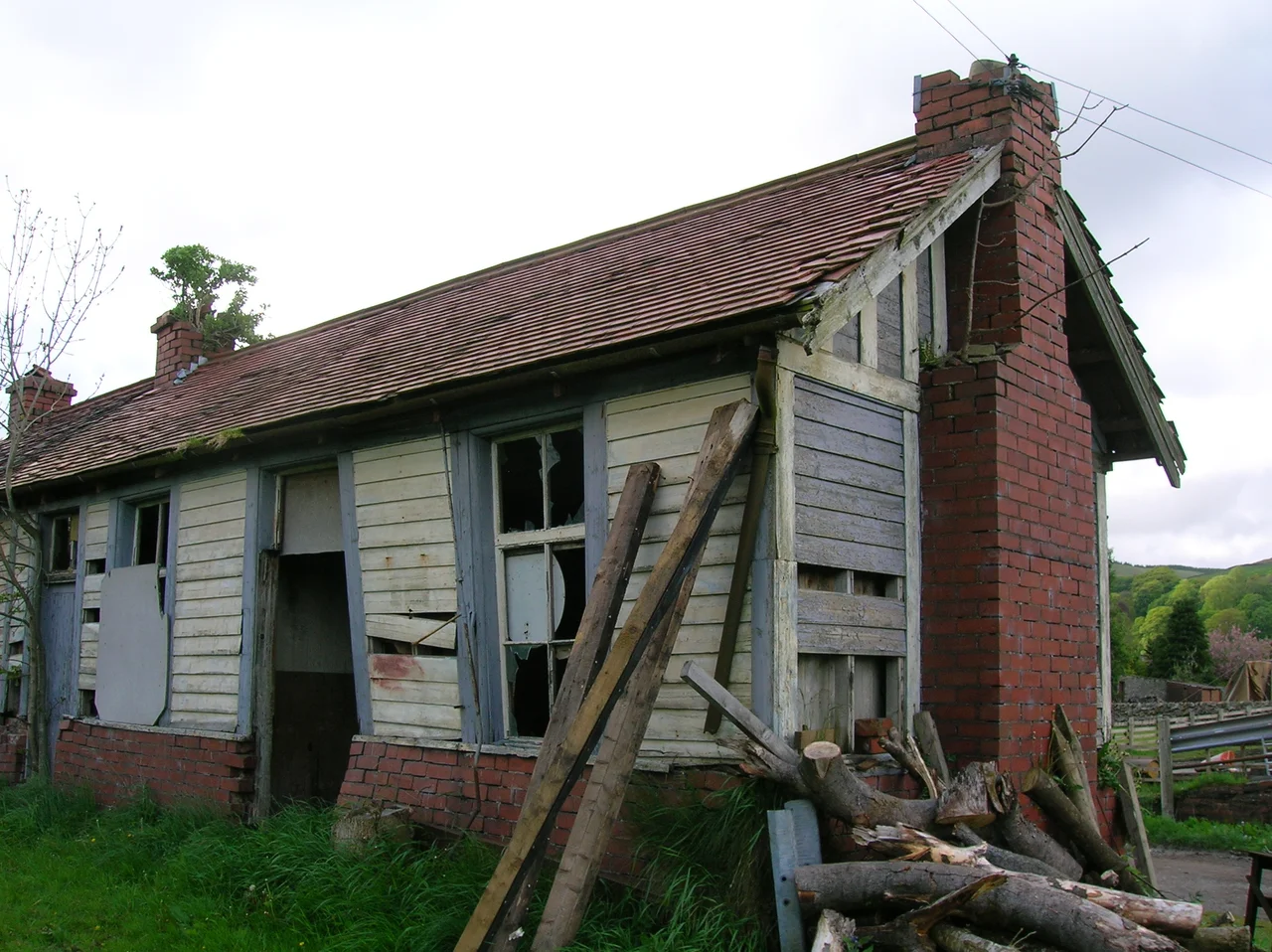
In 2009 the Geological Society of Dumfries and Galloway commissioned a GeoDial for the village, a stone instrument celebrating local geodiversity and standing beside the Dalwhat Water in the John Corrie Wildlife Garden. An interpretation board names the rock types in the GeoDial and the stone circle around it. The village once had a railway, opened from Dumfries in 1905 by the Cairn Valley Light Railway. Plans had even sketched a resort here, drawing in tourists from the cities to enjoy the scenic countryside. The First and Second World Wars intervened. Passenger services ended on 3 May 1943 as a wartime economy, and all traffic ceased on 4 July 1949. The trains never came back. The countryside, scenic and peaceful as ever, kept its peace. Moniaive went on being itself.
From the Air
Moniaive sits at 55.20 degrees north, 3.92 degrees west, in the Parish of Glencairn in the hills 16 miles northwest of Dumfries. The village lies at the confluence of the Cairn and Dalwhat Waters, with the Striding Arches visible on Bail Hill, Benbrack and Colt Hill to the north and west. Cruise at 3,000 to 4,500 feet to spot the white-painted village, the surrounding farmland, and the curved valleys cutting east toward the Nith. Dumfries Aerodrome (EGCO) lies about 20 miles southeast. Carlisle Lake District Airport (EGNC) is roughly 40 miles southeast, and Glasgow Prestwick (EGPK) sits 35 miles northwest. The B729 runs west from Moniaive into the hills.
Nearby Stories
- Dundonald Castle 3.7 km away
- Ruthwell Cross 7.2 km away
- Threave Castle 10 km away
- Maybole 11 km away
- Battle of Drumclog 13 km away
- Battle of Lochmaben Fair 18 km away
- Neidpath Castle 22 km away
- Wigtownshire 24 km away