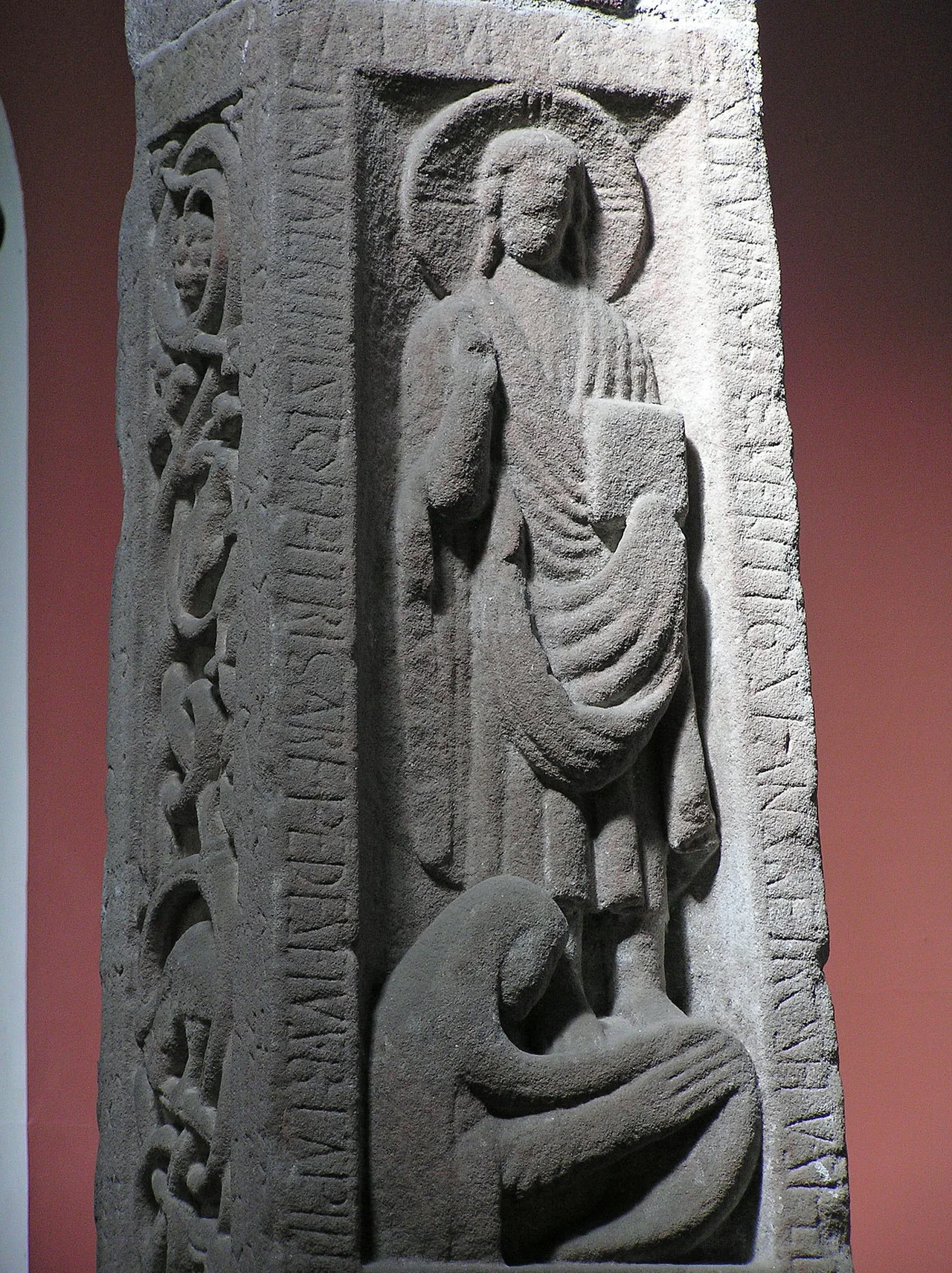

Ruthwell Cross
In 1642 a piece of the Ruthwell Cross was used as a bench. Two years earlier the General Assembly of the Church of Scotland had ordered the destruction of 'many idolatrous monuments erected and made for religious worship.' The 8th-century stone cross standing in the parish church at Ruthwell was duly taken down and broken up. The pieces lay in the churchyard. Some were carried inside again, some left to weather. One fragment, bearing carvings of saints and verses in the runic alphabet, served as seating. It was, in the words of architectural historian Nikolaus Pevsner, alongside its sister at Bewcastle, 'the greatest achievement of their date in the whole of Europe.' The bench held until 1823, when a minister named Henry Duncan went looking for the pieces.
Northumbria in Stone
When the cross was carved in the 8th century, the village now in southern Scotland sat within the Anglo-Saxon Kingdom of Northumbria. The cross stands 18 feet high and features the largest figurative reliefs found on any surviving Anglo-Saxon cross, among the largest surviving Anglo-Saxon reliefs of any sort. Anglo-Saxon crosses belong to the wider Insular art tradition, closely related to contemporary Irish high crosses. The Ruthwell Cross was probably created by the same workshop that produced the Bewcastle Cross just south of the modern border. The two are stylistic siblings, twin masterpieces of a brief Northumbrian golden age when Britain produced art that ranked with the best of Europe. Then the kingdom collapsed under Viking pressure, and the cross stayed where it was while history kept happening around it.
Dream of the Rood
The cross carries inscriptions in two scripts: Latin around the main panels, and the runic alphabet running up the sides among the vine-tracery carvings. The runic verses contain lines very similar to lines 39 to 64 of Dream of the Rood, an Old English poem preserved more fully in the 10th-century Vercelli Book. The cross may carry the oldest surviving text of English poetry, predating every manuscript that contains Old English verse. One inscription reads: 'Mith strelum giwundad alegdun hiae hinae limwoerignae gistoddun him,' translated as 'With missiles wounded, they laid him down limb-weary; they stood by him.' The voice is the cross itself, the rood that bore the crucified Christ, telling the story of the crucifixion from its own perspective. It is among the strangest, most beautiful conceits in early English literature.
The Carvings That Survived
On the north side stands Christ as judge, with two animals at his feet, surrounded by a Latin inscription naming him 'judge of righteousness' whom 'the beasts and dragons recognised in the desert.' Below that, Saints Paul and Antony share bread in the desert, identified by an inscription naming them as the two eremites who broke bread there. Other scenes include the Flight into Egypt and possibly a Nativity, the latter now too worn to be certain. On the south side, Mary Magdalene dries the feet of Christ, the longest Latin inscription on the cross bordering the scene. Below come the Healing of the man born blind, the Annunciation, and the Crucifixion, this last considered by scholars to be a later addition on stylistic grounds. The Four Evangelists once filled the four arms of the cross-head; only St Matthew and St John survive.
Henry Duncan's Recovery
By 1823 the cross had lain broken for 181 years. Henry Duncan, the minister of Ruthwell parish, was already known as the founder of the world's first commercial savings bank. He set himself to gather every fragment he could find of the broken monument. He had a new crossbeam made because the original was lost. He filled gaps with small pieces of stone. Then he erected the reassembled cross in the manse garden, the first deliberate restoration of an Anglo-Saxon monument of this scale in Britain. In 1887, the church built a special apse to house the cross indoors, and it was moved into its current position inside Ruthwell Church, the apse purpose-built around it. The cross was designated a Scheduled Monument in 1921; in 2018 that status was lifted because the controlled indoor environment no longer needed legal protection.
Column or Cross
Not every scholar agrees the monument was originally a cross. Art historian Fred Orton argued persuasively in 1998 that the lower stone bearing the runic poem may never have belonged to a standing cross. Orton noted that Reginald Bainbrigg in 1600 had described what he saw at Ruthwell as a 'column' even while calling it a 'cross.' Orton became convinced the piece is composed of two different types of stone, the original column amended with a Crucifixion scene and then again with a cross of yet different stone. Patrick W. Conner, agreeing in 2008, refers throughout his work to the Ruthwell Monument in preference to the Ruthwell Cross. In 2012 the Visionary Cross project led by Catherine Karkov and others performed 3D scans of the entire monument. The questions deepen. The runes still speak.
From the Air
The Ruthwell Cross stands inside Ruthwell Parish Church at 55.00 degrees north, 3.41 degrees west, in Dumfries and Galloway about 9 miles southeast of Dumfries. The village sits just north of the Solway Firth on the B724 road between Dumfries and Annan. Cruise at 2,500 to 3,500 feet to take in the church, the surrounding farmland of the Solway plain, and the broad estuary opening south toward Cumbria. Dumfries Aerodrome (EGCO) lies about 10 miles northwest. Carlisle Lake District Airport (EGNC) sits 18 miles southeast across the Solway. The English Lake District mountains rise dramatically to the south.
Nearby Stories
- Old Courthouse, Cockermouth 1.5 km away
- Moniaive 3.4 km away
- Penrith Castle 3.6 km away
- Threave Castle 6.6 km away
- Kielder Observatory 13 km away
- RAF Spadeadam 17 km away
- Morton Castle 27 km away
- Point of Ayre Lighthouse 43 km away