
Kielder Observatory
Gary Fildes was a bricklayer who looked up. As a child he had been bewildered by the stars; as an adult he kept being bewildered, and started going out to Kielder Forest, where the lack of artificial light meant the Milky Way was visible the way it had been for most of human history. He began advocating for an observatory on Black Fell. He raised several hundred thousand pounds. On 25 April 2008, Sir Arnold Wolfendale, the fourteenth Astronomer Royal, cut the ribbon on a building designed by Charles Barclay Architects after winning a RIBA-managed competition. About 1,200 people visited in the first year. By 2014, the count was approaching 20,000. Kielder Observatory had become one of the top tourist attractions in Northumberland by the simple expedient of standing in a place dark enough to see stars properly.
A Wooden Telescope on a Hill
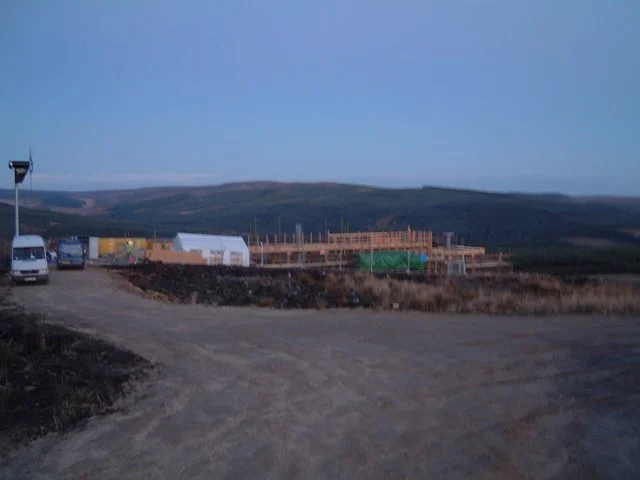
The observatory sits on Black Fell, overlooking Kielder Water, half a mile by forest track from James Turrell's Kielder Skyspace, which is a meditative cylindrical chamber open to the sky. The observatory building itself is constructed of timber and powered by solar panels and a wind turbine. It looks more like a precision-built shed than a planetarium, which is part of the appeal. It won the RIBA Award for architecture in 2009 and a Civic Trust Award the same year. The structure is deliberately humble, a wooden vessel for the universe rather than a monument to itself. Inside, telescopes are housed in two domes and an extending roof bay. The observatory is administered by the Kielder Observatory Astronomical Society, a registered charity with around ten permanent staff.
Darkness as a Resource
Kielder Forest was a popular stargazing site long before the observatory existed. The annual Kielder Forest Star Camp drew amateur astronomers for decades, pitching tents on the forest fringes and waiting out the British weather for one of those rare clear, windless nights when the sky became legible. The reason was simple geography: Kielder is one of the largest unbroken expanses of darkness in mainland Britain. The local authorities later reduced late-night street lighting and the area became part of Northumberland International Dark Sky Park, the largest area of protected night sky in Europe at the time of designation in 2013. Light pollution, for amateur astronomers, is the enemy. Kielder has less of it than almost anywhere else in England. The observatory exists because Gary Fildes recognised that darkness, properly preserved, is a precious resource.
Growing the Mission
In 2018 the observatory expanded to accommodate the Gillian Dickinson Astroimaging Academy, named for a major benefactor, which trains visitors and students in capturing the deep sky with cameras. In 2019 the observatory was awarded funding to deliver astronomy outreach across the North of Tyne Combined Authority district, taking telescopes and presenters into regional schools that might never otherwise see a working observatory. In 2021 a five-metre Radio2Space radio antenna, donated by the Tanlaw Foundation, was constructed on site to allow visitors to experience radio astronomy. The observatory teaches the science by letting people do it, rather than only watching it being done. The science communication team is led by Director of Astronomy Dan Pye, with Daniel Monk running the astroimaging academy, Eleanor Macdonald as science lead, and Adam Shore handling education.
Renaming for Caroline Herschel
In 2023 the observatory's sixteen-inch telescope turret, previously known only by its size, was renamed the Caroline Herschel Observatory. Caroline Herschel was a German-British astronomer who discovered several comets in the late eighteenth century and became, in 1828, the first woman awarded the Gold Medal of the Royal Astronomical Society. She worked for decades as her brother William's assistant, often without pay and almost always without sufficient credit. The plaque at Kielder was unveiled by local crime novelist LJ Ross. Naming a working telescope after Herschel rather than after a male donor or astronomer is a small correction to an old imbalance, the kind that matters when young women look up and ask whether anyone like them did this before. Caroline Herschel did. The telescope now points at the same stars she catalogued by hand, on the darkest hill in England.
From the Air
Coordinates: 55.232°N, 2.616°W. The observatory sits on Black Fell at roughly 380 m elevation, overlooking Kielder Water. Recommended viewing altitude 3,000-5,000 ft AGL. The observatory building is a low timber structure with two visible dome bays. Northumberland International Dark Sky Park airspace; avoid bright landing lights at night to respect the dark sky designation. Nearest airports: Newcastle (EGNT) approximately 39 nm east-southeast, Carlisle Lake District (EGNC) approximately 26 nm south-west.
Nearby Stories
- Dryburgh Abbey 3.3 km away
- Battle of Homildon Hill 3.9 km away
- Hexham Abbey 5.4 km away
- Simonside Hills 9.3 km away
- Peebles 12 km away
- Ruthwell Cross 16 km away
- Once Brewed 16 km away
- Lockerbie 22 km away