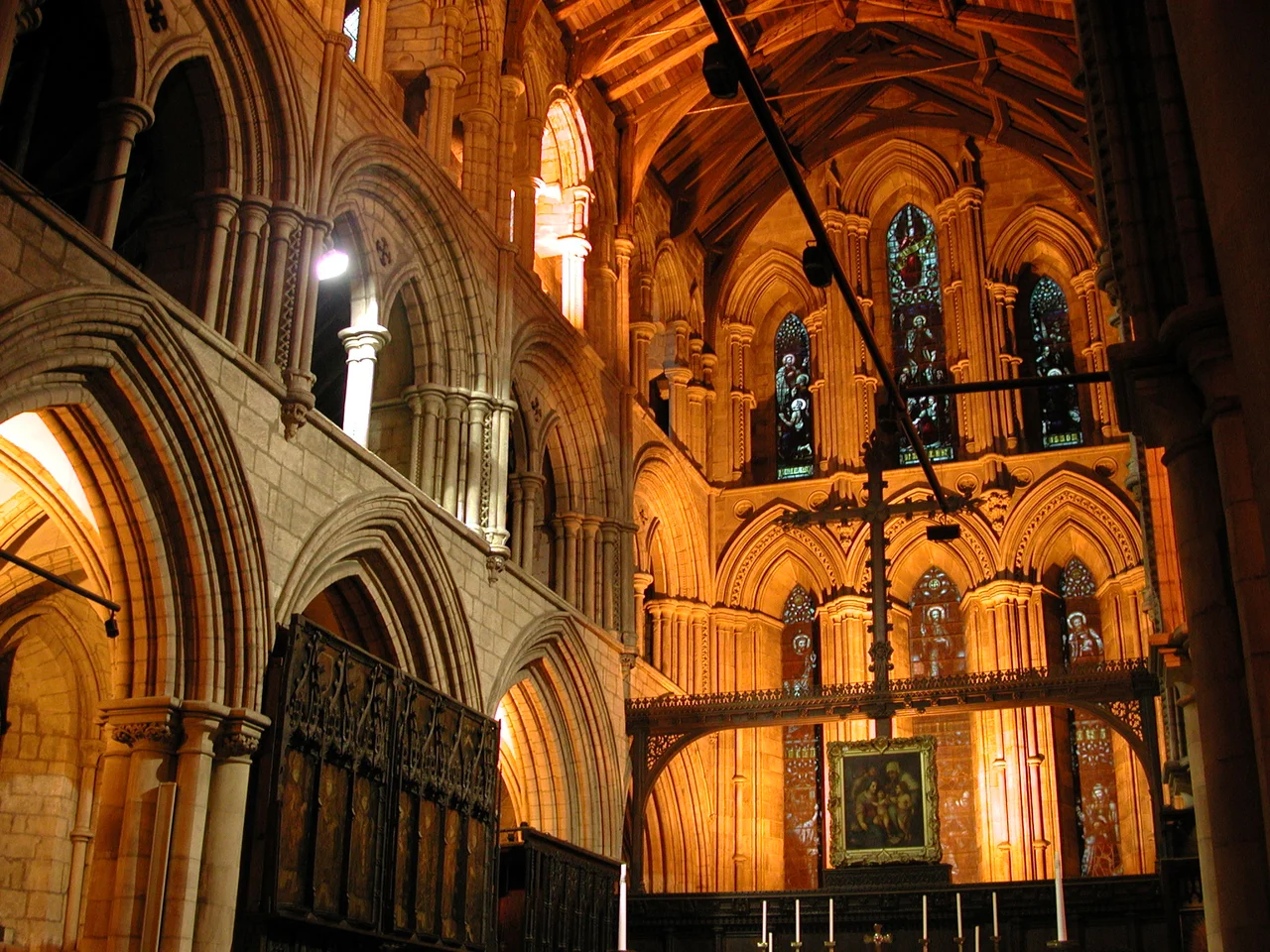

Hexham Abbey
Climb down the narrow stairs into the Saxon crypt and you are walking into the seventh century. The chambers are small, barrel-vaulted, plain. The stones around you are older still: they came from Roman buildings nearby, almost certainly Corbridge, and some still carry chiselled Latin inscriptions. Saint Wilfrid built this crypt in around 674 to house holy relics, and improbably it has survived everything that the next thirteen hundred years could throw at it. The abbey above has been burned, plundered, half-rebuilt, dissolved, restored. The crypt below has not moved.
Wilfrid and the Saxon Crypt
Queen Etheldreda of Northumbria granted the lands at Hexham to Saint Wilfrid, then Bishop of York, in around 674. Wilfrid was an ambitious, well-travelled churchman with Roman tastes, and he built his Benedictine abbey almost entirely from material salvaged from nearby Roman ruins. The Saxon crypt survives. So does the frith stool, a stone cathedra or bishop's throne dating to the 7th or 8th century. For a brief window in early Anglo-Saxon England, Hexham was a bishopric in its own right. In 875 Halfdan Ragnarsson, son of the legendary Viking Ragnar Lothbrok, rampaged through Tyneside. Hexham church was plundered and burnt to the ground. The crypt, buried under rubble, was forgotten and protected by its own concealment.
Norman Rebuild, Medieval Glory
Around 1050, the treasurer of Durham named Eilaf was put in charge of Hexham, though he probably never actually visited. His son Eilaf II finished what his father did not start, rebuilding the church in the Norman style. The structure standing today is mostly the Augustinian priory church of the 12th and 13th centuries, in Early English Gothic. The choir, the north and south transepts, and the cloisters where canons once studied and meditated all date from this period. When Henry VIII dissolved the monasteries in 1537, Hexham did not vanish like so many others. It simply changed function. The priory church became the parish church, which it has remained ever since.
The Hexham Hoard and the Modern Abbey
In 1833, gravediggers working in the Campey Hill area near the north transept turned up a buried hoard of around 8,000 stycas, the small copper coins of late Anglo-Saxon Northumbria. The Hexham Hoard had been concealed around 850, perhaps in advance of the same Viking raids that destroyed the church a generation later. The coins span the reigns of Kings Eanred, Aethelred II and Redwulf, and Archbishops Eanbald and Wigmund, a snapshot of a kingdom about to be overrun. A major restoration of the nave under Canon Edwin Sidney Savage between 1898 and 1908 incorporated walls from the earlier church. The new nave was re-consecrated on 8 August 1908. The building was Grade I listed in 1951. In 2014 the abbey regained ownership of its former monastic buildings, long used as the town's magistrates' court, and developed them into a visitor centre.
Flying Over Hexham Abbey
Coordinates 54.972 N, 2.103 W, geohash gcy88. Cruise at 2,000 to 3,500 ft AGL for a clear view of the abbey and its market square setting. The abbey dominates the western end of the Hexham marketplace, a substantial Early English Gothic mass with a square central tower. From the air, look for the long nave running east to west, the cruciform plan with transepts, and the open market square just east of the church. The River Tyne runs north of town, the A69 dual carriageway parallel to it. Newcastle International Airport (EGNT) lies 19 miles east-northeast. The dark Pennine moorland rises to the south and west; Hadrian's Wall (much of the same stone the Saxons recycled) traces an east-west line about 4 miles to the north.
From the Air
Coordinates 54.972 N, 2.103 W. Cruise 2,000-3,500 ft AGL. Look for the cruciform abbey with square central tower at the west end of the market square. River Tyne to the north, Hadrian's Wall 4 miles north. Newcastle International (EGNT) 19 miles east-northeast.
Nearby Stories
- Seaburn Dene 1.2 km away
- SM UB-115 3.5 km away
- Kielder Forest 4.5 km away
- Appleby Horse Fair 9 km away
- Simonside Hills 9.7 km away
- Streatlam Castle 12 km away
- Stockton-on-Tees 12 km away
- RAF Spadeadam 14 km away