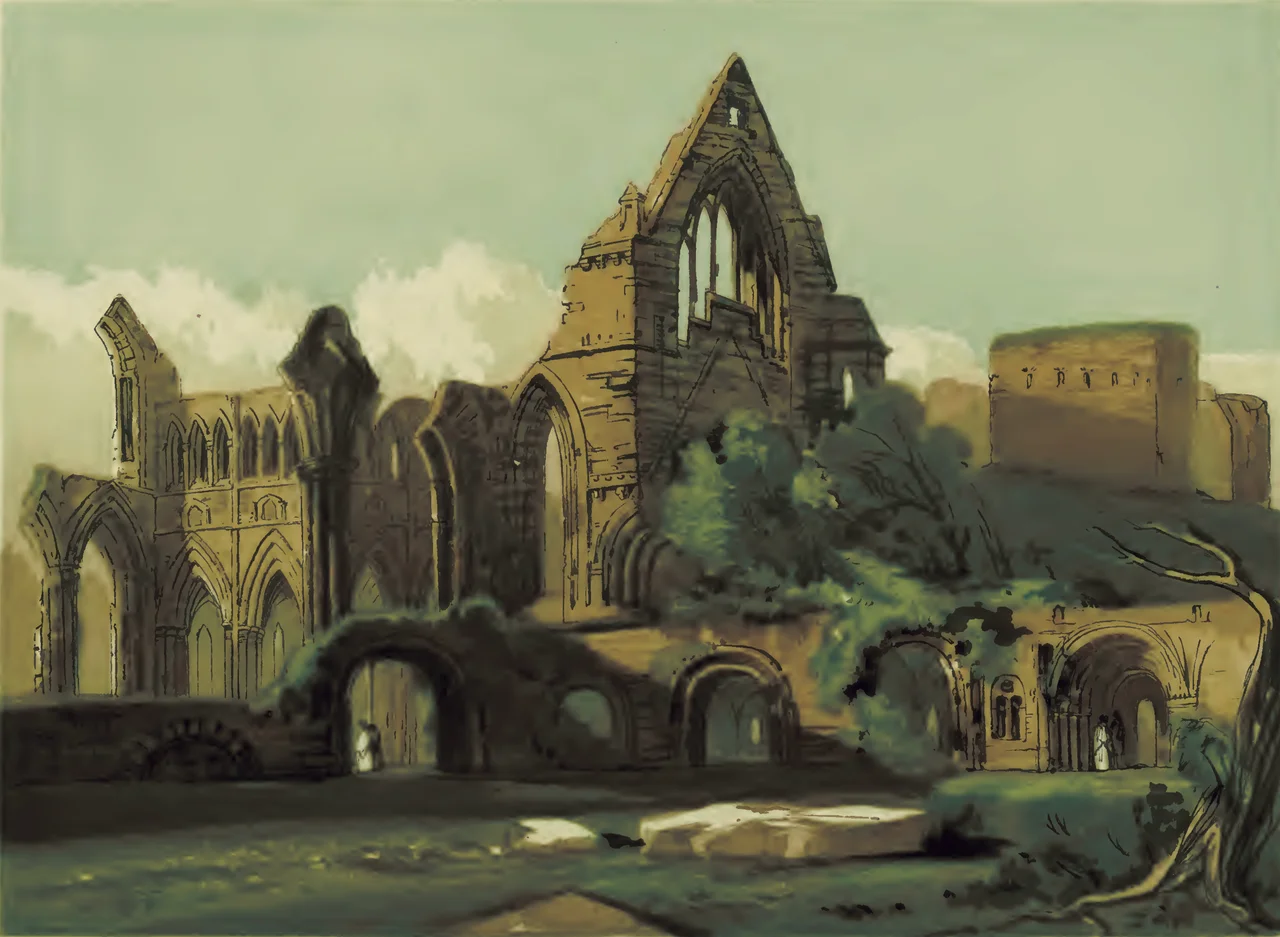

Dryburgh Abbey
Sir Walter Scott is buried here. So is Field Marshal Douglas Haig, the commander of British forces on the Western Front in the First World War. The man who all but invented the historical novel and the man who presided over the Somme lie within yards of each other beneath the roofless red-sandstone arcades of Dryburgh Abbey, founded in 1150 on the banks of the River Tweed by a Scottish noble and a community of white-robed canons from Northumberland.
Premonstratensians on the Tweed
On Martinmas - 10 November 1150 - Hugh de Morville, Constable of Scotland, signed an agreement with the Premonstratensian canons of Alnwick Abbey to found a new house on his lands in the Borders. The first abbot, Roger, and his community of canons arrived on 13 December 1152. The Premonstratensians were an Augustinian-derived order founded by St Norbert of Xanten in 1120 at Premontre in northern France. Unlike monks, they were canons regular: they wore the white habit rather than the black, and they had a duty to preach and teach beyond the cloister walls. They borrowed Cistercian methods of land management and lay-brother labour, and like the Cistercians they sought beautiful, remote sites. The bend of the Tweed at Dryburgh, ringed by wooded hills and quiet water, was exactly the kind of place they chose.
Burned, Rebuilt, Burned Again
The abbey's stone tells a story of repeated catastrophe. In 1322, after Robert the Bruce raided Northumberland and used Dryburgh as a base, Edward II of England retaliated by sacking the abbey on his retreat. Bruce generously funded Melrose's rebuilding nearby but, for reasons no one has explained, almost ignored Dryburgh - granting Melrose two thousand pounds and Dryburgh a confirmation of twenty shillings a year. In 1385 Richard II of England burned the abbey again as he marched on Edinburgh. Accidental fire destroyed it in 1443. The final destruction came on 7 November 1544, when Edward Seymour, Earl of Hertford, returning from the Rough Wooing campaign against the infant Mary Queen of Scots, put Dryburgh and its town to the torch. Seymour came back in 1545 and burned what was left. The canons never fully rebuilt.
Two Famous Graves
When the abbey passed to David Erskine, 11th Earl of Buchan, in 1786, it became a romantic ruin in the eighteenth-century sense - artfully decayed, suitable for poetry. Sir Walter Scott, who as Sheriff-Depute of Roxburghshire knew the Borders better than almost anyone, came to love the place. He chose to be buried in St Mary's Aisle, the north transept, where his tomb still lies. His funeral on 26 September 1832 brought the horses of his hearse to a halt at Bemersyde Hill on its own - they had stopped there countless times on his outings, and the animals, the story runs, knew the route by heart. A century later, Field Marshal Douglas Haig, the most controversial British military commander of the twentieth century, was buried near Scott. Haig's grave is marked by a simple regimental headstone identical to those of the soldiers who served under him on the Western Front. He had grown up at nearby Bemersyde, and he wanted the same stone his men had.
Fat Lips and the Chapter House
The abbey's last full-time resident was supposedly a spirit. After the 1745 Jacobite Rebellion, a woman who lost her lover in the fighting moved into the ruined abbey and lived there alone for years. She claimed she had a companion: a small man in iron boots called Fat Lips, who tidied her cell and kept her company in the night. The story is one of those Scottish folk legends that hovers between grief and madness and refuses to resolve into either. Today the abbey is a scheduled monument cared for by Historic Environment Scotland, and its surrounding landscape - hills, gardens, the river itself - is on the national inventory of designed landscapes. It is part of the Borders Abbeys Way, a long-distance footpath linking Dryburgh, Melrose, Kelso, and Jedburgh: the four great medieval foundations of the Tweed.
From the Air
Dryburgh Abbey sits in a sharp bend of the River Tweed at 55.58N, 2.65W, about 3nm east of Melrose. From the air the ruins are framed by the silver curve of the river and surrounded by mature woodland and farmland - the red sandstone walls catch warm light against the green. Use the Tweed valley and the distinctive triple peaks of the Eildon Hills (3nm west of Melrose) for visual orientation. Best viewed at 1,000-2,500 ft AGL. Nearest ICAO: EGPH (Edinburgh, 35nm northwest), EGNT (Newcastle, 55nm south), EGPN (Dundee, 60nm north). The Border country is exposed to weather from any quarter; expect westerly winds to push cloud against the Eildons.
Nearby Stories
- Peebles 2.5 km away
- Edinburgh South 3.2 km away
- Eyemouth Disaster 5 km away
- Gifford, East Lothian 6.8 km away
- Battle of Homildon Hill 9.2 km away
- Simonside Hills 14 km away
- Kielder Observatory 16 km away
- Lockerbie 30 km away