
Edinburgh South
Walk south from the Royal Mile and the city changes character with surprising speed. Within a quarter mile you cross the broad open space of the Meadows, where 17th-century brewers once dumped their waste into a stinking loch. Within a mile you are among the baronial tenements of Marchmont, the bay-windowed villas of Bruntsfield and Morningside, and the rambling Victorian streets where Edinburgh houses its students. Push further south and you reach Robert Louis Stevenson's summer hamlet, a 4,500-year-old standing stone in someone's front yard, and the green wall of the Pentland Hills rising from the city's edge.
The Meadows
Until the 17th century this broad green park was the South Loch, a polluted lake fed by hill streams from the Pentlands and ringed by tanneries, slaughterhouses and breweries pumping their waste into water that also doubled as a public supply. The city drained it in stages across the 17th and 18th centuries, leaving a stretch of common grazing land that became a Victorian public park. It is now a kilometre-long carpet of grass with avenues of cherry trees that flower spectacularly in April, tennis courts at the east end, and a constant flow of students between the residential south and the university buildings to the north. Bruntsfield Links, the southwest extension, was historically a quarried heath used for golf - the venerable Bruntsfield Links Golf Club still bears its name but now plays at Silverknowes on the coast.
The Quartermile and the Kidney
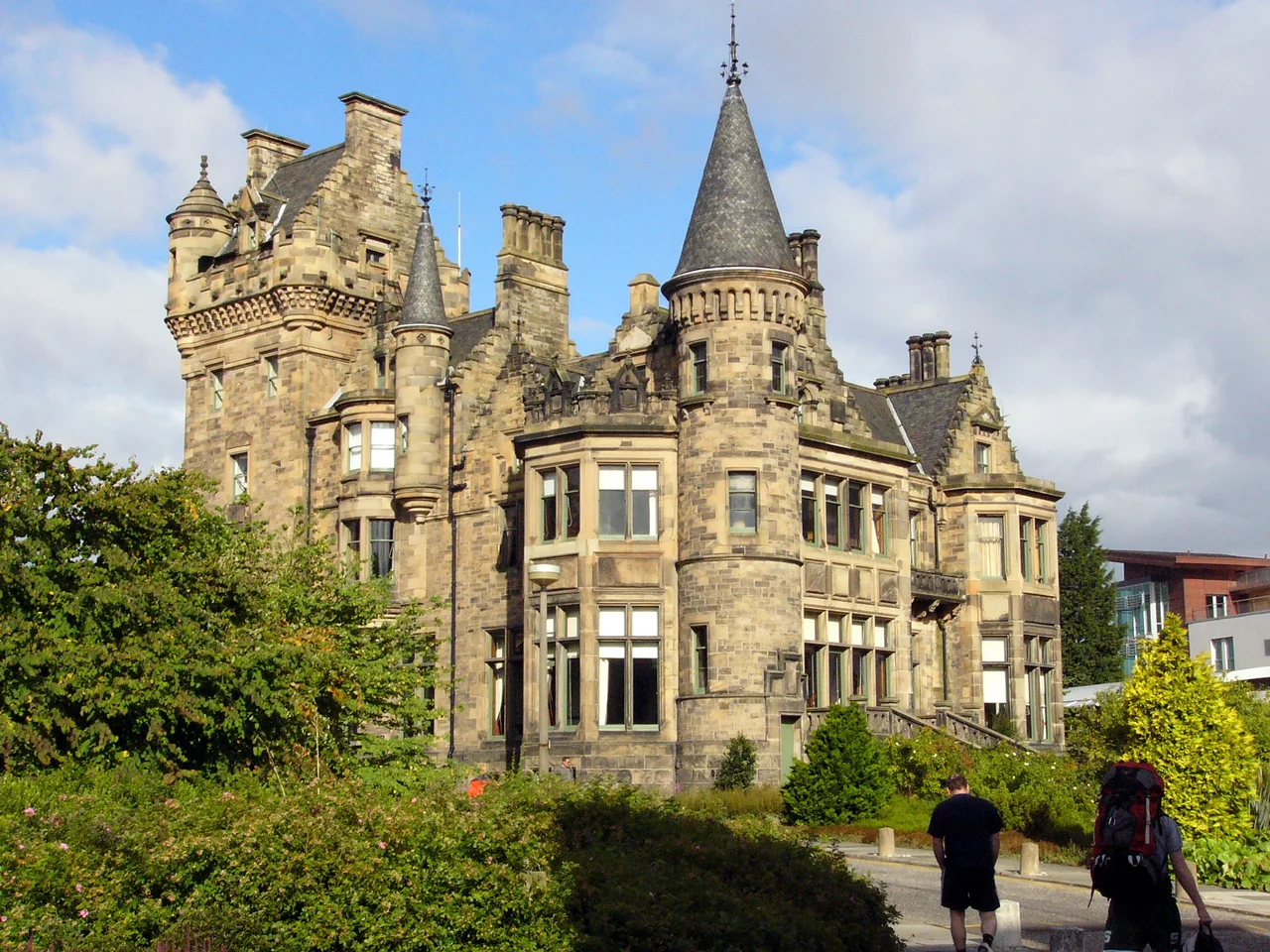
On Lauriston Place stands the long baronial bulk of Quartermile - the new commercial name given to what was, from 1872 to 2003, the Royal Infirmary of Edinburgh. In 1960 a team here performed the UK's first successful kidney transplant. Four years later in 1964 the infirmary opened the first dedicated coronary care unit anywhere in the world - one of those Edinburgh medical firsts that historians remember and tourists do not. The infirmary moved to a new site at Little France on the southeast edge of the city in 2003, and the old buildings were redeveloped for housing and offices. They are now home to the Edinburgh Futures Institute, which the local guide describes as 'juggling words like inter-disciplinary and innovative - in the future, we will work in turreted old buildings inspired by Disney castle.'
Stevenson at Swanston
South of the city, where the suburbs thin out and the Pentlands rise, lies the hamlet of Swanston - eight whitewashed thatched cottages around a green, almost unchanged since the 18th century. Robert Louis Stevenson's parents rented Swanston Cottage as a holiday house from 1867, and the young Stevenson spent much of his teens and twenties wandering the surrounding hills, writing in the cottage attic, and walking down to fish in the Glencorse reservoir higher up. He called the Pentlands his 'hills of home.' Some of the landscape descriptions in Kidnapped and St Ives drew on these walks. After his death in Samoa in 1894, his parents arranged for a plaque to be set into the cottage wall. The current owners are not the Stevensons but the hamlet remains startlingly intact. A short walk uphill brings you onto Allermuir, the closest of the Pentland summits and the first place the wind from the west has touched ground since clearing the Atlantic.
The Caiy Stane
On a quiet residential street called Caiystane View, off Oxgangs Road near the Pentland foothills, stands a chunk of reddish sandstone two metres tall. The Caiy Stane is Neolithic - probably between 4,000 and 5,000 years old - and was once part of a ritual complex spread across this hillside, with companion stones now lost to ploughing and development. The remaining megalith looks, to anyone with a passing knowledge of French comics, exactly like the menhir that Obelix carries on his back through Asterix the Gaul. Suburban Edinburgh has flowed around it; the modern bungalows on either side appear to be quietly ignoring a 4,500-year-old monument in the middle of their street.
Wild Edges
The Pentland Hills rear up just south of the city bypass and roll southwest for 20 miles toward Carstairs and Biggar. They are made of Devonian Old Red Sandstone, the same upland geology that runs across central Scotland; their highest summit, Scald Law, reaches 579 metres (1,900 feet) and the surrounding hills along the ridge are of similar height. The northern half is a regional park, popular for hiking, mountain biking and horse riding, accessible from Flotterstone Inn off the A702, from Bonaly above Colinton, or from the reservoirs at Threipmuir and Harlaw above the village of Balerno. To the west of South Edinburgh runs the Union Canal, opened in 1822 to bring coal from the Lanarkshire fields to the city and now a cycling and walking route all the way to Falkirk. Colinton Tunnel on the parallel Water of Leith path carries an elaborate mural based on Stevenson's poem 'From a Railway Carriage' - faster than fairies, faster than witches - which the writer composed remembering his train journeys down from Edinburgh as a boy.
From the Air
South Edinburgh covers a broad arc from The Meadows at 55.945 N, 3.190 W south to the bypass at roughly 55.890 N, 3.215 W. The defining geographic feature is the Pentland Hills, rising abruptly from the southern bypass to 579 metres at Scald Law. From altitude, the residential grid of Marchmont, Bruntsfield, Morningside and Newington fills the foreground, with the Meadows visible as a green rectangle below the Old Town ridge. Edinburgh Airport (EGPH) is 7 nm west-northwest. Note the masts on the Pentland summits and the Hillend dry ski slope on the northeastern flank of the range. Recommended viewing altitude 2,500-3,500 ft on a south-southwest transit from the city centre toward the Pentlands; in good visibility you can see the line of hills running 20 nm to the southwest. Stay clear of the Edinburgh CTR over the city centre.
Nearby Stories
- Ardoch Roman Fort 2.2 km away
- Craignethan Castle 3.1 km away
- Haddington 3.8 km away
- Balvaird Castle 4.3 km away
- Battle of Kilsyth 9.4 km away
- Siege of St Andrews Castle 9.9 km away
- Neidpath Castle 11 km away
- Melrose Abbey 15 km away