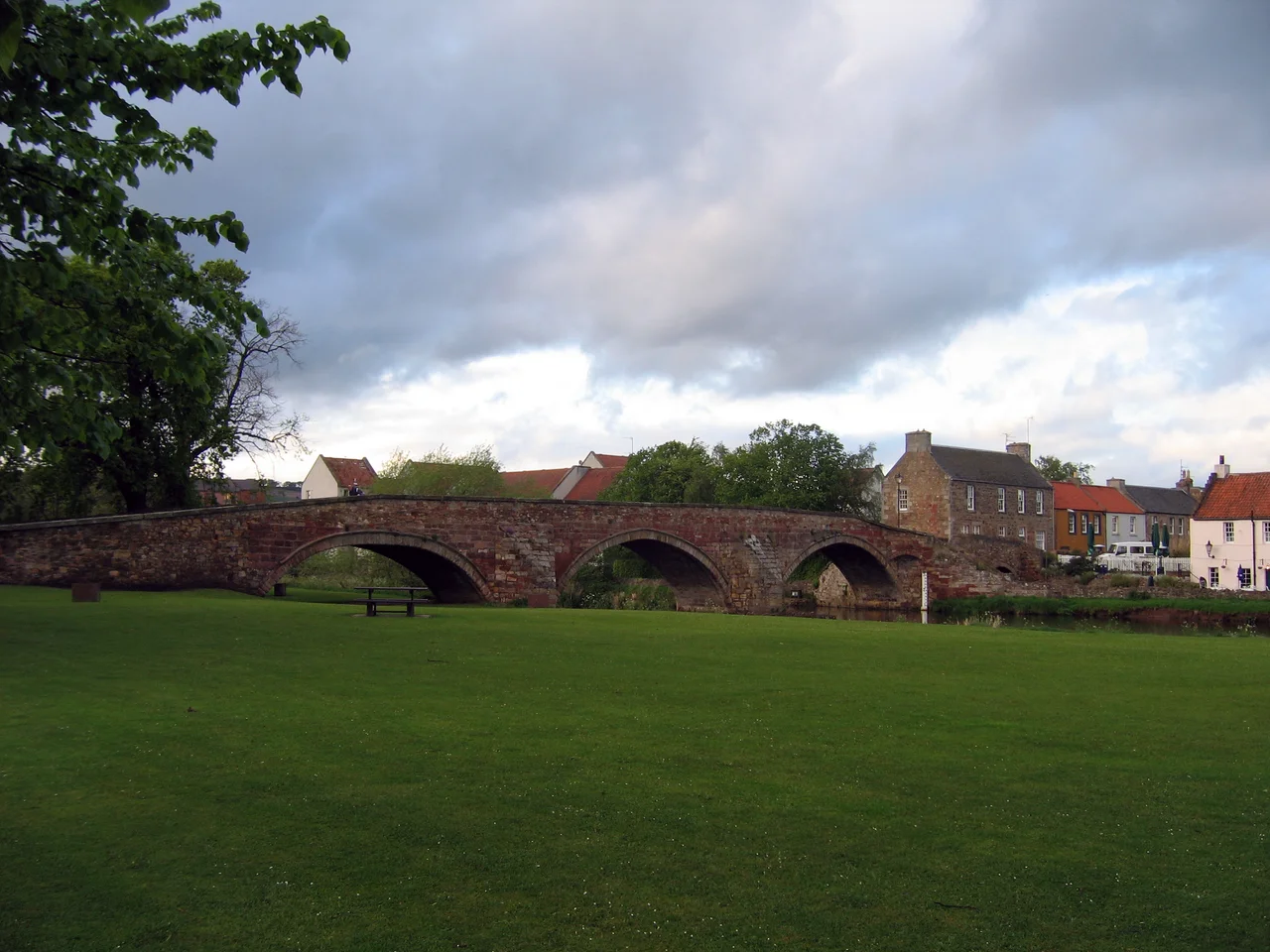

Haddington
In the High Middle Ages, Haddington was the fourth-largest town in Scotland, after Aberdeen, Roxburgh, and Edinburgh. The town was wealthy enough to attract repeated English armies that burned it down: in 1216 under King John, in 1244, in 1297 (this time burned by retreating Scots), and most catastrophically in 1356, the year now remembered as the Burnt Candlemas. The English came back twice more. Each time the town rebuilt itself on the same triangular medieval market plan around the River Tyne, the burgage plots and pends and closes still legible in the modern street map. Today Haddington has about 10,000 people and is the administrative centre of East Lothian. A walk through its conservation area still passes the longest parish church in Scotland, the house where John Knox probably grew up, and the riverbank where a 12th-century palace once stood.
Birthplace of Kings and Reformers
King Alexander II of Scotland was born in Haddington in 1198. So, around 1514 (dates between 1505 and 1515 have been proposed), was John Knox, the Protestant reformer who would break the Scottish church from Rome a half-century later. Knox was born probably in the Nungate, the lane on the east bank of the River Tyne just opposite St Mary's Collegiate Church, where he was almost certainly educated. The Nungate takes its name from the Cistercian Abbey of St Mary, founded in 1178 by Countess Ada de Warenne, mother of Malcolm IV and William the Lion. The abbey itself has left almost nothing on the ground; St Martin's Kirk in the Nungate, built around or before 1178, survives as the oldest standing building in Haddington. The Knox statue in front of the parish church is a reminder of how unusual it is for one small town to have produced both a Scottish king and the man who reshaped Scottish religion.
The Longest Parish Church
St Mary's Collegiate Church on the south bank of the Tyne is the longest parish church in Scotland. The current building was started in 1375 after an earlier St Mary's had been destroyed by Edward III's army in the Burnt Candlemas of 1356. It was consecrated in 1410, though building work continued until 1487. Then in 1548 to 1549 it was partially destroyed again, this time during the Siege of Haddington, the great set-piece of the Rough Wooing when Henry VIII (and after his death his son Edward VI's regents) attempted to force a marriage between Mary Queen of Scots and the future Edward VI. On the advice of John Knox after the war, the nave was restored as the church, while the choir and transepts were left ruined. They stayed ruined for more than four centuries. The whole church was finally restored in the 1970s. A Lammermuir pipe organ was installed in 1990, and eight bells for full change ringing were hung for the Millennium.
Two Men Who Changed Their World
Haddington's notable people list reads like a survey of Scottish intellectual life over six centuries. Walter Bower (1385 to 1449), abbot of Inchcolm Abbey, wrote the Scotichronicon, completed in 1447, which remains a major source for medieval Scottish history. John Mair (1467 to 1550), known as Haddingtonus Scotus, was a Scottish philosopher whose students included John Calvin, Ignatius Loyola, and John Knox himself. Jane Welsh Carlyle, born in 1801 as the daughter of a local doctor, married the great Victorian thinker Thomas Carlyle and conducted one of the 19th century's most luminous correspondences from London. Samuel Smiles (1812 to 1904), the social reformer and author of Self-Help, the founding text of Victorian self-improvement, lived on the High Street. The town's lengthy roster also includes Margaret Cunnison, the first Scottish woman flying instructor, who joined the Air Transport Auxiliary at the start of World War II.
The Burnings and the Rebuilds
Haddington was burnt by English armies in 1216, 1244, 1297, 1356, 1548, and (this time by a careless maidservant drying clothes by a fire) in 1598. The 1356 sacking by Edward III, the Burnt Candlemas, was severe enough to require almost complete rebuilding. The Siege of Haddington in 1548 to 1549 was different: a year-long fortified occupation by English troops attempting to control Scotland during the Rough Wooing, during which the Scottish Parliament met in the Abbey and agreed to send Mary Queen of Scots to France for safety. That decision shaped the next twenty years of Scottish history. The 1948 flood, when the Tyne overran its banks and most of the town went underwater for a week, is the modern catastrophe still remembered in Haddington. The railway line that had served the town since 1846 was damaged. Passenger services ended in December 1949; freight continued until 1968. The old station building was demolished, though parts of the platform and embankment survive.
The Improvement Scheme
After centuries of burning and rebuilding, what saved the historic centre of Haddington was a planning decision in the 1950s. Under Director of Planning Frank Tindall, the town council launched Scotland's earliest Improvement Scheme, rehabilitating period buildings rather than tearing them down, and developing a pioneering town colour scheme that gave Haddington the bright, varied frontages still distinctive today. Walk along Court Street, High Street, Market Street, and Hardgate and you walk the edges of the triangular medieval market place. The central island of buildings now standing in the middle of that triangle was developed from the 16th century onward on what had been the market stalls. To the north and south the medieval rigg pattern of long, narrow burgage plots is still visible, with narrow buildings fronting the main streets and long gardens behind, accessed by small closes and pends. The whole town centre is now a conservation area. For a place that English armies repeatedly tried to obliterate, the survival of so much of the medieval street plan is something of a small miracle.
From the Air
Haddington sits at 55.96 N, 2.78 W on the River Tyne in East Lothian, about 17 nm east of Edinburgh. EGPH is the nearest major airport. The town lies 1 km south of the A1 dual carriageway. The Lammermuir Hills rise to the south. Useful coastal landmarks include the Bass Rock and North Berwick Law about 10 nm to the north, with Dunbar and its red sandstone castle ruin about 10 nm east on the coast. East Fortune airfield is about 5 nm north of Haddington. From 2,500 feet the triangular medieval market plan of the town centre, the long arc of the Tyne, and the long red roof of St Mary's Collegiate Church on the south bank are all distinct.
Nearby Stories
- Leith 0.8 km away
- Crail 1.4 km away
- Falkland Palace 2.8 km away
- Peebles 8 km away
- Mellerstain House 9.9 km away
- Eyemouth Disaster 11 km away
- Battle of Homildon Hill 19 km away
- River Dee Ferryboat Disaster 99 km away