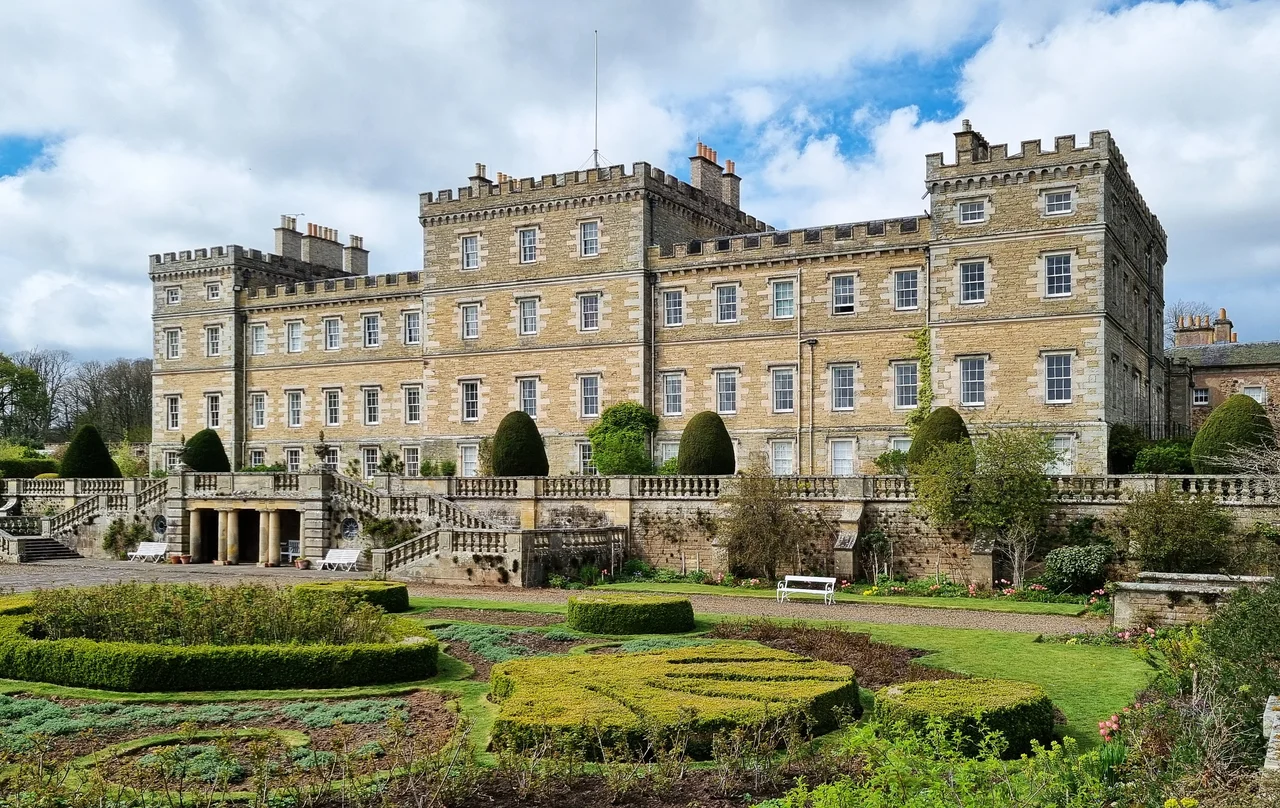

Mellerstain House
The two pavilions at Mellerstain went up in 1725. The main house between them did not begin construction until 1770. For forty-five years the Borders family who commissioned it lived in one of the pavilions and waited - through the death of the original patron, the rise of his nephew, and the entire transformation of Scottish architecture from William Adam's robust early Georgian to his son Robert Adam's polished neoclassical style. The result is a house designed by two generations of the most influential architectural family Britain has ever produced.
A House Built Across Generations
George Baillie (1664-1738) was a Scottish politician and a Whig who had spent years exiled in the Netherlands before returning home after the Glorious Revolution. His wife, Lady Grisell - born Grizel Hume in 1665 - was the daughter of Patrick Hume, Earl of Marchmont, and had famously, as a twelve-year-old, smuggled food to her father while he hid from royalist persecution in a vault beneath Polwarth Kirk. The Baillies hired the elder Adam, William, to design a new house at Mellerstain. He drew up plans, built the two flanking pavilions in 1725-29, and then the work stopped. George Baillie died in 1738. Their daughter Grisell, Lady Murray, lived in the east pavilion as if it were a complete house. When she died in 1759, the estate passed to her grand-nephew George - who had changed his surname from Hamilton to Baillie to honour the family - and he, in turn, hired the younger Adam, Robert, to finish what his father had started.
Robert Adam's Castle Style
Robert Adam was the most fashionable architect in Britain when he designed Mellerstain's main block in 1770. His grand tours of Italy and Dalmatia had given him a vocabulary - delicate friezes, light interiors, classical proportions wrapped in playful detail - that he applied across Britain in houses, churches, and entire London terraces. At Mellerstain he experimented with what he called his Castle Style: severe outer walls with battlements and a square tower-like silhouette, but elegant classical rooms inside. It was an early attempt at the picturesque revival that would later produce his Culzean Castle in Ayrshire. The constraint at Mellerstain was the pre-existing pavilions: they were too far apart to fit a conventional plan, so Adam designed a long, narrow E-shaped house with a corridor linking the principal rooms - library, dining room, drawing room, bed chamber - in a classical enfilade arrangement.
The Gardens and the Hundy Mundy
William Adam laid out the original gardens in 1725, including a tree-lined avenue that ran two and a half kilometres south to an eyecatcher folly: the Hundy Mundy tower, a tall Gothic archway flanked by square turrets. From the house, the eye is drawn down the avenue, across the ornamental canal William turned into a lake, all the way to that distant pinnacle on the horizon. In the early twentieth century, the architect Reginald Blomfield was commissioned to design grand Italianate terraces on the south front - balustrades, parterres, statues, and a series of stepped levels descending to the water. The result is a layered landscape: William Adam's eighteenth-century vision, Blomfield's Edwardian formal terraces, and the eyecatcher folly all still aligned, all still drawing the gaze through three centuries of garden design.
The Haddingtons of Mellerstain
Mellerstain has been the home of the Earls of Haddington since the late eighteenth century, when the Baillie inheritance merged with the Haddington title. The current occupant, George Baillie-Hamilton, is the 14th Earl. The house is designated a Category A listed building - the highest grade of Scottish architectural protection - and the gardens are on the national inventory of designed landscapes. The Gallery inside the house displays a collection of costumes, fans, embroideries, and historical documents, including material relating to Lady Grisell Baillie. Her domestic account books, kept meticulously over decades, are still consulted by historians of eighteenth-century Scottish household management. She would, perhaps, have appreciated that her detailed record-keeping outlived the political upheavals she had lived through as a child.
From the Air
Mellerstain House sits in the rolling Borders countryside at 55.64N, 2.56W, about 8nm north of Kelso. From the air the house is identifiable by its elongated E-shape, the formal terraces and lake on the south front, and the long avenue leading to the Hundy Mundy folly visible on the southern horizon. Surrounding parkland covers 1,413 hectares. Use the River Tweed (5nm south) and the Eildon Hills (10nm west) for orientation. Best viewed at 1,500-3,000 ft AGL. Nearest ICAO: EGPH (Edinburgh, 33nm northwest), EGNT (Newcastle, 50nm south). Borders weather is changeable; expect cloud building against the Cheviots in southerly flows.
Nearby Stories
- Peebles 2.5 km away
- Edinburgh South 3.2 km away
- Eyemouth Disaster 5 km away
- Gifford, East Lothian 6.8 km away
- Battle of Homildon Hill 9.2 km away
- Simonside Hills 14 km away
- Kielder Observatory 16 km away
- Lockerbie 30 km away