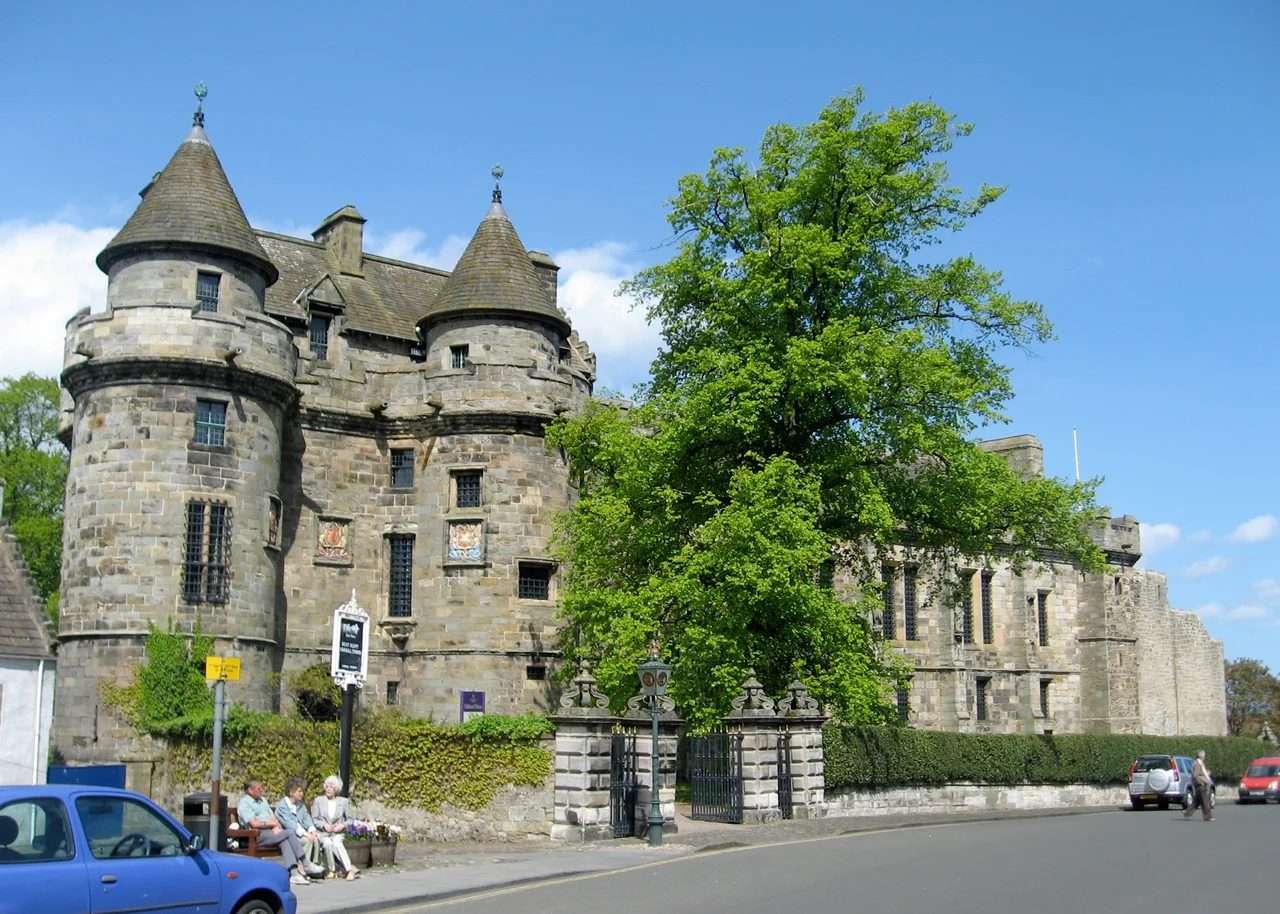

Falkland Palace
Mary, Queen of Scots scandalised her courtiers at Falkland by wearing men's breeches to play tennis. The court she played on is still there - the oldest real tennis court in the world still in use - and on summer afternoons you can hear the thwack of a ball striking the same plastered walls she knew. Falkland Palace was the Stewart kings' favourite escape, a place for falconry, boar hunts, and the slow theatrics of court life under the Lomond Hills. Mary loved it best of all.
Before the Palace
There has been something on this site since the late twelfth century, when a royal hunting lodge stood here. By the thirteenth, the lodge had grown into a castle held by the Earls of Fife of Clan MacDuff. The slight rise it sits on offered a defensible vantage over the surrounding parkland and the great oak wood that ran north to the River Eden. In 1402 the castle witnessed one of the darker moments of Scottish royal history. The Duke of Albany imprisoned his nephew, David Stewart, Duke of Rothesay, heir to Robert III, in the castle. Rothesay died there of neglect and starvation. The Parliament of Scotland exonerated Albany, but the suspicion never quite lifted, and the Albany Stewarts would pay for it in the next generation.
The Renaissance Comes to Fife
Between 1497 and 1541, James IV and James V transformed the old castle into one of the earliest French Renaissance buildings in Britain. James IV brought imported oranges to Falkland in April 1497, and a Pittenweem man delivered a live seal to him in 1502. The masons John Brownhill and Henry Bawtie raised the entrance tower in 1541. The courtyard facades were unified with pilasters in a style comparable to the Chateau of Villers-Cotterets, partly thanks to Nicolas Roy, a French mason sent to Scotland by Antoinette of Bourbon, Mary of Guise's mother. The tennis court, built in 1541, was called a caichpule in Scots and jeu de paume in French. It still hosts the Falkland Palace Royal Tennis Club.
The Death of James V
James V died at Falkland in December 1542, from a sickness brought on by grief. His army had just been broken at Solway Moss, and word arrived that his wife had borne him a daughter rather than the male heir he wanted - the infant who would become Mary, Queen of Scots. His body lay in the Chapel Royal for nearly a month, the walls draped in black, before being carried to Holyrood. The chapel ceiling he commissioned still survives, recently dated by dendrochronology to his reign. Mary of Guise stayed on at Falkland as a widow, hunting wild boar imported from her brother's lands at Elbeuf near Rouen, and Mary, Queen of Scots returned to Falkland after her years in France.
Mary's Palace
Mary held her Maundy Thursday ceremony at Falkland in March 1562, washing the feet of nineteen young women - the count matching her age. She came back for Easter in 1563 and again in 1564. It was at Falkland that James Hamilton, 3rd Earl of Arran, arrived in 1562 with the lurid claim that the Earl of Bothwell planned to abduct her from the deer park. Both earls ended up imprisoned; Arran was eventually judged mentally ill. Her son James VI later survived the Raid of Falkland on 28 June 1592, when the Earl of Bothwell besieged the palace for five hours before being driven off by gunfire from the gatehouse.
Ruin and Rescue
Charles II was the last reigning monarch to stay at Falkland, in July 1650. A fire during Cromwell's occupation in the 1650s gutted much of the palace, and for two centuries it stood as a romantic ruin. Then in 1887 John, 3rd Marquis of Bute, bought the estate and spent twenty years restoring what he could. His architects John Kinross and Robert Weir Schultz rebuilt where the foundations would allow and left elegant traces - a B carved into the guttering, portraits of his children in a cupboard door - to mark the work. In 1952 the Hereditary Keeper handed care of the palace to the National Trust for Scotland, who now maintain the gardens designed by Percy Cane in the 1940s and the surviving Stewart fabric.
From the Air
Falkland Palace sits at 56.25N, 3.21W in central Fife, at the foot of East Lomond. Best viewed at 1,500-2,500 ft AGL with the village laid out south of the palace and the Lomond Hills rising sharply behind. Nearest ICAO airport is Edinburgh (EGPH) 22 nm south-west across the Forth, with Dundee (EGPN) 16 nm north-east and Perth (EGPT) 14 nm north-west. Lomond Hills give a distinctive twin-peak signature on terrain displays.
Nearby Stories
- Drummond Castle 0.4 km away
- St Andrews 0.8 km away
- Aberfeldy 2.2 km away
- Yellowcraig 2.7 km away
- Fordell Castle 3 km away
- Battle of Sauchieburn 3.2 km away
- Battle of Dun Nechtain 3.3 km away
- Airlie Castle 13 km away