.jpg)
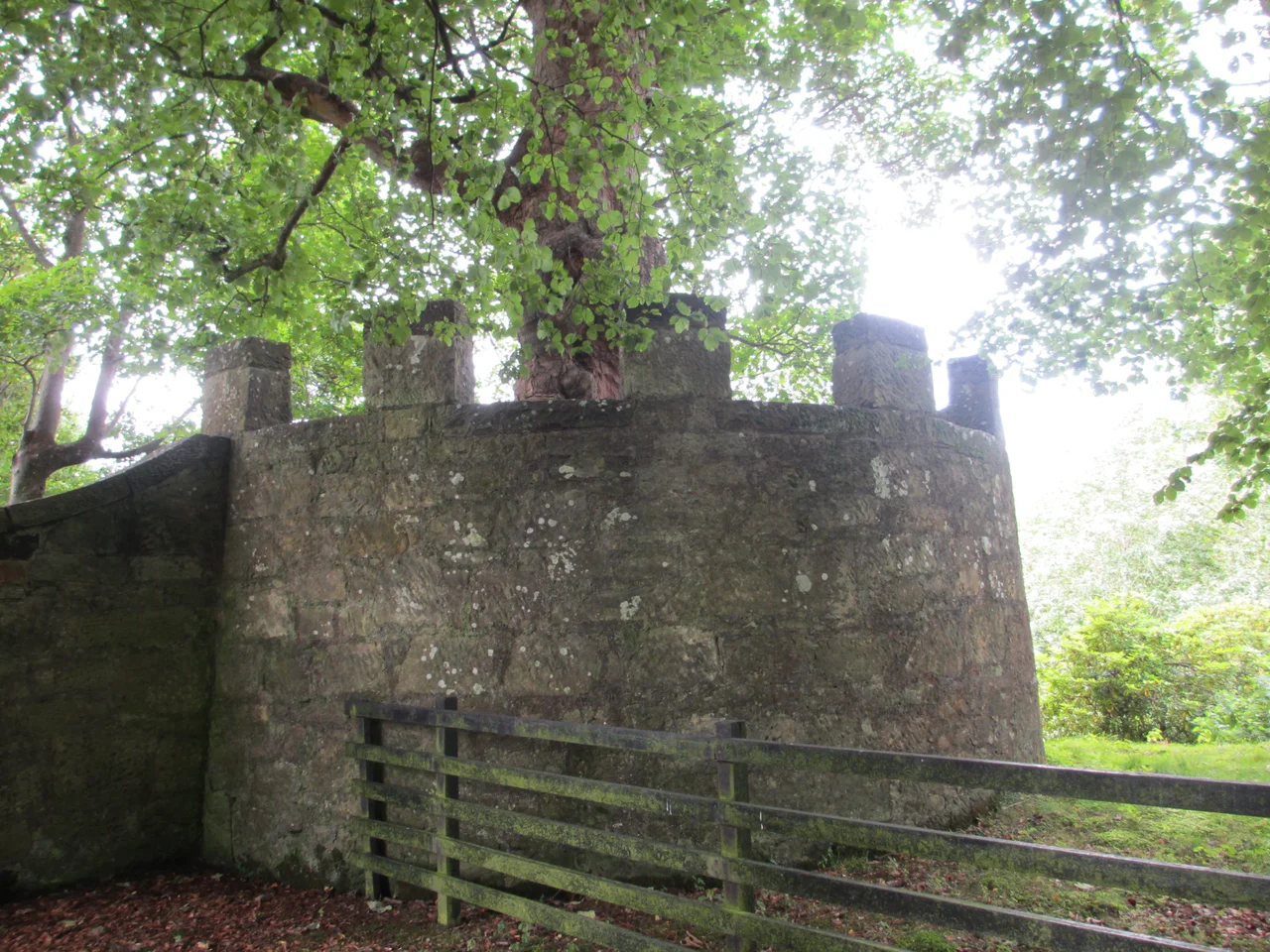
Fordell Castle
Most Scottish tower houses had one main staircase. Fordell Castle has two, each rising from its own door to the outside, each spiralling up to a different part of the building. It is the only tower house in Scotland built this way. The reason is lost to record - perhaps a quirk of two patrons, perhaps a defensive redundancy, perhaps a way of letting the laird and his lady arrive in their separate worlds. Whatever the answer, it makes Fordell strange even among Scottish strangenesses, and the castle has been hiding in its woods near Dunfermline for over four hundred years, accumulating stranger stories still.
Two Doors, One Family
Fordell Castle sits about a mile and a quarter northwest of Dalgety Bay and two miles east of Dunfermline, in Fife. Its main entrance tower is believed to date from the 1400s, but most of the present Z-plan tower house was built or rebuilt after 1566, when James Henderson, third of Fordell, began extending it. Workers were still on site in June 1567 when a man named William Spittal of Luquhat turned up claiming the lands belonged to him and forced them to stop. A year later the building was damaged by fire - evidence still visible just left of the main entrance tower - then patched up. The lintel above the north tower door bears the initials I.H. for James Henderson and the date 25 March 1580. Above that another stone carries I.H. and I.M. for his wife Jean Murray of Tullibardine, then a heraldic panel dated 1567 with the Henderson motto: Sola Vertus Nobilitat. Only virtue ennobles.
Mary, Coal, and Cromwell
Marion Scott, one of Mary Queen of Scots' ladies-in-waiting, married George Henderson, the laird. Tradition has it that the young queen visited Fordell for the wedding - hence the vaulted, panelled chamber over the main stair head, still called Queen Mary's Room. The Hendersons spent the late sixteenth century opening the coal seams that lay beneath their estate, and that coal became the foundation of their fortune. Sir John Henderson built St Theriot's Chapel in 1650 as a family mausoleum, just southwest of the tower. One year later, in 1651, Cromwell's troops were billeted at the castle and damaged it during the English invasion of Scotland. The Hendersons became baronets in 1664, under Charles II - a Nova Scotia baronetcy created on 15 July 1664 for John Henderson. Such are the timekeeping vagaries of Scottish baronial records.
The Witch Knowe
Margaret Echlin, born a Henderson of Pittadro, was accused of witchcraft and imprisoned in 1649 during the Great Scottish witch hunt of 1649 to 1650. The Witch Knowe stands on the right of the carriage drive that leads up to the castle - the small mound where, according to local memory, witches were burned, the last in 1649. The Gallows-tree that once stood as the secular counterpart blew down before 1887. To the west of the carriage drive lies an irregular block of sandstone said to commemorate the 1317 victory of a Scottish force led by William Sinclair, Bishop of Dunkeld, over an English raiding party. Down the slope, the Fordell Day Level once surfaced - a mine river that drained pits across Fife and became one of Scotland's worst pollution problems, turning local watercourses iron-red until late twentieth-century remediation cleaned it up. The estate's history sits on layers of working life as much as of lairds and witches.
Cedars, Sundials, and St Theriot
St Theriot's Chapel, about seventy yards southwest of the castle, was dedicated to an 8th-century cleric one historian called splendidly apocryphal - Saint Therotus, or Theoretus, or Theriot, take your pick. The chapel is rectangular and Renaissance in proportion, with late Gothic traceried windows holding German and Flemish painted glass from the sixteenth century onward. It became a Category A listed building in 1972. The gardens were laid out in the Italianate style by Thomas White Jr in 1818 and still hold a Cedar of Lebanon planted by Sir Robert Henderson in 1721 - three centuries of growth, witnessed by every laird since. The sundial in the garden is an 1860 copy of a 1644 sundial that originally stood at Pitreavie Castle. To the south of the encircling barmkin wall sits a natural spring called St Theriot's Well. Local folklore claims its water grants what you wish for as you drink. Reports of subsequent disappointment are not recorded.
The Modern Lairds
After the Hendersons came the Mercer-Hendersons, then the Earls of Buckinghamshire, then Sir Nicholas Fairbairn, the controversial Solicitor General for Scotland who died in 1995 and was buried in the crypt beneath St Theriot's Chapel. He was followed by Andrew Berry, then in November 2007 by Stuart Simpson - a venture capitalist and art collector - who bought the castle for 3.85 million pounds, then the fifth-highest price ever paid for a Scottish home. As 17th Baron of Fordell, Simpson lives there with his daughters Sabrina and Lara. The castle remains private and is not open to public tour. The remains of one of Scotland's oldest railways - the Fordell mineral line that once carried coal to St David's Bay - run 400 metres east of the castle, its wooden rails long gone but its embankments still visible. Carriages from the line survive in the National Museum of Scotland in Edinburgh. The castle, the chapel, the cedar, the witch mound, the railway, and the well all wait in the woods together, mostly unseen.
From the Air
Fordell Castle sits at 56.054N, 3.371W in Fife, hidden in dense woodland about 2 nm east of Dunfermline and 1.25 nm northwest of Dalgety Bay. From the air the castle is difficult to spot because of the surrounding trees - look for the wooded estate set back from the M90 motorway, between Inverkeithing and Cowdenbeath. Easier landmarks: the Forth bridges are 4 nm south, Dunfermline Abbey 2 nm west, Edinburgh Airport (EGPH) 10 nm south-southwest. Rosyth Dockyard is just south on the Forth. The Hillend airstrip is nearby. Best viewing altitude 1,500-2,500 ft, ideally with low sun to pick out the tower roofline through the canopy. The castle remains a private residence.
Nearby Stories
- Ardoch Roman Fort 2.2 km away
- Craignethan Castle 3.1 km away
- Haddington 3.8 km away
- Balvaird Castle 4.3 km away
- Battle of Kilsyth 9.4 km away
- Siege of St Andrews Castle 9.9 km away
- Neidpath Castle 11 km away
- Melrose Abbey 15 km away